REVIEW · MILAN CATHEDRAL TERRACES
Milan Cathedral: Duomo Terraces Ticket (No Church Access)
Book on GetYourGuide →Operated by Veneranda Fabbrica Duomo di Milano · Bookable on GetYourGuide
Rooftops in Milan beat street-level photos every time. With the Milan Cathedral Duomo Terraces Ticket (No Church Access), you get up onto the roof to see the city from high above and spot the cathedral’s famous white marble spires up close. It’s a rare chance to experience one of Europe’s grandest churches from the angle most people miss.
What I love most is the panoramic view over Milan from about 46 meters up, and the fact that you’re staring at the Duomo’s craft in real scale while walking between terraces. You’re not just looking at a landmark; you’re moving through the architecture.
The main drawback: this is a terraces-only ticket, so it does not include entry to the Duomo church, the museum, or other specific areas listed as not included. If your priority is the full interior experience, you’ll need a separate plan.
In This Review
- Key highlights at a glance
- Milan Duomo Terraces: Why the Rooftop Changes Everything
- Value and price: What $22 really buys you
- Getting in: Tickets, security, and finding your terrace entrance
- Terraces hours and timing: How to pick the right slot
- Stairs vs elevator: The 250-step choice that shapes your experience
- What you see up there: spires, statues, and Milan’s skyline
- The Duomo story on the roof: 1386 to 1965, explained by what you can see
- Rules and dress code: the stuff that can ruin your morning if you ignore it
- Who this ticket suits best (and who should pick something else)
- Final verdict: Should you book the Duomo Terraces ticket?
- FAQ
- What does the Milan Duomo Terraces ticket include?
- Does this ticket include access to the Duomo church or museum?
- How many steps are involved if I choose the stairs?
- What are the terrace opening hours?
- What is the last entry time?
- Is there a security check?
- What dress code do I need to follow?
- What items are not allowed during the visit?
- Do I need to visit each area only once?
- Is this experience suitable for people with mobility impairments?
Key highlights at a glance
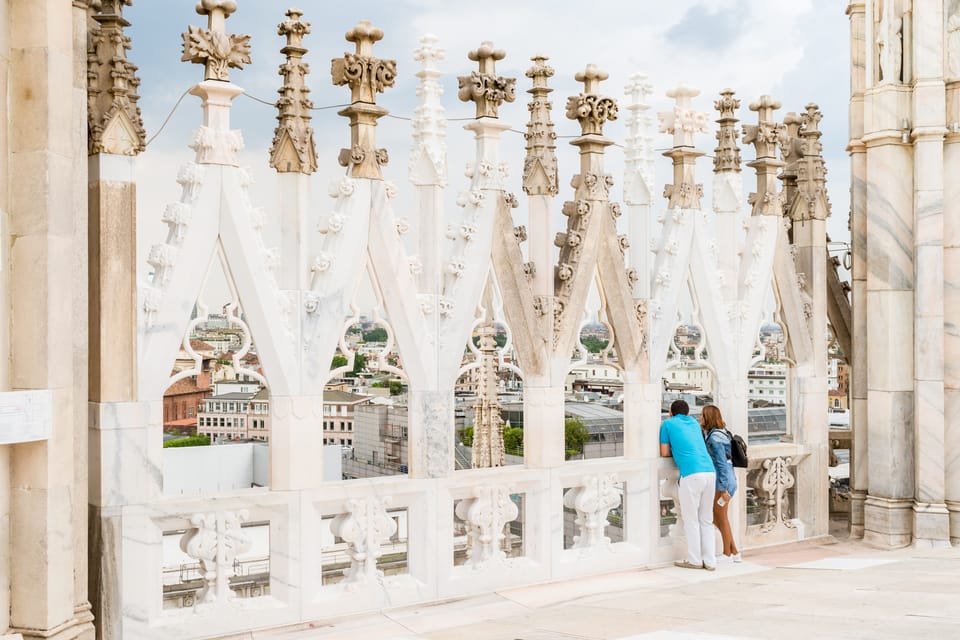
- 46-meter views put Milan’s rooftops under your feet
- Terraces-only experience means the focus stays on roof, spires, and craftsmanship
- Stairs option (about 250 steps) with built-in resting points along the route
- Elevator option for a faster ascent when you want it
- Candoglia marble details look different once you see them from above
- Security check + dress rules are part of the deal, so plan your outfit and timing
Milan Duomo Terraces: Why the Rooftop Changes Everything
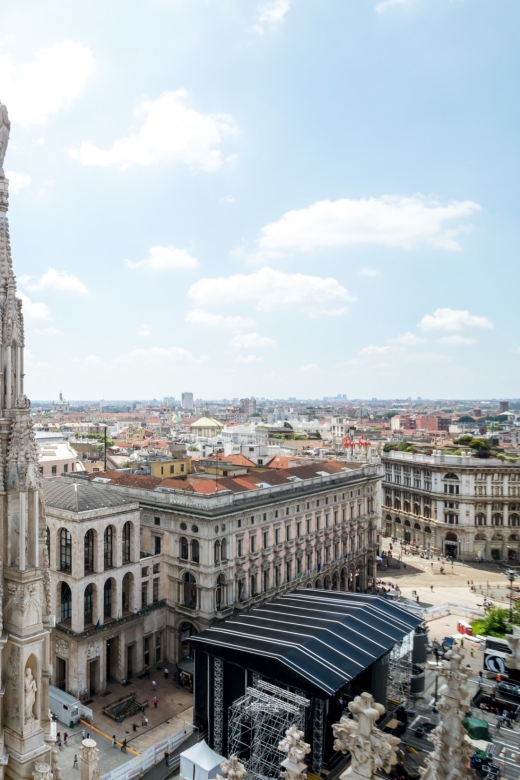
The Duomo can feel like a giant open-air sculpture even before you step onto the roof. But once you reach the terraces, the cathedral stops being an object in the square and becomes a whole landscape of stonework. You’re suddenly looking outward at Milan, then turning around to inspect the Duomo’s layers as if you’re walking around inside its design.
From the terraces, you get a true birds-eye perspective: you’re high enough to see beyond the immediate streets, and close enough to notice the way the spires, statues, and architectural edges were built to catch the light. The roof is where the Duomo’s scale clicks. You understand why the construction took nearly 600 years: the level of detail is so dense that you can keep discovering things as you walk.
This is also a good fit if you want a meaningful experience without spending all day in galleries or reading through long interpretive displays. Your time is spent in fresh air, taking in the view, and moving at your pace.
Value and price: What $22 really buys you
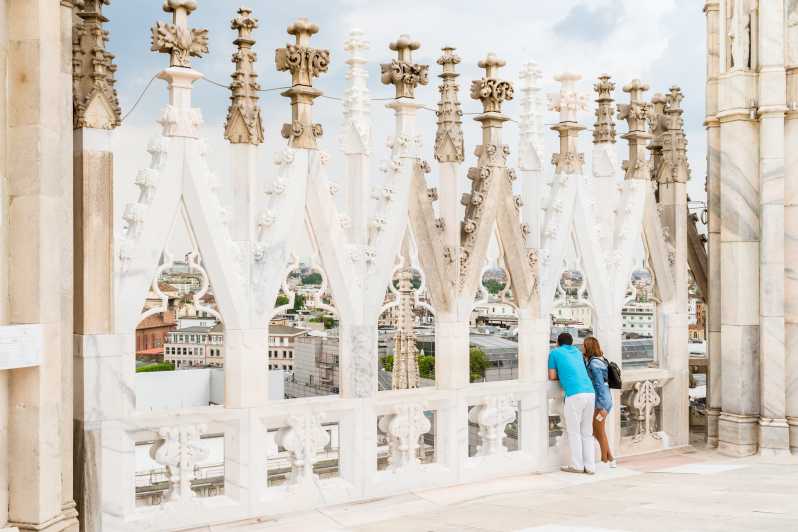
At around $22 per person, this ticket is surprisingly good value for what you get: access to the terraces plus an included Duomo gift and a choice between stairs and elevator ascent. On top of that, you also receive a 10% discount at the Duomo Shop (with the note that some items, like the Adopt a Spire line and books already on sale, are excluded from the promotion).
The terraces are what you’re paying for, and they’re not a small add-on. It’s a full roof route, with ample time to look around once you’re up there. Even if you’ve seen photos, you’ll likely notice angles and textures you couldn’t capture from street level.
A quick way to judge value for your trip: if your Duomo day is mainly about rooftop views and close-up architecture, this ticket matches that goal well. If you want museum rooms, the wider church interior areas, or other ticketed sections, this is not the right standalone purchase.
Getting in: Tickets, security, and finding your terrace entrance
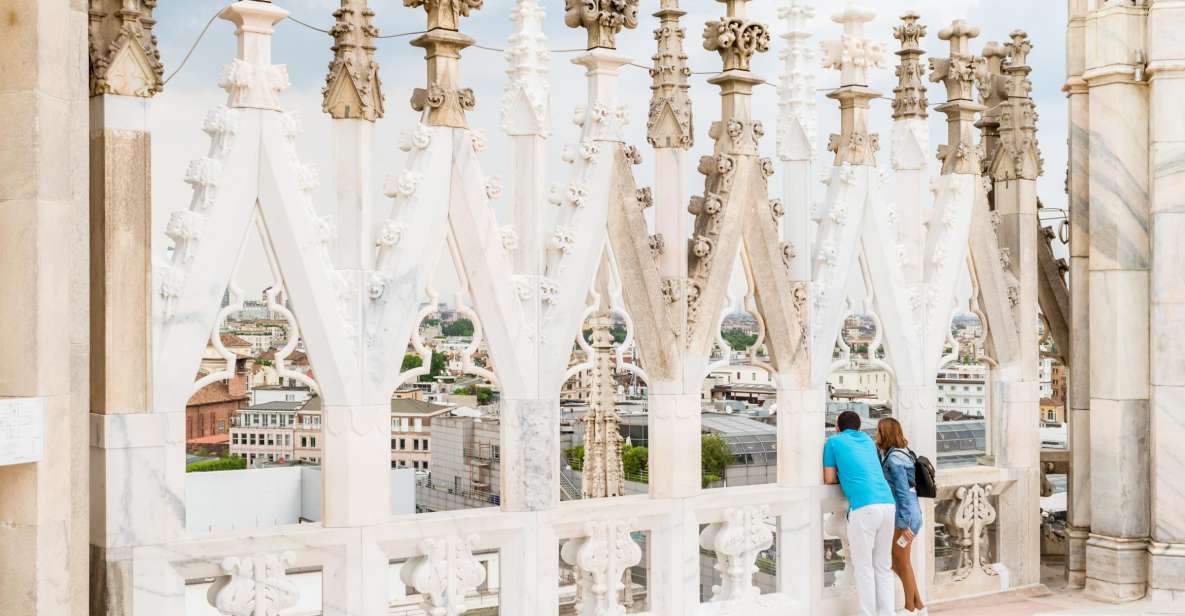
This ticket is designed to help you avoid the mess of buying tickets on the spot. You get skip-the-line entry for the terraces, but it’s not a magic pass that removes all waiting. You still go through an airport-style security check, including bag checks and the type of scanning/wanding process used at major attractions.
Plan for three practical realities:
- You’ll want to arrive with time to spare, especially if it’s your first stop of the day.
- The meeting point can vary based on the option you booked, so don’t assume the route is identical for everyone.
- You should treat the day as one continuous flow: security first, then your terrace access.
Also keep in mind the rules that can slow you down if you’re not ready. High-heeled shoes aren’t allowed, and luggage or large bags are not allowed. Items like tripods, drones, glass objects, and food are also prohibited, so pack smart.
One small but important detail: each area can be visited only once. That means you shouldn’t rush your first look or skip a terrace section because you think you’ll come back later.
Terraces hours and timing: How to pick the right slot
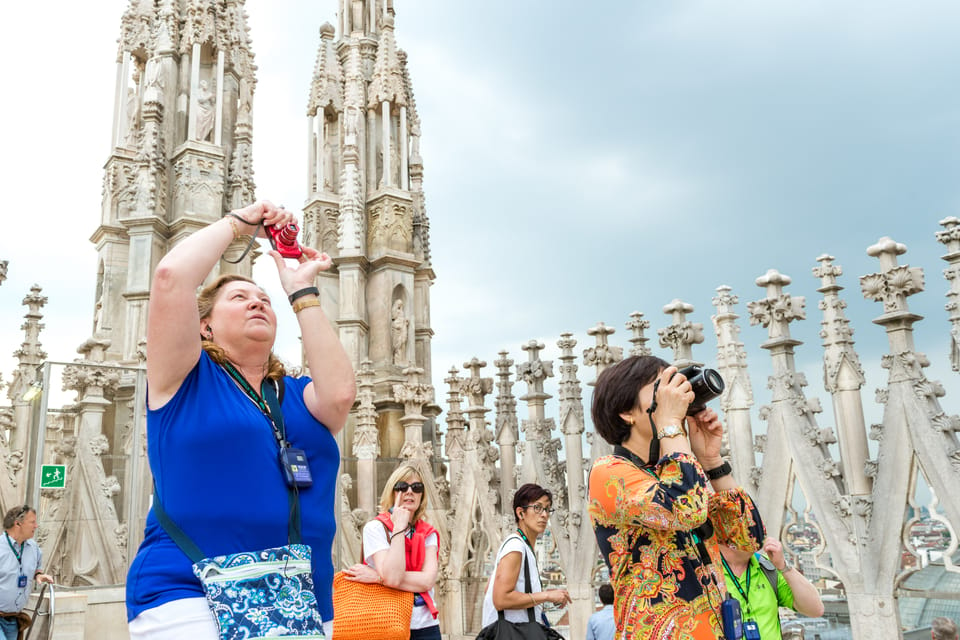
Terraces are open daily from 9:00 AM to 6:30 PM, with the last entry at 5:50 PM. That means your timing decision is mostly about light and crowd levels.
If you like photos, consider aiming for a morning slot to start the day with easier entry. You’ll often get better movement on the terraces earlier in the day, before foot traffic builds. The roof can get busy later, and the angles can be harder to manage when you’re sharing narrow stairways and terrace edges.
If sunset is your thing, there’s a real payoff too. On a clear day, the rooftop can deliver dramatic light and wide sightlines, and you can sometimes see the Alps in the distance from the terraces. That’s not something you should count on every day, but it’s a real possibility when the weather cooperates.
Stairs vs elevator: The 250-step choice that shapes your experience
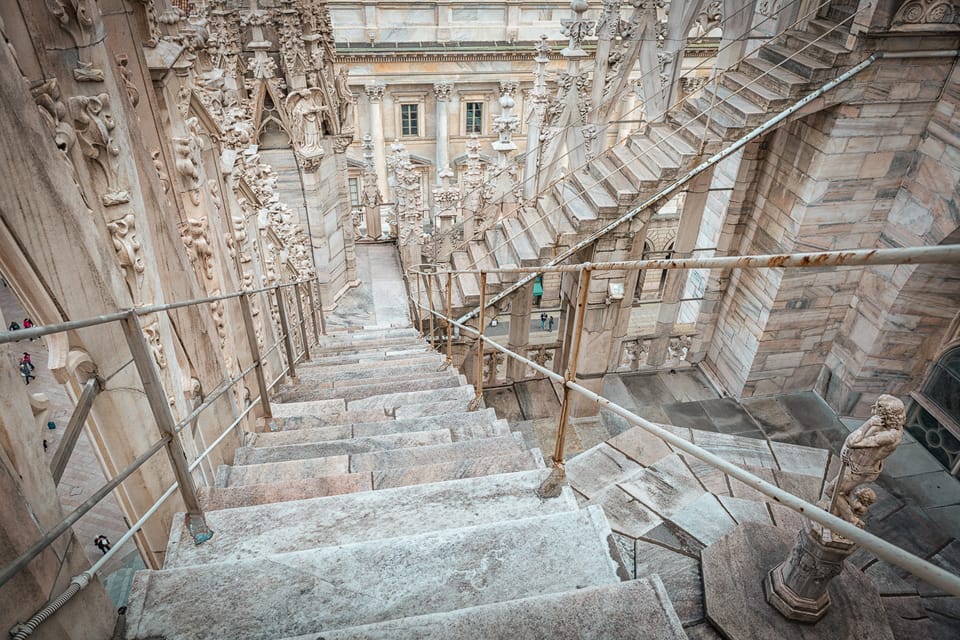
You get to choose between an elevator or stairs ascent, depending on the option you select. The stairs route is about 250 steps, and for many people it’s a manageable effort rather than a full workout—but it still requires comfort with stairs and tight circulation.
What I like about going up by stairs is that it turns the climb into part of the experience. You’re not just arriving at a viewpoint; you’re transitioning gradually from street level into the cathedral’s “working height.” You also get moments to pause and reset as the route changes.
A detail that matters: the climb is not one uninterrupted sprint. There’s often a middle terrace, then a final section (some routes include about 90 final steps) so you can catch your breath before the last push. If you’re going by stairs, this pacing helps make the route feel more doable.
Going by elevator is useful if you:
- want to preserve energy for the roof walk,
- don’t like stair compression (the stairs can feel narrow as people move in both directions),
- or you expect rain and want to reduce time on steps.
Here’s the tradeoff: stairs usually feel more immersive. Elevator usually feels more convenient. Either way, once you reach the terraces, the view reward is the same.
What you see up there: spires, statues, and Milan’s skyline
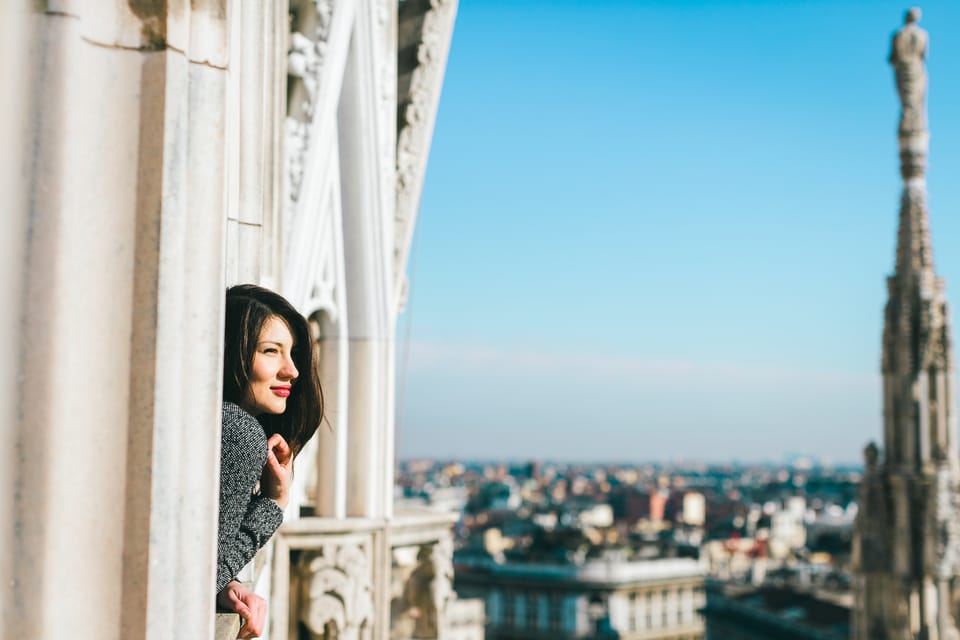
The terrace experience is all about scale. You’re roughly 150 feet (46 meters) above street level, and the roof view gives you an “over the city” perspective that street-level sightseeing can’t replicate.
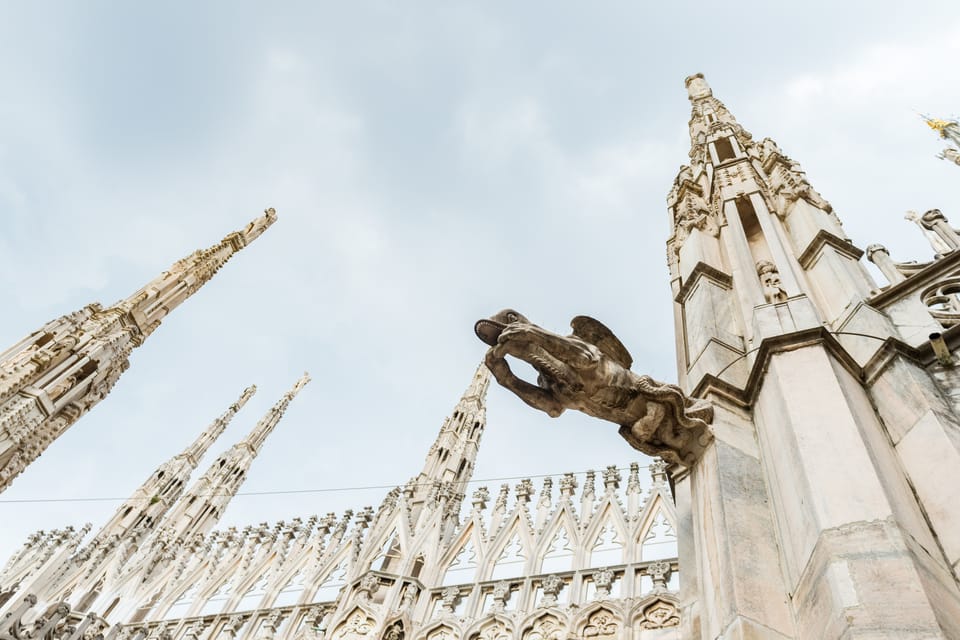
You’ll see the Duomo’s iconic white marble spires in long rows, and you’ll start noticing the small sculptural language that makes Gothic architecture so satisfying up close. One of the best things about going up is that you can inspect details that usually blur into background in photographs.
A few rooftop points that tend to hit hard:
- Spire density: the Duomo roof is covered with spires and statues, not just a handful of points of interest. You’ll likely spend time walking to compare angles.
- Close craftsmanship: the marble and carving work looks different under real daylight, especially if you pause along terrace edges to look straight across.
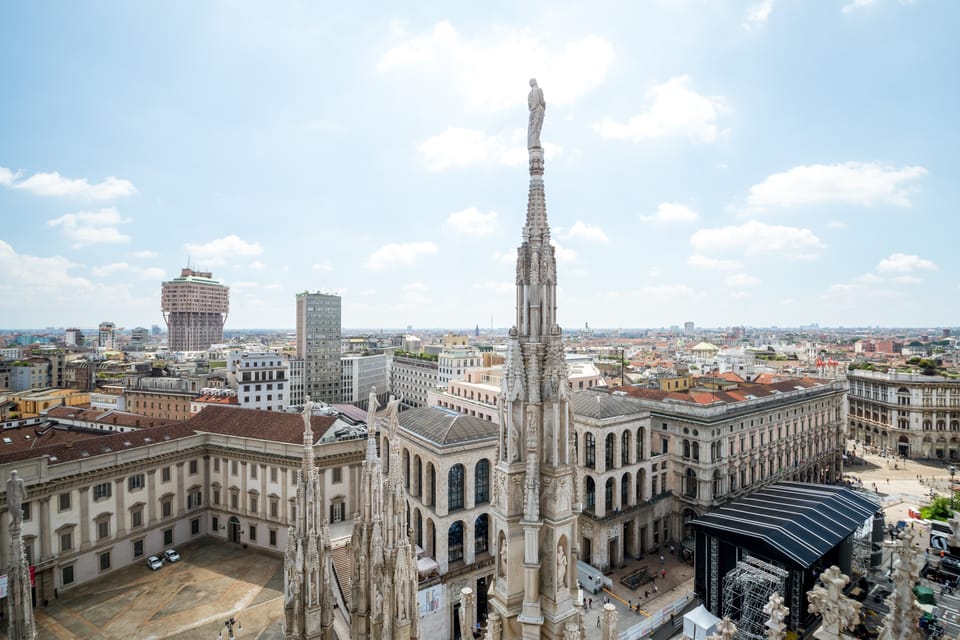
- Birds-eye city views: from your height you can track how Milan’s neighborhoods stack together—rooflines, streets, and distant landmarks.
On a good-weather day, you may also get a long-distance view. That includes the chance of seeing the Alps in the far background, a detail that makes the rooftop feel bigger than Milan itself.
And yes, even with no church access ticket, you can still get a sense of the Duomo’s interior architecture in passing during your route through the site. If your ticket truly focuses on terraces only, keep your expectations aligned—but don’t be surprised if you get a brief glimpse of the interior on your way out.
The Duomo story on the roof: 1386 to 1965, explained by what you can see
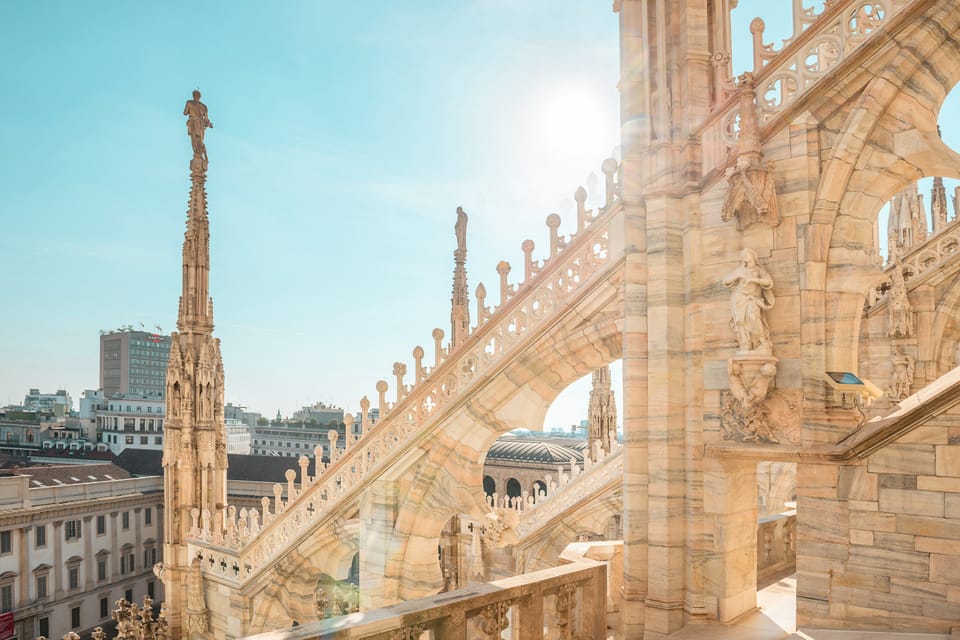
The Duomo’s timeline isn’t just a trivia line. It’s the reason the cathedral feels like layers of ambition rather than one unified build. Groundbreaking began in 1386, and the project wasn’t completed until 1965—nearly 600 years later.
From the terraces, you can connect that timeline to the way the roof is built: you see how the design had to keep evolving, and how the final look depends on centuries of decisions and refinements. The roof is where that long development becomes visible, because you can see the whole roofline as an assembled system of stonework.
A material detail you’ll appreciate once you’re standing among the structures: the Duomo was built using marble quarried from the Candoglia region. Up close, this marble reads differently than the kinds of stone you’ll see on newer buildings around Milan. The color and finish can look subtly “alive,” especially when the sun hits it cleanly.
The result is that your terrace walk becomes more than sightseeing. It’s a guided experience without a guide—because the roof itself shows you what the building is made of and how it was meant to be seen.
Rules and dress code: the stuff that can ruin your morning if you ignore it
This ticket has real restrictions, so it’s worth getting ready before you reach the front gates.
Not allowed:
- Food
- Tripods
- Drones
- Glass objects
- Luggage or large bags
- Pets
- Smoking
- Non-folding strollers
- High-heeled shoes
- Unaccompanied minors
And you’ll need to follow a modest dress code. Shorts and tank tops are not allowed, so pick clothing that covers appropriately. If you’re visiting in warm weather, bring a light layer you can wear instead of tank tops.
Also note: this experience is not suitable for people with mobility impairments, which matters even if you choose the elevator, because the terrace route still involves walking and navigating the site layout.
Who this ticket suits best (and who should pick something else)
This is one of the best options in Milan if:
- you love skyline views and want a rooftop perspective,
- you’re into architecture and want close-up detail without committing to a full museum day,
- you want a clear, focused plan that doesn’t require hours inside.
It’s also great for travelers who don’t want to over-plan. Once you’re up, you can spend time looking around at your pace, then head back down when you’re done.
Choose something else if:
- the interior church and museum rooms are your top priority,
- you need a fully accessible route (this one is not suitable for mobility impairments),
- or you’re hoping for a flexible day with lots of alternative indoor stops.
Final verdict: Should you book the Duomo Terraces ticket?
Yes—if your goal is roof-level Milan and close-up Duomo craft, this is a strong buy. The reason is simple: you’re paying for the experience that’s hardest to fake—being on the Duomo itself, high above the city, with spires and stonework around you.
I’d book it when:
- you want a standout Milan moment that’s different from shopping streets and museum queues,
- you plan to dress appropriately and handle security quickly,
- and you can commit to a fixed terrace entry time within the open hours.
I’d skip or add a separate plan if you’re mainly chasing full church interior access or museum content. This ticket keeps the focus on terraces, and it does that well.
If you want one practical move that often pays off: pick a time earlier in the day for easier movement, and treat the roof as a slow walk with pauses, not a quick photo stop. That’s when the Duomo terraces really deliver.
FAQ
What does the Milan Duomo Terraces ticket include?
It includes entry to the terraces of the Milan Duomo, a Duomo gift, and either an elevator or stair ascent (based on the option you choose). You also receive a 10% discount at the Duomo Shop, with certain excluded items.
Does this ticket include access to the Duomo church or museum?
No. It does not include entry to the Duomo, Museum, the Church of St. Gottardo in Corte, or the archaeological area.
How many steps are involved if I choose the stairs?
The ascent by stairs is about 250 steps.
What are the terrace opening hours?
The terraces are open daily from 9:00 AM to 6:30 PM.
What is the last entry time?
The last entry for all sites is at 5:50 PM.
Is there a security check?
Yes. Be prepared for an airport-style security check, and all visitors undergo security checks.
What dress code do I need to follow?
You must follow a modest dress code. Shorts and tank tops are not allowed.
What items are not allowed during the visit?
Items not allowed include high-heeled shoes, pets, smoking, luggage or large bags, drones, non-folding strollers, food, tripods, glass objects, and unaccompanied minors.
Do I need to visit each area only once?
Yes. Each area can be visited only once.
Is this experience suitable for people with mobility impairments?
No. It is not suitable for people with mobility impairments.