REVIEW · POMPEII
Pompeii and Herculaneum Small Group Tour with an Archaeologist
Book on Viator →Operated by Askos Tours · Bookable on Viator
Pompeii and Herculaneum go together like time travel. This archaeologist-led tour keeps you from wandering around lost, while you learn what to notice in the Forum, baths, theaters, and houses in both cities. The main trade-off: the day is efficient, so Pompeii is only about two hours, which can feel tight.
What I like most is how the logistics handle the hard part. You travel with a guide on modern transport from Naples/Rome/Sorrento, and for Pompeii starts you take the Circumvesuviana train to Herculaneum with your group. With a small group (up to 20) and headsets included, it’s built for listening and moving at a steady pace (English-speaking).
In This Review
- Key points before you go
- Is This the Best Way to Do Pompeii and Herculaneum?
- Meeting Points and How the Day Actually Moves (Minibus vs Train)
- Pompeii Highlights in About Two Hours: Forum, Baths, Theaters, and Key Houses
- Lunch Break: Keep Your Energy Up Between Two Ruins
- Herculaneum: The Smaller Site That Feels More Like a Place
- House by House: What You Actually See at Herculaneum
- Guides, Headsets, and Group Size: Why It Feels Smooth (Even When It Doesn’t)
- Price and Value: What You Get for $77.09
- Practical Tips So You Don’t Waste Time on the Wrong Stuff
- Should You Book This Pompeii + Herculaneum Archaeologist Tour?
- FAQ
- How long is the Pompeii and Herculaneum small group tour?
- What’s included in the tour price?
- Where do I meet the guide?
- How do you travel between Pompeii and Herculaneum?
- Are meals included?
- Is there a limit to group size?
- Is the tour refundable if plans change?
Key points before you go
- Two guided sessions: about 2 hours in Pompeii and 2 hours in Herculaneum
- Skip-the-line entry: you get the included express-style tickets for both sites
- Transport is handled: minibus from Naples/Sorrento/Rome, plus Circumvesuviana for Pompeii departures
- Curated highlights, not random walking: Forum to theaters to the famous Pompeii brothel; then Herculaneum’s preserved houses and baths
- Headsets included: easier listening when groups tighten up near walls, doorways, and mosaics
Is This the Best Way to Do Pompeii and Herculaneum?
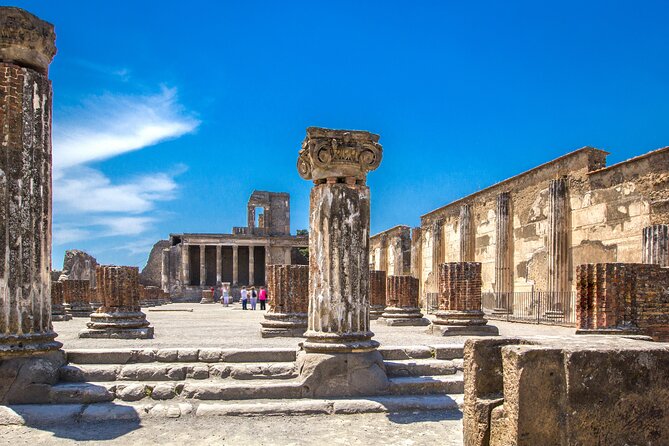
If you want one day where the ruins actually make sense, this kind of archaeologist-guided format is hard to beat. Pompeii and Herculaneum are massive, and it’s easy to spend hours “looking at rocks” if you don’t know what you’re seeing. A guide turns the site into a map of daily life—markets, baths, theatre culture, wealth, and how homes worked.
I also like that the tour does the “two-site combo” without making you manage every step. You get guided time in both places, admission covered, and the transfer between sites is built into the plan. The overall result is good value for people who want meaning more than strolling.
Still, I’d call out the pace. Pompeii is huge, and two hours for the headline areas is a smart overview—but it’s not a full, slow-detailed visit. If you want to linger in every mosaic and side-street, you’ll likely want a return trip later.
You can also read our reviews of more tours and experiences in Pompeii.



Meeting Points and How the Day Actually Moves (Minibus vs Train)
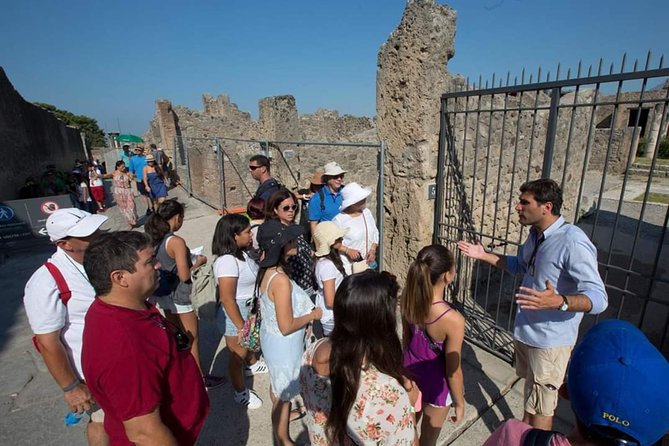
Start locations depend on where you’re staying. You meet your archaeologist at:
- Pompeii (Porta Marina Superiore)
- Naples and Rome (Starhotels Terminus)
- Sorrento (Piazza Angelina Lauro)
From Naples, Rome, and Sorrento, you use a modern minibus for the full-day transport between the sites. From Pompeii, you’ll use the included Circumvesuviana train to reach Herculaneum, with about 30 minutes on the train plus a short walk (around 10 minutes).
That matters because it keeps the plan realistic. Pompeii-to-Herculaneum is doable on your own, but doing it with a guide avoids the “we’re late” spiral. It also means the group stays together for the most important part: arriving at the ticket area and moving into the ruins while your energy is still good.
One more practical note: your drop-off depends on your start option. If you start in Pompeii, the tour ends in the Herculaneum ruins area, so you’ll need to handle how you get back to Pompeii afterward.
Pompeii Highlights in About Two Hours: Forum, Baths, Theaters, and Key Houses
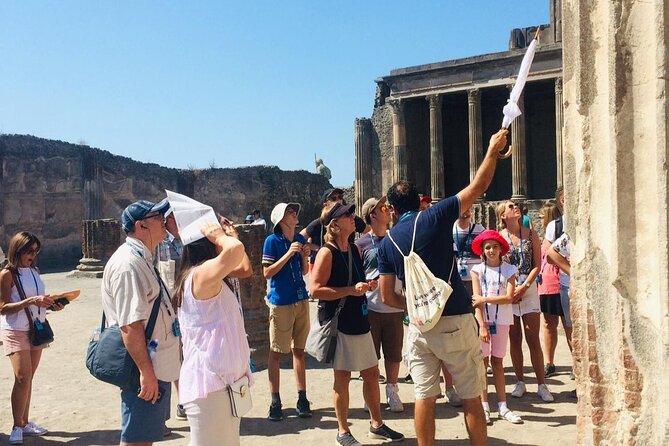
Pompeii is where you can easily feel overwhelmed. The guide format here is basically a greatest-hits tour, with time focused on architecture and everyday functions you’d otherwise miss.
You begin with major highlights and a guided flow that hits the big public spaces and several standout homes. Expect to spend around two hours in the ruins, with time allocations tied to key stops.
Here’s how the experience tends to “read” on the ground:
1) Basilica and the Forum area
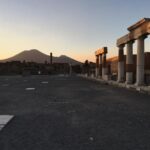
The Basilica is introduced as an open portico sheltering merchants and activities. Then you step into the main square area of Pompeii—the Foro de Pompeya—which is the best “anchor” for understanding the city as a working place, not just a museum.
What you should look for: notice how public space supports trade and civic life. With the guide, even short stops help you understand what these buildings were for.
2) Main street walk
You walk through Pompeii’s main street, which is a simple but effective move. It’s not just scenery; it’s a way to connect the public spaces to the neighborhoods and homes around them.
3) House of Menander
This is one of Pompeii’s richest private residences, praised for architecture, decoration, and contents. The guide helps you read rooms as status signals—how wealth shows up in design choices.
4) Granaries of the Forum
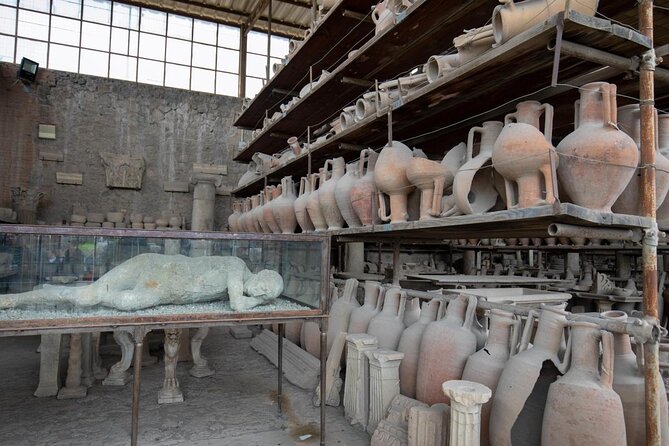
The granaries get attention for a reason: you see marble tables and features tied to fountains, plus casts showing victims of the eruption and even references like a dog and a tree. It’s one of those stops where the guide’s explanation changes the emotional weight.
5) Stabian Baths (Terme Stabiane)
These baths cover a huge area and are described as the oldest thermal complex in Pompeii. Baths are a core part of Roman life—social, practical, and ritual—so a guided stop here is more useful than it sounds.
6) Lupanar (Pompeii brothel)
This is the famous one. The Lupanar is quick but memorable, especially with an explanation that connects architecture and function to how the city worked.
Heads-up: it’s a very “specific” stop. If you prefer only sanitized highlights, you may feel this is too much detail.
7) House of the Faun
This is a large, impressive residence and a major Pompeii highlight. Again, the value isn’t just seeing the size—it’s understanding the home as a statement and the layout as a lived-in system.
8) Odeon (Teatro Piccolo) and the Teatro Grande
You’ll see both the Teatro Piccolo and the Teatro Grande, Pompeii’s most important theatre. These stops help you understand how performance culture shaped public life.
The drawback to plan around: Pompeii is a time squeeze. One of the common frustrations is that Pompeii can feel rushed, and if you love mosaics and frescoes you might want more minutes than the tour allows. I’d treat this as a strong orientation plus top sights, not a full deep-dive day.
Lunch Break: Keep Your Energy Up Between Two Ruins
Between Pompeii and Herculaneum, there’s a short lunch break where meals are not included. The tour is designed so you don’t lose the day, but lunch is still on you.
From a practical standpoint, I’d plan for two realities:
- You’ll probably spend part of lunch time in a more commercial area rather than in the “quiet museum corner” vibe you might imagine.
- If you care about “holding the magic,” you’ll want snacks and patience.
A simple tactic: bring a backup snack (or grab something quick nearby) so you’re not stuck waiting while your group reshuffles. You’ll thank yourself when you hit Herculaneum and want to focus.
Herculaneum: The Smaller Site That Feels More Like a Place
After Pompeii, the day shifts. Herculaneum is different in feel: smaller, more intimate, and often easier to “read” while walking. The tour includes guidance to keep you moving efficiently without turning it into a sprint.
You’ll go to the Herculaneum ticket office area with your guide, then you’re in the ruins for about two hours of guided time. Admission for Herculaneum is included, and the experience runs long enough to see the major preserved homes and public buildings.
What makes this part special is the variety of houses and how many details survive—doorways, thresholds, baths, and living-room layouts. When the guide points out what you’d otherwise overlook (names of buildings, benefactors, and layout clues), the site feels more human.



House by House: What You Actually See at Herculaneum
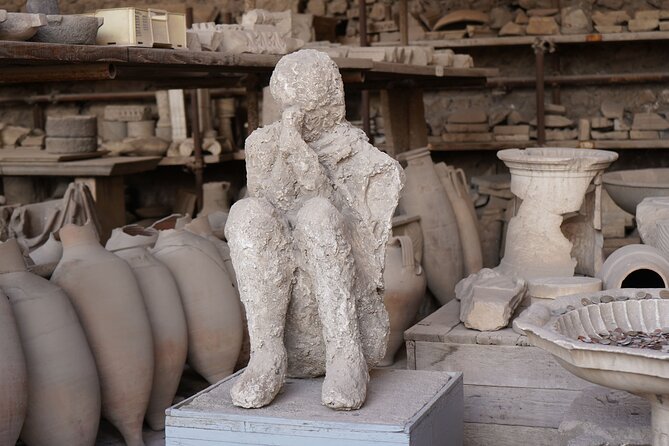
In Herculaneum, the tour’s focus is on homes and public bathing spaces, plus a few key civic/religious buildings. Here are the headline stops you can expect to see:
House of the Deer
Named for marble statues of stags/deer in the peristyle. This is one of those “art + wealth” moments that helps you picture a real household.
La Terrazza di M. Nonio Balbo
This terrace links to the city’s benefactor, M. Nonius Balbus, with a long inscription tied to his role and honors after death. It’s a great example of how Roman elites used construction to shape civic identity.
College of the Augustales
A building tied to the cult of Emperor Augustus, and possibly the local civic leadership group. If you like the “who ran what” side of ancient life, this is a good stop.
Casa del Rilievo di Telefo
Connected (possibly) to leading benefactors such as Marcus Nonius Balbus, with an unusual link to adjacent rooms like the suburban thermae. Even short explanations make the layout feel purposeful.
Partem Domus lignea (Casa del Tramezzo di Legno)
This stop is important because it includes an example of a preserved wood partition. If you’re used to stone ruins, the idea that parts of timber survived changes your mental picture.
House of the Skeleton
Named from human remains found in a second-floor room during discoveries. It’s somber, and a guide helps you interpret the context without turning it into shock tourism.
Central Thermae
These baths are described as built around the start of the 1st century AD, with separate men’s and women’s entrances. It’s a strong “Roman routine” stop.
House of the Black Salon
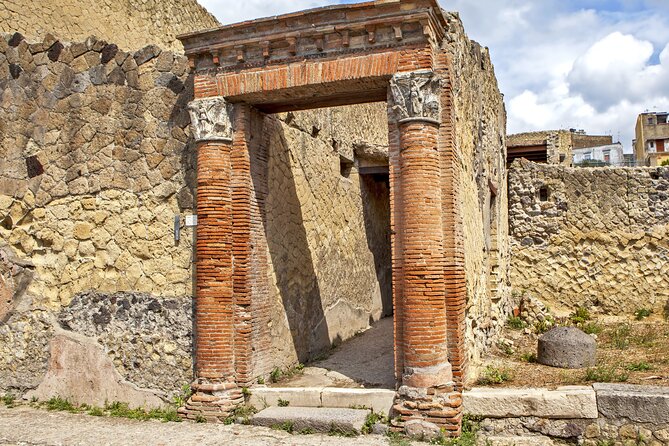
A luxurious mansion with a monumental entrance, including carbonised remains of doorposts and lintel. This is the kind of detail where a guide’s pointing direction makes a huge difference.
Casa Sannitica
Noted for a Samnite-style typical arrangement: a splendid atrium with a gallery and Ionic columns, plus fresco decoration. Even in brief viewing time, you learn how regional styles shaped building choices.
Casa del Bel Cortile
A standout because it has a courtyard with a stairway and stone balcony, rather than the typical atrium setup. It’s a reminder that “Roman home” wasn’t one template.
House of the Grand Portal
A central domus with multiple environments, columns, frescoes, and the charred remains of wooden parts. It’s a fitting final wow-stop because it brings together art, architecture, and survival.
Time reality check: You won’t see everything, and some stops may feel like quick “photo + point + move on.” Still, the tour structure is a smart compromise: you leave with enough landmarks that returning later would feel effortless.
Guides, Headsets, and Group Size: Why It Feels Smooth (Even When It Doesn’t)
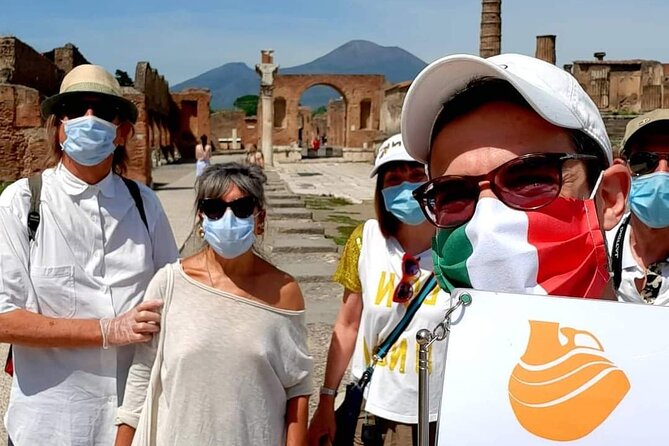
This is a small-group experience capped at 20 people, which helps a lot at busy archaeological sites. Plus, you get headsets for all participants, so you can hear explanations without craning your neck around taller people.
The tour also benefits from archaeologist-style storytelling. In the guide names shared by past groups, you’ll see a pattern of passion and depth—people like Michele, Diego, Tomas, Paulo, Vince, Gianni, Amadeo, Antonio, Paolo, and Alfredo are specifically mentioned as knowledgeable and engaging. That matters because Pompeii and Herculaneum punish generic guide talk.
One caution: because you’re relying on headsets, you may occasionally run into minor audio issues like cuts in signal. If that happens to you, it helps to immediately flag it so the team can fix placement or volume.
Price and Value: What You Get for $77.09
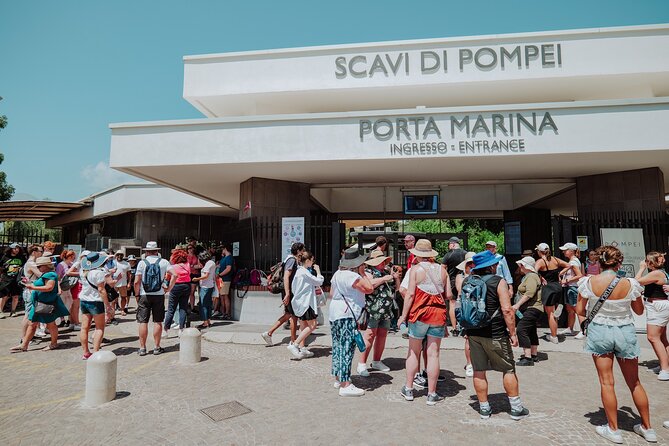
At $77.09 per person, the big value isn’t just the guide. It’s the “bundle” effect:
- Guided tour service in both sites
- Entrance tickets included (Herculaneum and Pompeii)
- Headsets included
- Transport handled between Naples/Rome/Sorrento and the ruins
- For Pompeii starts, an included Circumvesuviana train ticket to Herculaneum
For context, admission values listed for adults are 16 euros for Herculaneum and 20 euros for Pompeii (with EU citizen 18–25 pricing also mentioned). Even before you think about the guide and transport, you’re not paying twice just to access the sites.
What’s not included is meals and drinks, so budget for lunch. That’s the only part that can add up fast if you don’t plan.
Practical Tips So You Don’t Waste Time on the Wrong Stuff
A few things will make or break your day at these ruins:
- Wear grippy shoes. Both sites involve uneven ground and lots of walking.
- Bring a layer. Even in warm months, shade shifts quickly in open ruins.
- Plan for weather. Rain and wind can happen; keep a compact rain jacket handy.
- Use your headset right away. Adjust it at the start so you aren’t stuck fiddling when the group moves.
- Have lunch expectations. You get a quick break, but meals aren’t included. If you want more control, consider snacks.
- If you need extra mobility or visual help, the tour data says it is not recommended for visually impaired guests unless accompanied by a dedicated personal assistant.
If you do these basics, you’ll spend less time coping and more time understanding what you’re seeing.
Should You Book This Pompeii + Herculaneum Archaeologist Tour?
I’d book it if you want:
- A structured highlights route through two major sites
- Meaningful guidance from an archaeologist, not just a map and a caption
- A day that handles transport and entry for you, so you can focus on the ruins
I’d think twice if you:
- Want to spend long hours in Pompeii without time pressure (this tour prioritizes top areas over “every corner”)
- Hate any lunch stop that feels commercial (lunch is on your own, and the break can land you in a practical, not dreamy, spot)
- Need special accessibility support beyond what’s described (the tour notes it’s not recommended for visually impaired guests without an assistant)
For most people, this works as the best first visit plan. You’ll leave with enough landmarks—and enough “why this matters”—to either enjoy Pompeii/Herculaneum further on your own later, or plan a return with a slower pace.
FAQ
How long is the Pompeii and Herculaneum small group tour?
The duration is listed as approximately 6 to 11 hours, depending on the departure option and the day’s timing.
What’s included in the tour price?
You get guided tour service in both Pompeii and Herculaneum, headsets, entrance tickets for both sites, and included transport between the sites. Pompeii-option guests also receive an included Circumvesuviana one-way train ticket from Pompeii to Herculaneum.
Where do I meet the guide?
Meeting points depend on your option: Pompeii (Porta Marina Superiore), Naples and Rome (Starhotels Terminus), or Sorrento (Piazza Angelina Lauro).
How do you travel between Pompeii and Herculaneum?
For Naples, Sorrento, and Rome options, you travel by modern minibus. For the Pompeii option, you go by Circumvesuviana train (about 30 minutes) plus a short walk (about 10 minutes).
Are meals included?
No. There’s a lunch break available, but meals and drinks are not included.
Is there a limit to group size?
Yes. The tour has a maximum of 20 travelers.
Is the tour refundable if plans change?
Yes. You can cancel up to 24 hours in advance for a full refund.