REVIEW · ASSISI
Small Group Tour of Assisi and St. Francis Basilica
Book on Viator →Operated by Umbria con Me · Bookable on Viator
Assisi rewards slow looking, but this tour gives you fast focus. In a 2 hours 30 minutes walk, you cover the city’s top churches and major sights, including St. Francis’s fresco world, plus big views over the Umbrian valley. I especially like the small-group setup (up to 15), which means you can ask questions and get your bearings quickly, and I like that the guide ties buildings to the people and art you’re actually seeing, not just dates on a wall.
The main thing to consider is the walking: expect uphill lanes and steep church steps, and that can be a deal-breaker if mobility is limited. Dress code is strict too—plan on covered knees and shoulders.
Key things I’d zero in on
- St. Francis split in two: dark, solemn lower basilica first, then the brighter upper church
- Art you can name: fresco tradition with Giotto as the standout reference point
- Assisi beyond the basilica: Roman amphitheater ruins, Minerva’s temple, and smaller sanctuaries
- Pink-stone St. Clare: the church’s building material is part of the story, not just decoration
- Small group energy: easier pacing and more direct time with the guide
In This Review
- Why this Assisi highlight tour works (even if you’re short on time)
- Roman roots first: amphitheater ruins and the Rocca Maggiore view
- The medieval power center: Piazza del Comune and Minerva’s Temple
- St. Clare in pink stone: frescoes and the Crucifix tradition
- Chiesa Nuova and Assisi Cathedral: the stops that add context
- Santa Maria sopra Minerva: ancient temple, later church
- Basilica of St. Francis: UNESCO, Brother Elias, and the lower/upper contrast
- Price and value: what $72.59 buys you
- Practical tips: dress code, hearing, and the uphill reality
- Sunday and special dates: when you might enter alone
- Should you book this Assisi and St. Francis small group tour?
- FAQ
- How long is the Small Group Tour of Assisi and St. Francis Basilica?
- Where does the tour meet?
- What time does the tour start?
- What’s included in the price?
- Is the Basilica of St. Francis always open for guided entry?
- Are there dress requirements for entering churches?
- What happens during the relic display period in 2026?
- Is there a maximum group size?
Why this Assisi highlight tour works (even if you’re short on time)
Assisi can feel like a maze in the best way: winding medieval lanes, sudden piazzas, and churches stacked on hillsides like they grew there. This tour is designed for the reality that most visitors have limited time and want the big spiritual and artistic anchors without guessing where to start.
You’ll move efficiently from stop to stop, but you’re not stuck in a long bus loop. It’s a walking tour through the historic core, so each shift in level and each turn matters. That helps you understand why St. Francis’s story is tied to geography here—Assisi isn’t flat, and the churches weren’t built as museum pieces. They’re part of the city’s daily rhythm and dramatic terrain.
Small-group also means the guide can keep an eye on the pace and help you reconnect when a lane swallows your sense of direction. Many people specifically call out guides like Alessandra, Francesca, Michele, Emmanuela, and Barbara for bringing the art and saints to life.
Roman roots first: amphitheater ruins and the Rocca Maggiore view
You start with a meet-up at Parcheggio Saba Matteotti (Piazza Giacomo Matteotti) at 10:30am. Note the practical hitch: the Matteotti parking lot is closed for renovation, so you may not be able to park there even though it remains the meeting point. The good news is the tour is near public transportation, so you can plan a non-car approach without stress.
From there, the route begins with old Roman leftovers: the local amphitheater ruins that were later reused in the Middle Ages as a quarry for building stones. This is one of those “look closer” moments where the city’s layers become visible. You’re not just hearing that Assisi has history—you’re seeing how one era physically fed the next.
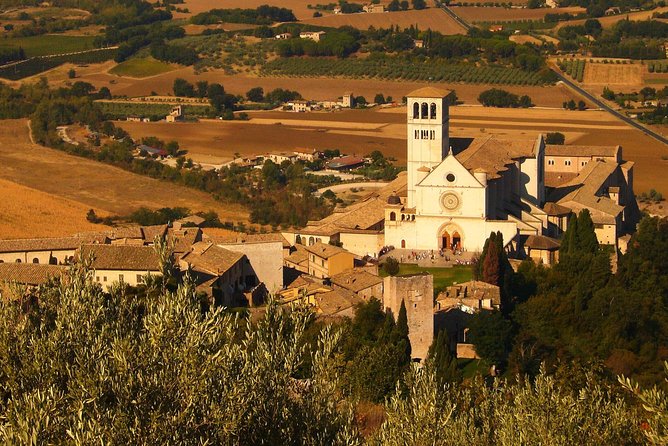
Then you get a standout payoff: the view toward Rocca Maggiore, visible from winding medieval paths. It’s the kind of view that makes you understand why people chose to build here in the first place.
You can also read our reviews of more tours and experiences in Assisi.

The medieval power center: Piazza del Comune and Minerva’s Temple
As you weave through narrow alleys and medieval squares, you reach Saint Rufino’s Cathedral and Saint Claire’s Basilica before arriving at the main public hub: Piazza del Comune.
This square isn’t only scenic. It’s a contrast point. On one side, you’ve got churches tied to Franciscan devotion and medieval spirituality. On the other, you see civic gravity—imposing government buildings wrapped around the square’s identity.
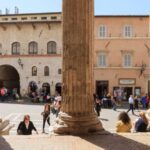
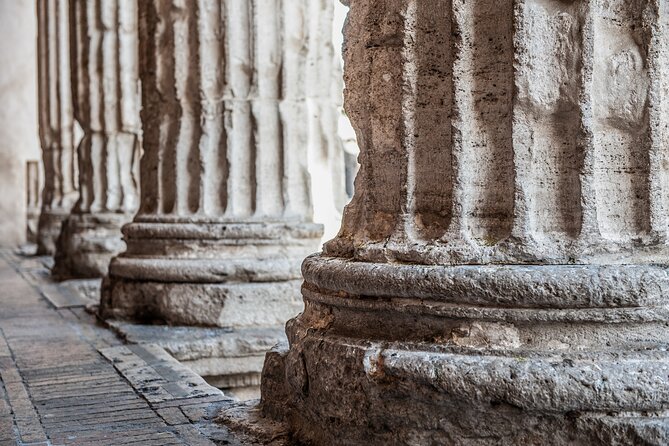
At the center of that mix sits Minerva’s Temple, one of the best-preserved Roman temples in Italy. The temple is surrounded by medieval buildings, so it feels like Rome is still in the neighborhood even though time tried to bury it. If you’re the kind of traveler who likes to connect art and architecture to how people lived, this stop gives you a strong anchor fast.
St. Clare in pink stone: frescoes and the Crucifix tradition
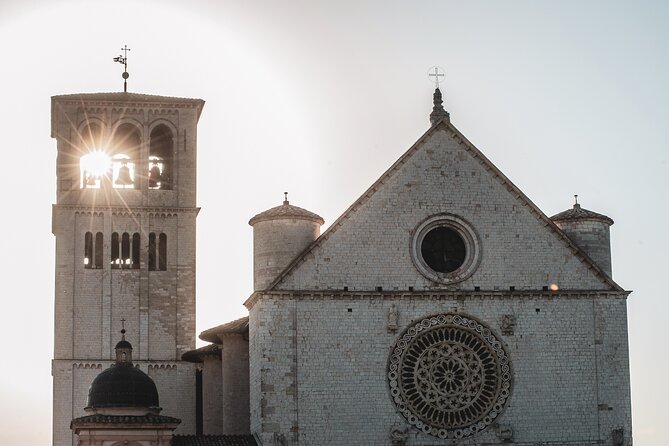
Next comes Basilica di Santa Chiara (St. Clare of Assisi). What makes this stop click is the building material: the basilica uses the typical pink stone from the quarry of the Subasio mountain. That detail matters because it helps you “read” the church. You notice the color, you connect it to the landscape, and the whole place stops feeling generic.
Inside, you’re looking at precious frescoes dating from the 12th to the 14th century. This is one of the ways the tour delivers more than a quick photo stop. You learn what you’re seeing and why it fits into the Franciscan world.
You also get a specific moment in the right chapel: the Crucifix associated with a tradition about inviting St. Francesco to restore the church at St. Damiano. Traditions like this aren’t just folklore here—they explain why devotion, art, and local geography are tangled together.
This stop is designed to be paced (about 15 minutes) and typically doesn’t include a ticket requirement for entry, which helps keep the logistics simple.
Chiesa Nuova and Assisi Cathedral: the stops that add context
Between the big-name basilicas, the tour includes a couple of smaller churches that still make the story feel real.
Chiesa Nuova is built in 1615 on the site believed to be the birthplace of St. Francis, in the house of Pietro di Bernardone. It got the name Chiesa Nuova because it was called the last church built in Assisi at the time. That’s a neat reminder that the Francis story didn’t end with the saint’s life. People kept building new ways to frame it.
Then there’s Assisi Cathedral (San Rufino’s Cathedral), dedicated to Rufinus of Assisi. Even without a long stay, it matters because it widens the focus beyond Francis and places Assisi’s religious importance in a broader local tradition.
If you’re worried about “church fatigue,” these stops help break up the heavy feeling of St. Francis. They keep your brain busy with different themes: civic identity, local saints, and how Assisi keeps reinterpreting itself over centuries.
Santa Maria sopra Minerva: ancient temple, later church
You’ll also pass Santa Maria sopra Minerva, which currently houses a church inside an ancient Roman building. The original structure is Roman, and the church Santa Maria sopra Minerva was built in 1539, later renovated in Baroque style in the 1600s.
This is a great example of how Assisi’s layers don’t sit quietly side by side. They blend. If you like architecture, you’ll probably enjoy seeing how an older sacred space gets repurposed instead of erased.
The timing is short (around 15 minutes), but it’s enough to notice the idea: Rome’s presence survives, even when the function changes.


Basilica of St. Francis: UNESCO, Brother Elias, and the lower/upper contrast
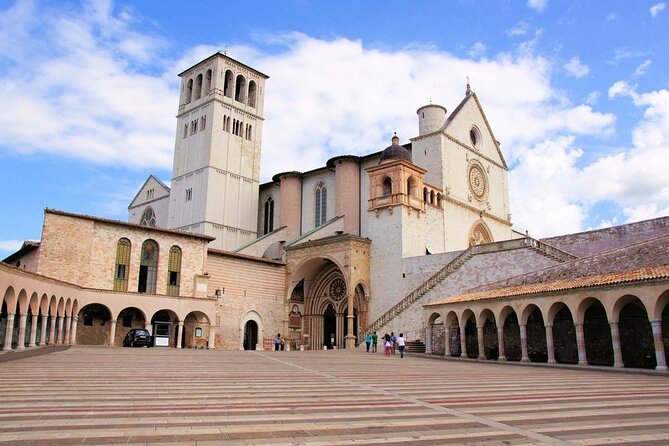
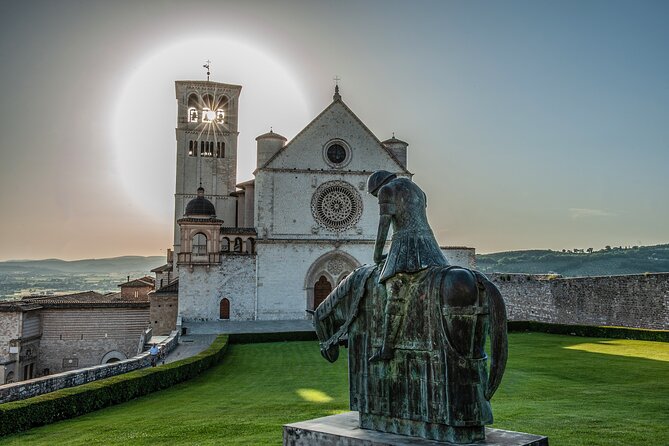
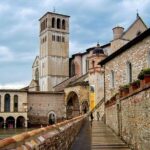
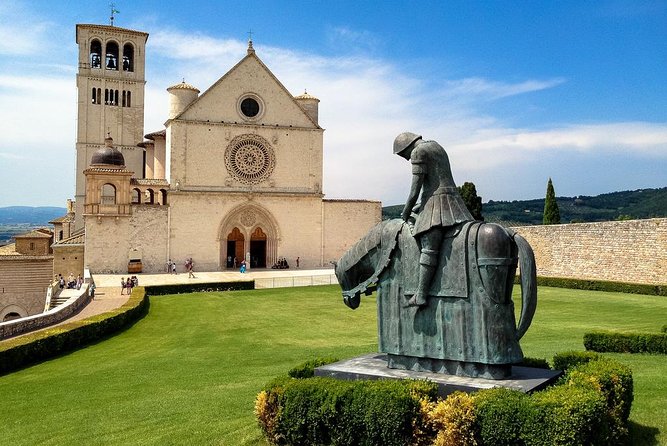
The tour’s headline is the Basilica Papale e Sacro Convento di San Francesco d’Assisi, a UNESCO World Heritage site. You’ll learn that construction began under Brother Elias (vicar general and architect of the order) starting in 1228, only two years after St. Francis’s death—built specifically to receive his remains.
That quick timeline is a big deal. It explains why this place feels immediate. It wasn’t built centuries later as a monument. It was built while the story was still living.
Then you get the signature split:
- Lower basilica: a more solemn, dark space that invites silence and penance.
- Upper church: airy and bright, in a Gothic style with French influences. The nave has four bays, with cross vaulting and a polygonal transept and apse.
You’ll spend about 30 minutes at each level, with entry included. This isn’t a “look at the ceiling and move on” stop. You’re given enough time to notice the emotional shift between the two spaces.
Also, if frescoes are your reason for coming, this is where the tour pays off. The basilica is famous for 13th–14th century frescoes, associated with the best painters of Italy at the time, with Giotto often highlighted as the name you’ll want to remember.
Price and value: what $72.59 buys you
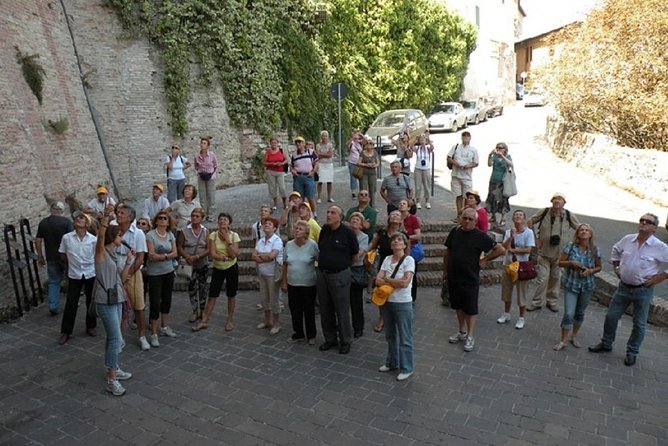
At $72.59 per person, you’re paying for a guided route that compresses a lot of Assisi’s key sites into one morning. The value is strongest in two places:
1) A guide who connects buildings to meaning. This matters in Assisi because without context the churches can blur together. People often praise guides like Alessandra for making the basilica stories and artwork make sense.
2) Admission to the Basilica of St. Francis is included. That’s the expensive anchor in many Assisi plans. Other church entries on the route are typically free, but the main basilica is the one you’re most likely to care about most.
What’s not included is tips. Also, budget-minded travelers should be aware: one piece of feedback mentioned an extra €2.50 per person fee for entering one sanctuary. The tour info here says several entries are free, but in real life, it’s smart to carry small cash or a card for any last-minute entry adds tied to how sanctuaries manage access.
In short: this is good value if you want an organized orientation and you’re coming for St. Francis, not just scenic strolls.
Practical tips: dress code, hearing, and the uphill reality
Assisi churches enforce a clear dress code: no shorts or sleeveless tops, and you need knees and shoulders covered for both men and women. Don’t treat this as optional. If you show up dressed casually, you risk being turned away.
Sound can be tricky in churches. One review mentioned that a microphone system helped, but the ear pieces were uncomfortable for them. Another complaint said headsets weren’t provided until the last stop, with a headset purchase required at the Basilica of St. Francis. That tells me two things:
- You should plan to hear through a small device at least part of the time.
- If the ear pieces fit poorly for you, bring something simple like hair to hold them in place if you normally use devices.
Finally, walk expectations. Multiple comments flag steep stairs and uphill walking. If your legs don’t love hills, this tour may be harder than you’d guess from the distance alone.
Sunday and special dates: when you might enter alone
Church rules can change how the experience feels.
On Sundays, big Catholic holidays, and National holidays, guided tours inside the Basilica of St. Francis are forbidden. Your guide will explain things from the outside, and you enter alone in silence. This doesn’t remove the basilica—it changes the format.
There are also date-specific closures:
- On October 4th, the Basilica of St. Francis is closed.
- From February 15 to April 6, 2026, access to the Basilica of St. Francis can be suspended due to public display of relics. During this period, you’ll get explanation from outside.
So if your dates line up with those windows, this tour may feel more like an exterior-and-context visit than the full inside experience.
Should you book this Assisi and St. Francis small group tour?
Book it if you want:
- A high-impact overview of Assisi in about 2.5 hours
- A guide who helps you make sense of frescoes and church symbolism
- A small group where questions are actually possible
Consider skipping or swapping to a gentler plan if:
- You have mobility limits or struggle with stairs and uphill lanes
- You’re traveling on October 4th or during the Feb 15–Apr 6, 2026 relic access suspension window and you really need full interior time
- You’re expecting a fully guided walk inside St. Francis on a Sunday or major holiday, when you may go in alone
If you’re a first-timer, this tour is a solid way to get your bearings fast. Assisi is too beautiful to wander blindly for hours, and this route gives you the key anchors without turning the day into a marathon.
FAQ
How long is the Small Group Tour of Assisi and St. Francis Basilica?
It runs for about 2 hours 30 minutes.
Where does the tour meet?
You meet at Parcheggio Saba Matteotti, Piazza Giacomo Matteotti, 06081 Assisi PG, Italy.
What time does the tour start?
The start time is 10:30am.
What’s included in the price?
An official English-speaking guide and entrance fee/admission tickets to the Basilica of St. Francis are included.
Is the Basilica of St. Francis always open for guided entry?
No. On Sundays, big Catholic holidays, and National holidays, guided tours inside the Basilica of St. Francis are forbidden. The guide explains from outside and you enter alone in silence.
Are there dress requirements for entering churches?
Yes. You must cover knees and shoulders. No shorts or sleeveless tops.
What happens during the relic display period in 2026?
From February 15 to April 6, 2026, access to the Basilica of St. Francis will be suspended. The guide will provide explanations from outside during that time.
Is there a maximum group size?
Yes. The tour has a maximum of 15 travelers.