REVIEW · FLORENCE
The Best Tour in Florence: Renaissance and Medici Tales
Book on Viator →Operated by All Around Florence · Bookable on Viator
Giotto’s tower and the Duomo—on the same walk. This tour strings together Medici power, Renaissance art, and Florence landmarks with story-driven guide commentary. You’ll start in the market heart near San Lorenzo and finish near the Uffizi area, so it’s an efficient way to get your bearings fast. What I like most: you hit both big icons like the Duomo complex and the Palazzo Vecchio area, and you also get context behind them (Medici motives, Dante’s place in the city). One thing to consider: many stops are brief and several churches/buildings list admission as not included, so you may still need to plan for which interiors you want to enter later.
If you want a walking plan that’s more than a highlight reel, this one works. The group stays small (up to 30), the ticket is mobile, and the route is paced for a 2-hour stroll through dense center-city Florence. Guides in the experience have earned strong praise for storytelling—people specifically mentioned names like Aurora, Deborah, and Alberto for making the Medici tale stick.
In This Review
- Key things that make this Florence walk worth it
- San Lorenzo meet-up: where the Medici story begins
- From Basilica di San Lorenzo to Palazzo Medici Riccardi
- The Duomo complex, Campanile, and Brunelleschi’s dome
- Dante’s House and the Piazza della Signoria power grid
- Michelangelo’s David copy, Loggia dei Lanzi, and ending near the Uffizi
- How the 2-hour format actually feels on the street
- Price, donations, and what your money is really buying
- What to do after: turn the walk into a smart second half of your day
- Who should book this Medici and Renaissance walking tour
- Should you book The Best Tour in Florence: Renaissance and Medici Tales?
- FAQ
- Where does the tour start and where does it end?
- How long is the walking tour?
- What language is the tour offered in?
- Are entrance tickets included for the stops?
- Is there a maximum group size?
- How does the donation compensation work?
Key things that make this Florence walk worth it
- Medici connections at street level: You learn why the family shaped Florence’s buildings and reputation
- Prime landmark pairing: San Lorenzo, the Duomo complex, and Piazza della Signoria in one flow
- Great “start day” energy: It ends near the Uffizi area, handy for what comes next
- Dante included, not just dusted over: A stop at Museo Casa di Dante gives you literary context
- A tour that’s guide-led, not just photo stops: Story time is part of each location
- Small groups: Maximum 30 travelers keeps it more interactive than a huge bus-style tour
San Lorenzo meet-up: where the Medici story begins
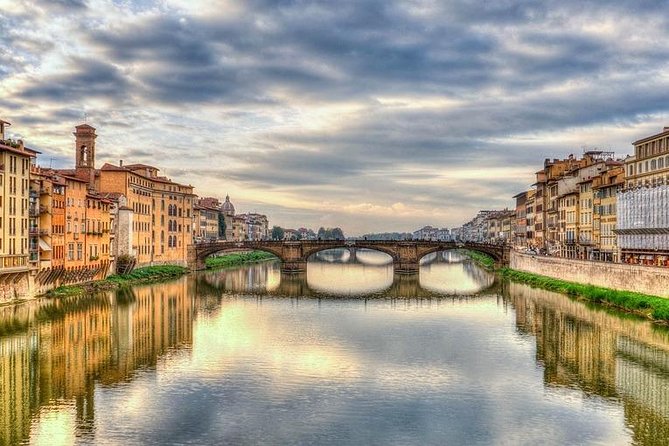
The tour kicks off in the center of Florence, right in front of San Lorenzo Church, at Piazza di San Lorenzo 35R. Your guide meets you near the statue of Giovanni de’ Medici seated on a throne—an immediate signal that you’re about to explore Florence through one of its most influential families.
This first step matters because it changes how you look at the city. Instead of treating churches and palaces as separate “stops,” you start connecting them. You’re also on foot early, which helps with the simple thing first-time visitors need: rhythm. Florence can feel like a maze at the start; a planned route gives you a mental map for later.
The tour is listed in English and is designed for most travelers. Still, you’ll be walking—so if your day is already heavy with stairs and museums, plan your energy accordingly.
You can also read our reviews of more tours and experiences in Florence.
- Tuscany Day Trip from Florence: Siena, San Gimignano, Pisa and Lunch at a Winery
★ 5.0 · 21,634 reviews

From Basilica di San Lorenzo to Palazzo Medici Riccardi
The first major stop is Basilica di San Lorenzo. It’s one of Florence’s large churches and, crucially, the burial place for principal Medici family members—from Cosimo il Vecchio through Cosimo III. Even if you don’t go inside, the setting tells you a lot. San Lorenzo sits in Florence’s central market zone, so you can feel the overlap between commerce, politics, and status.
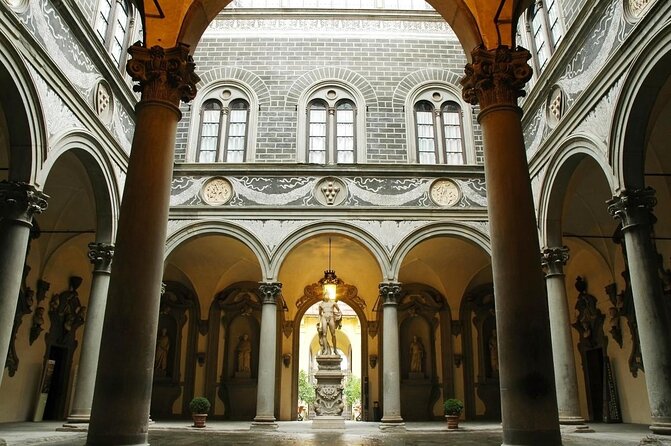
From there, you move to Palazzo Medici Riccardi, associated with Cosimo de’ Medici, built between 1444 and 1484. That date range is useful because it places the palazzo firmly in the Renaissance momentum era, when wealth wasn’t just money—it was architecture, symbolism, and influence. A guide-led stop here is more than “see a palace.” You’re learning how power gets displayed and how it lasts through stone.
One practical note: these early stops are time-efficient. The tour makes short introductions at each location (think around 10 minutes per stop in many cases), so you’ll get the storyline and orientation, not a slow, in-depth interior visit. If you love lingering in chapels or studying details up close, treat this as your briefing, then come back for longer visits.
The Duomo complex, Campanile, and Brunelleschi’s dome
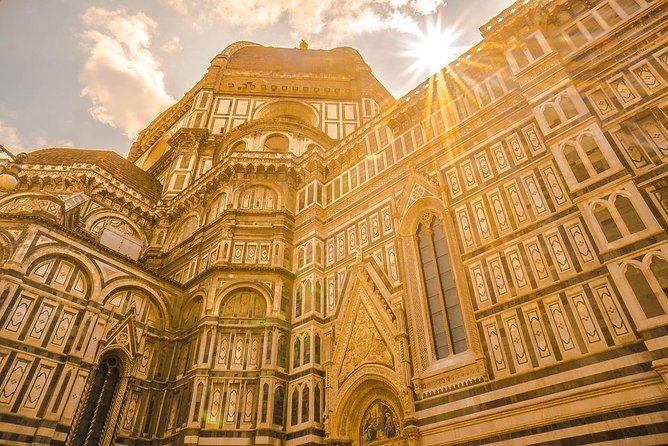
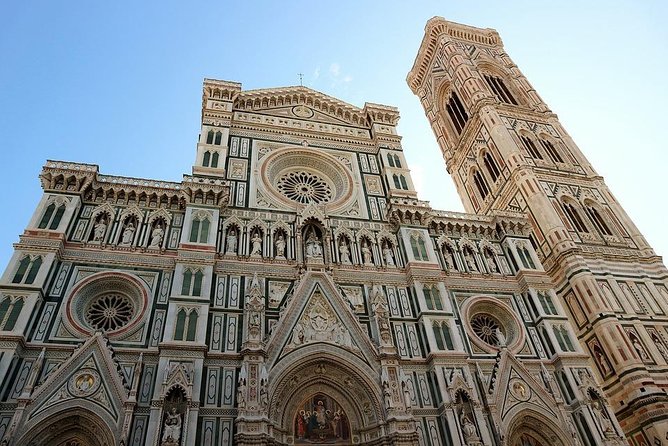
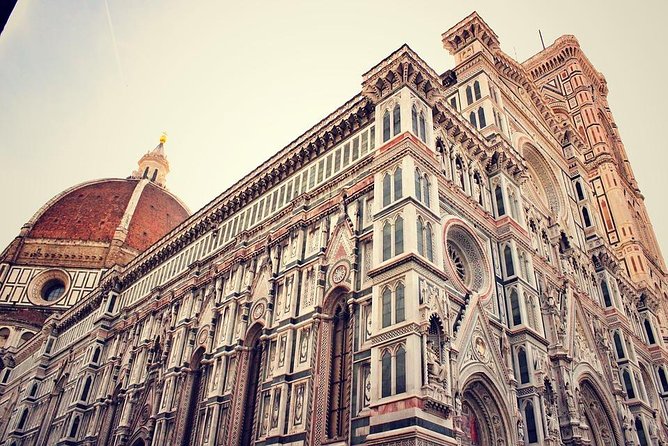
Next comes the big one: the Florence Cathedral complex, the area people come to for the skyline. You’ll pass the Duomo (Cattedrale di Santa Maria del Fiore), and you’ll also see the Baptistery of St. John and Giotto’s Campanile in the same corridor of attention.
At the Battistero di San Giovanni, the building dates are a big deal: constructed between 1059 and 1128 in a Romanesque style. That’s a useful contrast with the later Renaissance vibe you’ll hear about next. Florence didn’t “switch to Renaissance” overnight. It layered centuries, and this baptistery reminds you how old the city’s religious center is.
Then you reach the Campanile di Giotto, adjacent to the cathedral and the baptistery. This tower is described as a showpiece of Florentine Gothic architecture, with rich sculptural decorations and polychrome marble encrustations. The takeaway is simple: Florence’s artistic identity wasn’t only paintings and sculptures in galleries. It’s also in towers, surfaces, and public façades you can see from streets.
Finally, you see the Cupola del Brunelleschi. Even if you’ve seen photos, it helps to have someone explain what you’re looking at: it was the largest in the world when built, and it remains the largest brick dome ever constructed. That scale makes the Renaissance feel less like an abstract art movement and more like engineering audacity.
If you’re the type who wants to climb steps and go inside immediately, you might feel the tour moves on before you’re done staring. That’s not a flaw—it’s the structure. You’re using the walk to understand the big picture, then choosing what to deepen later.
Dante’s House and the Piazza della Signoria power grid
After the Duomo area, the tour shifts from architecture to ideas and public life. You’ll pass the House of Dante and get a specific stop at Museo Casa di Dante. Dante Alighieri wrote the Divine Comedy, widely considered a cornerstone of Middle Ages literature and a major work in the Italian language. This stop gives you a lens for understanding why Florence cared so much about writing, status, and reputation.
Then you head toward Piazza della Signoria, an L-shaped public square in front of the Palazzo Vecchio. The square functions as a meeting point for locals as well as tourists, and it’s also described as a gateway to the Uffizi Gallery area. It’s the kind of place where you can feel the city’s civic life: not just religious ceremony, but government, judgment, and public display.
The tour continues with Palazzo Vecchio, Florence’s town hall, a fortress-palace style building that overlooks the square. Here, the story of the Renaissance gets tied to power systems. Even the way public buildings look is part of political messaging. You’ll see the square’s association with art too, including the copy of Michelangelo’s David positioned as part of the visual program around the area.
A small but helpful detail: the next area you can naturally continue to after the walk is the Uffizi region. That means you’re not stranded at the end of the tour. Your geography improves right away.
Michelangelo’s David copy, Loggia dei Lanzi, and ending near the Uffizi
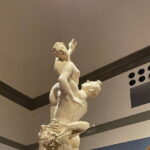
One of the most memorable visuals during the walk is the David copy in the Palazzo Vecchio area. This matters because Florence is full of original works and copies that still carry meaning. Seeing the David in this civic context helps you understand how art was used to reinforce ideals—beauty, strength, and cultural legitimacy—inside public space.
Near the end, you’ll be in the zone around Piazza della Signoria and the Uffizi complex. The tour end point is described as convenient for those heading into Uffizi. Even if you don’t plan to enter immediately, being close to that museum area is a practical win: you can decide later how much time you want for paintings versus streets.
If you’re also visiting other museums that day, use this as your anchor. The tour gives you a theme to carry with you: Medici ambition, Renaissance spectacle, and the way civic Florence shaped itself through art and architecture.
- The Best tour in Florence: Renaissance & Medici Tales – guided by a STORYTELLER
★ 5.0 · 12,316 reviews



How the 2-hour format actually feels on the street
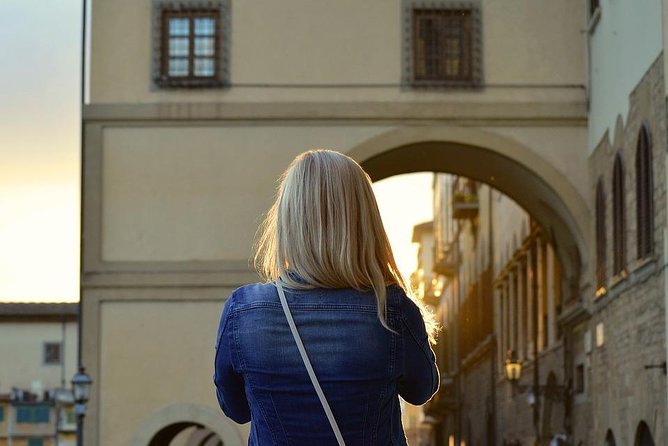
The tour runs for about 2 hours. With around 10 minutes at many stops (and a few shorter segments like the Dante museum spot), the pacing is built for orientation. You’ll get the major beats: Medici sites, Duomo complex landmarks, Dante context, and the Palazzo Vecchio / Signoria atmosphere.
This format is ideal if:
- You’re on a tight schedule and want to see top sites without a day-long commitment
- You want stories that connect buildings rather than treating each site as isolated
- You plan to return for deeper visits afterward
It’s less ideal if:
- You need long interior time at churches and museums
- You want a tour that pauses for lots of questions at each monument
- You’re sensitive to walking distances and standing around in crowds
The tour also lists a maximum of 30 travelers, which keeps things more human. People often mention guides like Deborah, Aurora, Alberto, and Manuel for making the experience feel personal and lively—exactly what you want in a short window.
Price, donations, and what your money is really buying
The tour price is listed at $3.62 per person, which sounds extremely low for a licensed guide walking you between major landmarks. In this setup, the experience notes that it’s made possible thanks to your donations at the end, and that the guide’s compensation comes from what you choose to give. Translation: the booked price is more like an entry into the experience, not the full cost of the guidance.
So how do you judge value? Look at what you’re getting:
- A licensed guide in English
- A concentrated route through major Renaissance and Medici connections
- Stops that include orientation around key monuments (Duomo complex, Palazzo Vecchio, Dante’s place)
- A structure that helps you decide what to revisit later
This is the kind of tour where your donation is part of the bargain. If your guide tells great stories and answers questions, the fair move is to tip generously. Several visitors specifically suggested that it’s worth compensating well—one review even pointed out at least €20 per person.
Also factor in admissions. The tour states that some stops are free and some list admission not included. For example, the Duomo area is marked as free, while several other stops note admission ticket not included. That means you’ll likely spend little on entry for this tour itself, but you should still plan for optional deeper visits afterward.
What to do after: turn the walk into a smart second half of your day
The tour ends in the Piazza della Signoria / Uffizi area, and that’s not a random choice. It sets you up to keep moving with a theme instead of wandering. After a walk like this, I’d do one of two things:
- Pick one interior you really care about (Duomo complex details, a museum entrance, or another landmark you found most relevant during the stories)
- Slow down in the square zones you’ve just learned about—Signoria and Palazzo Vecchio are public spaces you can revisit without needing a ticket
If you’re hungry afterward, guides often share practical food ideas in these settings. One review specifically mentioned restaurant recommendations and foods to try. You’ll be in a better position to follow those tips because you’ll know what neighborhood logic looks like around the sights.
Finally, keep your eyes open for details. After the Medici and Renaissance framework goes in, Florence starts looking different: coats of arms, public symbolism, and the way buildings try to influence your opinion of power.
Who should book this Medici and Renaissance walking tour
Book it if you want:
- A strong first-day Florence plan that reduces confusion
- A guide-led route with storytelling focused on the Medici family and Renaissance Florence
- An efficient way to see major icons plus a few contextual stops like Museo Casa di Dante
Skip it if you:
- Want a museum-heavy day with long timed-entry interior time
- Don’t enjoy standing and walking in dense central areas
- Are counting on admissions being included for every stop
Also keep weather in mind. The experience requires good weather, and if it’s canceled due to poor weather, it’s offered as a different date or a full refund.
Should you book The Best Tour in Florence: Renaissance and Medici Tales?
Yes, if you’re the kind of traveler who likes to understand what you’re seeing and then choose your next move with confidence. This is a short, well-planned walk that links major landmarks—San Lorenzo, the Medici palazzo, the Duomo complex, Dante, Piazza della Signoria, and the Palazzo Vecchio area—into one understandable Renaissance story.
If your time is limited, this tour is one of the easiest ways to get oriented and learn why Florence looks the way it does. Then you can spend your remaining hours going deeper exactly where your interests pull you next.
FAQ
Where does the tour start and where does it end?
The meeting point is Piazza di San Lorenzo, 35R, 50123 Firenze FI, Italy, and the tour ends near Piazza della Signoria. The endpoint is described as only indicative and can vary slightly within the area.
How long is the walking tour?
The duration is about 2 hours.
What language is the tour offered in?
The tour is offered in English.
Are entrance tickets included for the stops?
Some stops are marked as free (for example, the Duomo area), while others list admission ticket not included. You may need to pay for certain interiors separately if you want to enter.
Is there a maximum group size?
Yes. The tour has a maximum of 30 travelers.
How does the donation compensation work?
The experience says it’s made possible thanks to your donations, and at the end of the tour you decide the appropriate amount to compensate the guide. The guide’s compensation comes only from what you choose to donate.
You Might Also Enjoy

More Tour Reviews in Florence
- Tuscany Day Trip from Florence: Siena, San Gimignano, Pisa and Lunch at a Winery
★ 5.0 · 21,634 reviews - The Best tour in Florence: Renaissance & Medici Tales – guided by a STORYTELLER
★ 5.0 · 12,316 reviews