REVIEW · NAPLES
Herculaneum Small Group Tour and Ticket With an Archaeologist
Book on Viator →Operated by Askos Tours · Bookable on Viator
Herculaneum feels like a time capsule—and the guide turns it into a story. This small-group tour in Ercolano is led by a licensed archaeologist with strong site expertise, and you get skip-the-line entry plus headsets so you can actually follow along at a walking pace. The main drawback to plan for is simple: there’s a lot of standing and walking, with limited chances to sit.
If you want the highlights (big houses, baths, and daily life details) without spending your whole day figuring things out, this is a smart pick. The tour caps at 20 people, so it stays manageable, and the route hits the most memorable spots fast.
In This Review
- Key takeaways before you go
- What You’re Actually Paying For: Archaeologist Guide + Skip-the-Line Entry
- Meeting in Ercolano: Getting to Corso Resina 187 Without Stress
- Your 2-Hour Walk Through Herculaneum’s Best Stops
- House of the Deer: How archaeologists use details like clues
- La Terrazza di M. Nonio Balbo: Power, patronage, and public building work
- College of the Augustales: A meeting place tied to the Emperor’s cult
- Casa del Rilievo di Telefo: A house with private access to baths
- Partem Domus lignea – Casa del Tramezzo di Legno: The wooden partition that matters
- House of the Skeleton: Why the name came from human remains
- Central Thermae: Separate entrances for men and women
- House of the Black Salon: Carbonised traces at the grand entrance
- Casa Sannitica: A mix of layout and frescoed rooms
- Casa del Bel Cortile: A courtyard-and-stair layout that breaks expectations
- House of the Grand Portal: Frescoes, collonnati, and charred wooden traces
- Guide Quality Makes or Breaks This Tour
- Pacing, Comfort, and Who This Tour Suits Best
- Tickets, Timing, and What to Expect Inside
- Booking Verdict: Should You Book This Herculaneum Archaeologist Tour?
- FAQ
- FAQ
- How long is the Herculaneum small group tour with an archaeologist?
- What’s included in the price, and what isn’t?
- Is this tour skip-the-line?
- How many people are in the group?
- Where do I meet the guide?
- Can I get a full refund if I cancel?
Key takeaways before you go
- Archaeologist-led storytelling: You’ll hear how archaeologists read the site, not just dates and names.
- Headsets help you keep up: Guides make regular checks so everyone can hear.
- Skip-the-line ticket: You’re not trapped in queues when you could be looking at wall paintings.
- A tight 2-hour route: Each stop is short, which keeps momentum but means you won’t linger long.
- Packed stops through major spaces: Houses, baths, and public/ritual buildings all show up on one walk.
- Meet at the ticket office, end inside the ruins: You go straight into the experience instead of starting outside in limbo.
What You’re Actually Paying For: Archaeologist Guide + Skip-the-Line Entry
At $53.81 per person for about 2 hours, the value isn’t just the ticket. You’re paying for three practical upgrades that make Herculaneum easier and more meaningful:
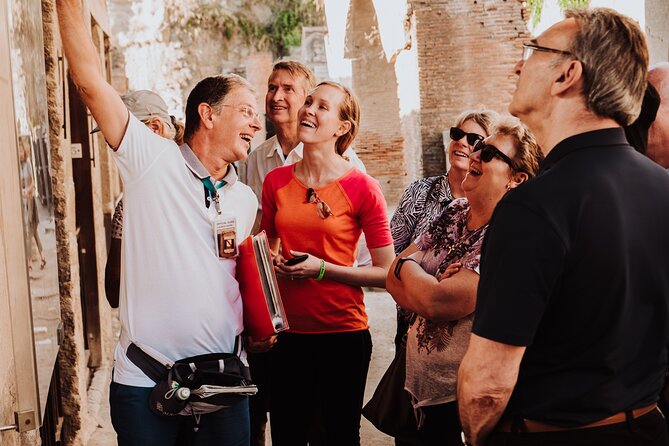
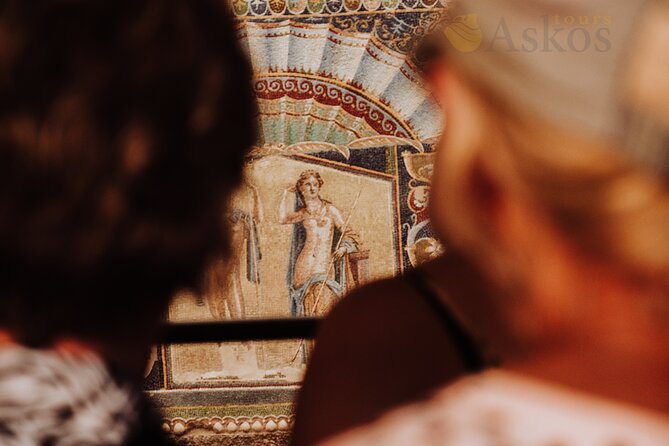
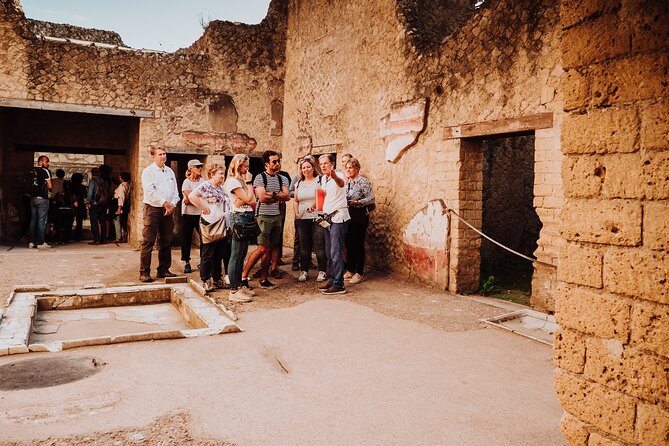
First, you get a licensed guide with archaeological training. That matters here because Herculaneum isn’t laid out like a simple museum. The walls, charred wood traces, and room layouts need explanation to click. I like that the tour uses the site’s physical details—floor levels, room purpose, and building features—to help you understand what daily life looked like.
Second, you get the skip-the-line entry approach. Herculaneum is compact, so time feels tight. When you cut waiting time, you spend more of those two hours looking at things that can’t be replaced later with photos.
Third, you get headsets. Even on a small group tour, ruins and crowds can make hearing tricky. Headsets help you follow the guide’s pace and keep your attention on what you’re standing next to.
A quick expectation check: this isn’t a sit-down lecture. It’s a walking route through key houses and baths, so you should be ready for standing and moving.
You can also read our reviews of more tours and experiences in Naples.


Meeting in Ercolano: Getting to Corso Resina 187 Without Stress
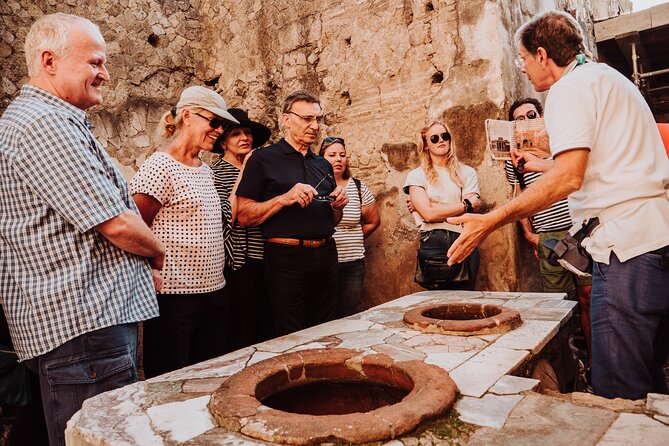
The meeting point is at the Ticket Office of the Herculaneum ruins area, specifically Corso Resina 187, 80056 Ercolano NA, Italy. The tour ends inside the ruins (so you don’t need to fight your way back through entrances afterward).
Getting there is pretty straightforward:
- By car: You can park close to the meeting area in via Pignalver, and it’s described as not guarded parking nearby.
- By train: Take the Circumvesuviana, get off at Corso Resina 1, then walk about 10 minutes.
Two small practical notes. If it’s your first time in this part of Naples, give yourself extra buffer time to find the ticket office. Also, since the tour operates in all weather conditions, dress for rain or shine and keep your phone accessible in a waterproof way.
Your 2-Hour Walk Through Herculaneum’s Best Stops
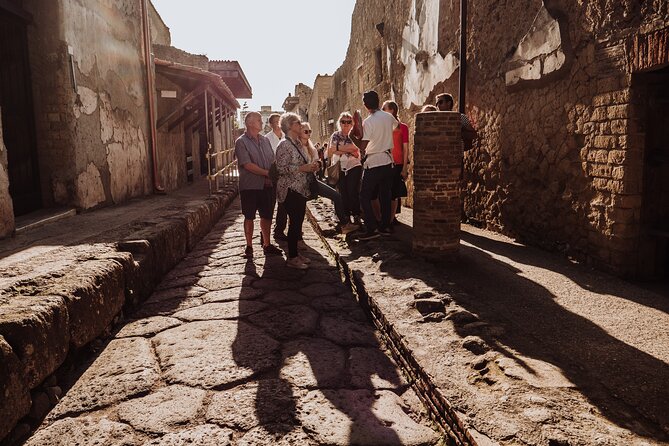
The tour runs for roughly two hours with a small group (maximum 20 travelers). Each major stop is brief—around 10 minutes—so you’ll move with purpose. Think of it as a “high-impact overview” where the archaeologist guide points out what your eyes might miss.
Here’s the route, stop by stop, and what makes each place worth your attention.
House of the Deer: How archaeologists use details like clues
You start at the House of the Deer, named for marble statues of stags/deer found in the peristyle (the central open area surrounded by columns). This is where the guide helps you practice the archaeologist’s way of looking: identify what’s decorative, what’s structural, and what that tells you about status and taste.
If you like seeing how a single object name can lead to bigger conclusions, this stop is a strong beginning.
La Terrazza di M. Nonio Balbo: Power, patronage, and public building work
Next is La Terrazza di M. Nonio Balbo. M. Nonius Balbus is treated as a major benefactor who restored and built public buildings. The long inscription on his funeral altar is part of what you’re meant to notice—because inscriptions are how ancient communities preserved a story about responsibility and reputation.
Even in 10 minutes, this stop gives you a handle on how influence worked in Roman towns.


College of the Augustales: A meeting place tied to the Emperor’s cult
Then you’ll stand in the College of the Augustales. This building is thought to be connected to the cult of Emperor Augustus, and possibly the headquarters for the Collegium Augustalium or even the local curia.
What I like about this stop is the shift from private houses to organized community worship and administration. It helps you see Herculaneum as a functioning social system, not just a tragic “buried city” headline.
Casa del Rilievo di Telefo: A house with private access to baths
At Casa del Rilievo di Telefo, the house may have belonged to an important benefactor such as Marcus Nonius Balbus. One detail that makes it unusual is its private access to the adjoining Suburban Thermae to the south.
This is the kind of architectural tidbit that sounds small until your guide explains what it implies about convenience, wealth, and everyday routines.
Partem Domus lignea – Casa del Tramezzo di Legno: The wooden partition that matters
A standout stop is Partem Domus lignea – Casa del Tramezzo di Legno, important because the elegant wooden partition remained. Even though the eruption-era damage was severe, certain traces can survive in ways that stone alone wouldn’t explain.
This is where the archaeologist guide’s job becomes clear: you’re not only seeing what’s left, you’re learning how to interpret it.
House of the Skeleton: Why the name came from human remains
Then comes the House of the Skeleton, named after the discovery of human remains in a second-floor room in 1831. The guide uses this to connect excavation discoveries to the lived reality of the city’s end—without turning it into drama.
It’s a sobering stop, and because it’s tightly framed by an archaeologist, it stays factual and respectful.
Central Thermae: Separate entrances for men and women
You also visit the Central Thermae, built around the beginning of the 1st century AD. Like many bath complexes of the time, it’s divided into men’s and women’s baths, each with separate entrances.
This is an excellent place for practical “how did people use the space?” thinking. Baths weren’t just hygiene—they were social time. Your guide’s explanation helps you picture the routine in a way that a quick sign-and-photo visit won’t.
House of the Black Salon: Carbonised traces at the grand entrance
Next is the House of the Black Salon, one of Herculaneum’s more luxurious mansions. The tour points out a monumental entrance that still retains carbonised remains of the doorposts and lintel.
This stop is visually memorable because the guide shows you what you’re looking at and why it’s significant. You’re seeing the ancient threshold, literally marked by the eruption aftermath.
Casa Sannitica: A mix of layout and frescoed rooms
Then you’ll reach Casa Sannitica, described as having an arrangement typical of the Samnites. You’ll see the splendid atrium skirted by a gallery with Ionic columns, and the rooms are decorated with frescoes.
If you want your Herculaneum visit to feel like “Roman art meets Roman architecture,” this stop delivers.
Casa del Bel Cortile: A courtyard-and-stair layout that breaks expectations
At Casa del Bel Cortile, you’re looking at one of the more original houses. Instead of an atrium, it has a courtyard with a stairway and a stone balcony. The guide uses this layout to show that “typical Roman home” isn’t one single design.
This is a good reminder: Herculaneum varied. People adapted space to their needs and status.
House of the Grand Portal: Frescoes, collonnati, and charred wooden traces
Finally, you end at House of the Grand Portal, a central domus with various environments, collonnati, frescoes, and areas marked by charred remains of wooden parts.
The “grand portal” idea ties the whole route together: private luxury, but also visible traces of how daily life changed—or stopped—very quickly.
Guide Quality Makes or Breaks This Tour
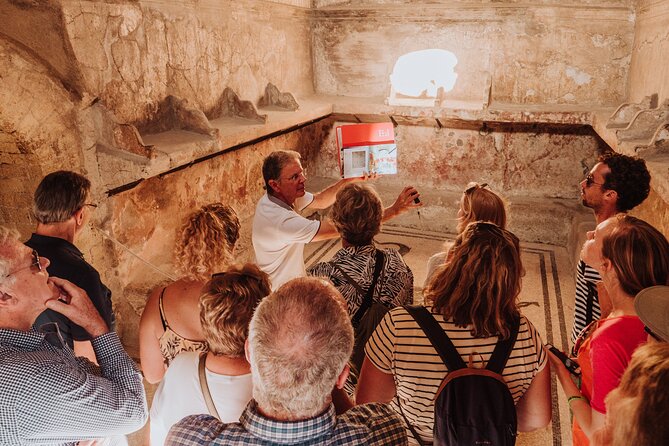
A tour like this can easily become a checklist. This one works because the archaeologist guide does the connecting work: what you’re seeing, what it likely meant, and how excavators interpret it.
In the reviews data you provided, several guides are praised for different strengths:
- Luciano Leone is highlighted for using visual reconstructions showing how buildings might have looked around 2,000 years ago. If you get him, it’s a major bonus because it turns flat remains into understandable scenes.
- Michaele/Michael is praised for weaving engineering and cultural history into stories about daily life and family routines.
- Julia is praised for exceptional English and clear authority.
- Paulo and Gennaro are praised for informative pacing and passion.
- Antonella is praised for making ancient history feel alive rather than dry.
- Luciano and others are praised for humor without losing focus, and for spotting the small details that turn ruins into evidence.
Even the practical details show up in the feedback. People mention guides checking hearing needs and headsets doing their job, which is important in a site where everyone is looking at different walls at once.
Pacing, Comfort, and Who This Tour Suits Best
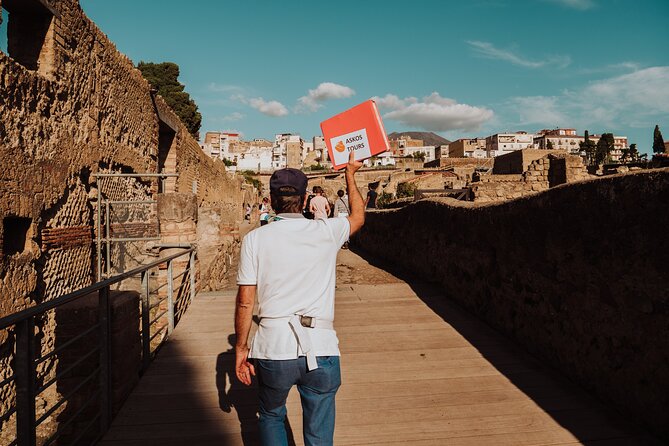
This tour is best for people who want structure. You’ll see the major areas quickly and get explanations while standing in the rooms. It’s also great if you’re visiting Herculaneum as a stop on a broader Naples/Amalfi week and want something focused.
Who should be careful?
- If you need lots of seating breaks, know that there’s limited opportunity to sit. The route involves standing and walking, and the pace can feel quick because each stop is about 10 minutes.
- If you prefer browsing at your own speed, consider pairing this with some extra time after the guided portion to linger. The guided portion is a “see the essentials with context” format.
A helpful mindset: arrive ready to look closely, then ask your guide questions. When the guide has archaeological training, your questions often get better answers than what you’d find by reading alone.
Tickets, Timing, and What to Expect Inside
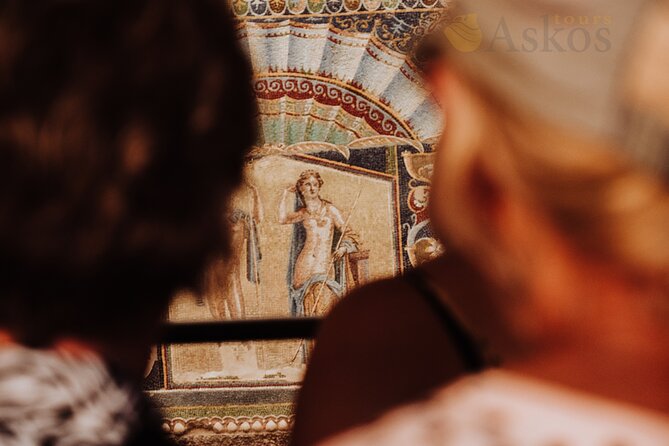
This is a guided walking tour that ends inside the Herculaneum ruins. Since the entry ticket is included, you’re not juggling separate purchases on the spot.
The headsets help keep the group moving, and because the group cap is 20, you’re less likely to lose the guide. I also like that the tour is described as operating in all weather conditions—so you’re not stuck chasing an alternate plan.
If it’s raining, you’ll still do the walk. That’s when sturdy shoes and a weather-ready layer matter most.
Booking Verdict: Should You Book This Herculaneum Archaeologist Tour?
I’d book it if:
- You want Herculaneum’s highlights in about two hours.
- You value an archaeologist guide who can explain how buildings and objects are interpreted.
- You’d rather pay for skip-the-line access and headsets than spend your time fighting queues or struggling to hear.
I’d think twice if:
- You strongly dislike walking/standing and need frequent seated breaks.
- You plan to spend most of your day wandering and photographing without a structured route.
If you’re in Naples and you only have a short window for Herculaneum, this is one of the most efficient ways to make the site make sense fast—without turning it into a rush-through.
FAQ
FAQ
How long is the Herculaneum small group tour with an archaeologist?
It lasts about 2 hours (approx.).
What’s included in the price, and what isn’t?
The price includes guidance, assistance, the Herculaneum entrance ticket, a small group format (max 20 per guide), a licensed archaeologist-background guide, and headsets. Meals and drinks are not included, and private transportation is also not included.
Is this tour skip-the-line?
Yes. It includes skip-the-line tickets, so you avoid waiting in long queues.
How many people are in the group?
The tour is limited to a maximum of 20 travelers.
Where do I meet the guide?
You meet at the Ticket Office of the Herculaneum ruins. The start location given is Corso Resina, 187, 80056 Ercolano NA, Italy, and the tour ends inside the ruins.
Can I get a full refund if I cancel?
Yes, you can cancel for free up to 24 hours in advance for a full refund. If you cancel less than 24 hours before the start time, the amount paid is not refunded.