REVIEW · POMPEII ARCHAEOLOGICAL SITE
Pompeii: Group Tour with an Archeologist Guide
Book on GetYourGuide →Operated by Tempio Travel Pompei Tickets · Bookable on GetYourGuide
Pompeii makes real ruins feel painfully alive. This 2-hour archaeologist-led group tour gets you past the worst waiting with skip-the-line entry and whisper headsets, so you can spend your time inside the site. The trade-off? It’s a high-density route in a busy footprint—great for seeing the major sights, but not for slow wandering or covering every street corner.
I like that the tour focuses on the western side of Pompeii, where the big landmarks and the most recognizable buildings sit close together. You’ll move through places tied to everyday life—markets and meeting spaces in the Forum, bathing culture at the baths, and the theatrical world of the theaters—then get context from a guide who knows how to connect the dots between what you see and what life used to look like.
One more practical note: Pompeii involves uneven ground and a lot of walking, so this tour is not suitable for people with mobility impairments. Wear comfortable shoes, skip bulky luggage, and go into it expecting heat and sun.
In This Review
- Key highlights worth packing for
- Pompeii in Two Hours: What This Archaeologist-Led Walk Covers
- Starting at Tempio Travel and Getting to Porta Marina Quickly
- West Pompeii Landmarks: Marina Gate, Basilica, and the Forum
- Frescoes, Baths, and the Lupanar: Everyday Pompeii
- Named Houses and the Garden of the Fugitives
- Plaster Casts and the Tragedy of 79 AD: Why This Tour Uses Them
- Group Tour Reality Check: Headsets, Heat, and Pace
- Where Your Tour Ends and How to Use the Rest of Your Day
- Price and Logistics: Is $50.11 Good Value?
- Should You Book This Pompeii Tour?
- FAQ
- How long is the Pompeii group tour with an archaeologist guide?
- Where do I meet the tour?
- Is skip-the-line entry included?
- What languages is the guide available in?
- Are tickets and guided tour included in the price?
- What should I bring for Pompeii?
- Is luggage allowed?
- Is it ever free to enter Pompeii?
- What’s the cancellation policy?
Key highlights worth packing for
- Skip-the-line tickets that save time when Pompeii is crowded
- Whisper headsets that keep you hearing your guide in a large group
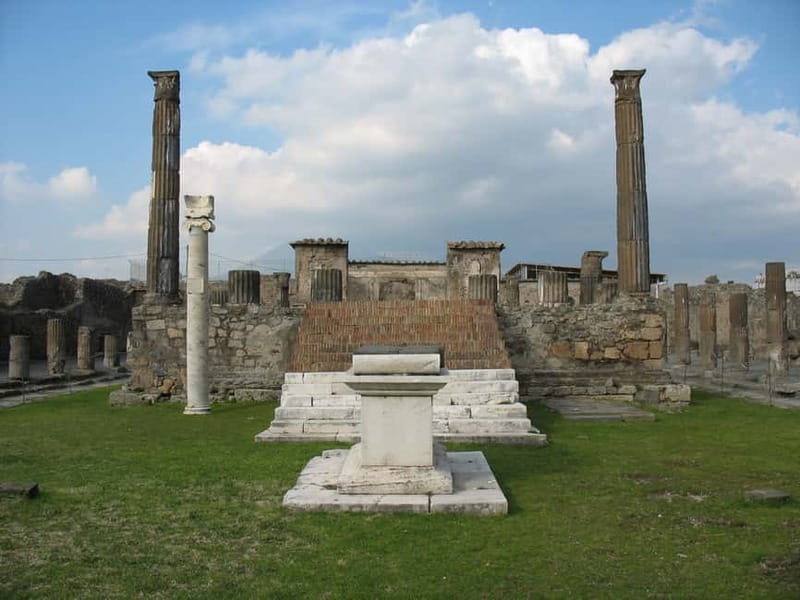
- Western Pompeii route focused on major buildings like the Forum and theaters
- Named houses and the Garden of the Fugitives for human stories, not just stone
- Plaster casts that bring the tragedy of 79 AD into sharper focus
Pompeii in Two Hours: What This Archaeologist-Led Walk Covers
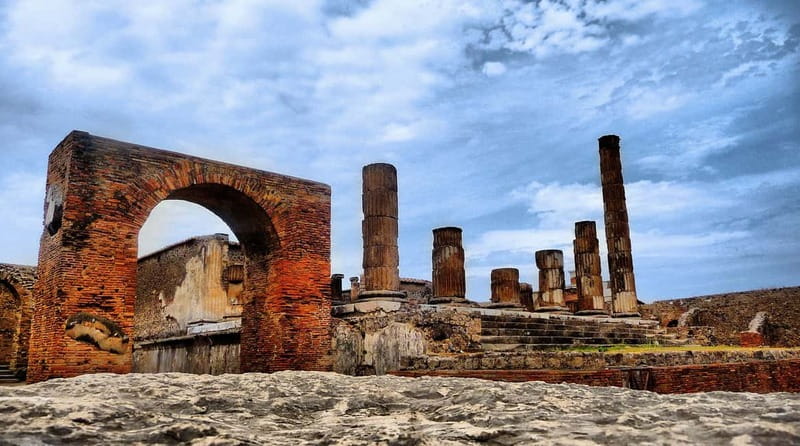
A lot of Pompeii visitors lose time by doing it “by vibes”—walking until they recognize something, then realizing they’ve skipped the most meaningful pieces. This tour is built to fix that. In about two hours, you’ll cover the western part of the city and hit the monuments that most help you understand how Pompeii functioned before Vesuvius buried it.
The route is designed for momentum. You’ll pass through areas like Porta Marina, then work toward the Basilica and Forum, which are key to understanding Roman civic life. After that, you’ll shift toward everyday spaces—baths, a look at the Lupanar (the well-known brothel site), and the long stretch of main street—before reaching the theaters, where public spectacle was a major form of entertainment.
The most memorable part, in my opinion, is how the tour adds “people” to the ruins. You’ll see plaster casts of Pompeii’s trapped citizens and visit named features such as the Garden of the Fugitives and notable houses including the House of the Tragic Poet and the House of the Golden Cupid. That combination helps the site stop being a list of postcard backdrops.
You can also read our reviews of more tours and experiences in Pompeii Archaeological Site.


Starting at Tempio Travel and Getting to Porta Marina Quickly
The meeting point is straightforward: meet at the Tempio Travel office on the 1st floor of the Vircumvesuviana train station. From there, the tour proceeds to Porta Marina—the western gateway area that helps funnel you into the heart of what you’ll see.
Two things make this part worth caring about. First, Pompeii’s entrance process can be slow, especially when tours and independent visitors overlap. Second, if you’ve only got a short window, cutting friction matters. This tour includes skip-the-line entrance tickets, which is the difference between starting your visit full of energy versus arriving already tired.
Also pay attention to the “small but real” rule: no luggage or large bags. If you’re arriving with a daypack only, you’re usually fine. If you’ve got bigger luggage, you’ll want to sort storage options before you go.
West Pompeii Landmarks: Marina Gate, Basilica, and the Forum
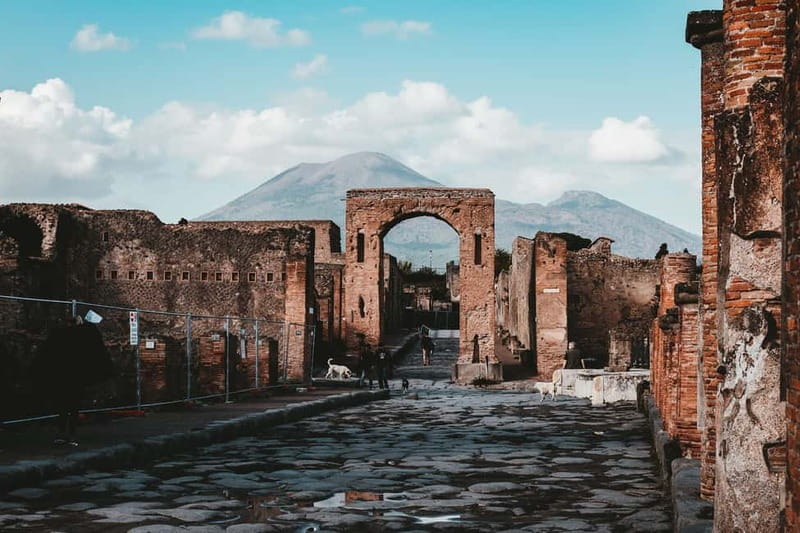
The tour’s early stop is Porta Marina. It’s not just a pretty gate—it’s a way to understand Pompeii as a city connected to movement and access. Once you’re inside, the emphasis shifts quickly to major civic and public spaces.
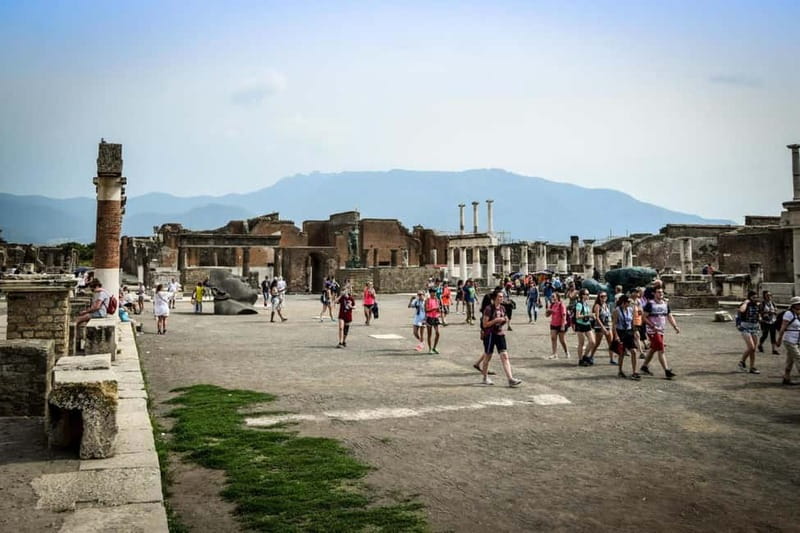
From there, you’ll see the Basilica and the Forum, two areas that help you picture how Romans organized public life. The Forum is where politics, commerce, and community routines would have collided. The Basilica sits nearby in function and symbolism, and seeing it in context makes it easier to understand why these buildings mattered beyond their architectural footprint.
If you care about “how a city worked,” this is where the guide’s role becomes most valuable. You’re not just looking at worn stone—you’re being pointed to the logic of the layout: what people likely did here, why certain buildings sat where they did, and how the spaces connected.
A small drawback: because the route is efficient, you won’t sit long in any one spot. If you like museum-style pacing—stop, read, sit, absorb—this tour may feel a bit quick early on. But if you’re here for a best-of overview, it fits the bill.
Frescoes, Baths, and the Lupanar: Everyday Pompeii
After the civic core, the tour leans into daily life. This is where Pompeii stops feeling like “history you read” and starts feeling like “a place with routines.”
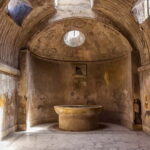
You’ll visit the baths, which are central to understanding Roman hygiene and social life. Even when the remains look incomplete, the function comes through when your guide points out how the spaces were used and how the bathing culture fit into a typical day.
Then there’s the Lupanar, Pompeii’s most famous name attached to a brothel. It’s not included to shock you; it’s included because it shows how economic and social life worked, even in a tragic end-of-days setting. Seeing it through a guide’s explanation also helps you avoid the common trap: treating it like just a scandal site rather than a piece of how Pompeii’s society functioned.
One more standout: frescoes. The tour highlights frescoes of Pompeii’s famous archaeological areas. Fresco fragments and painted spaces are often what makes people slow down, even when the tour doesn’t. In real terms, it’s a reminder that the city you’re walking through had color, taste, and personality—long before the ash.
Named Houses and the Garden of the Fugitives
This is the part of the tour where you get more than architecture—you get story.
You’ll visit the Garden of the Fugitives, a named area tied to Pompeii’s tragedy. It’s one of those places where your brain wants to rush forward, but the guide’s job is to anchor what you’re seeing in the human reality of 79 AD. Even with just ruins and casts, the experience tends to land emotionally, especially once you move from public spaces into areas associated with private life.
Then you’ll step into named houses such as the House of the Tragic Poet and the House of the Golden Cupid. “Named house” can sound like a marketing label, but it’s actually useful. Names give you a handle to remember what you saw: you’re not just wandering through walls, you’re visiting a specific household with specific artistic and spatial cues.
If you’re the kind of person who likes to make a mental map, the guided approach helps. The named houses give you reference points that make it easier to keep track of what’s where—so when you walk away, you don’t feel like you saw “random parts.”





Plaster Casts and the Tragedy of 79 AD: Why This Tour Uses Them
Plaster casts are not just an add-on. They’re the emotional “bridge” that helps the ruins stop being abstract.
During the tour, you’ll see casts of Pompeii’s tragic citizens. This is where a guide’s explanations matter a lot. Without context, you can look at the forms and still miss why they were made, what they represent, and how people moved through those final moments.
This is also one reason why I think the tour works better than going totally on your own with a basic map. Pompeii is enormous and the site can feel chaotic if you don’t know what you’re looking for. A good guide keeps you from getting lost in the “cool walls” category and nudges you toward the bigger picture.
You might also benefit from the guide’s way of describing the city in a simple, story-first format. Multiple guides tied to this service have been praised for pacing, humor, and making details easy to follow—names that show up include Ernaldo, Alfonso, Giuseppe, Lena, Laura, and Antonio. You can’t count on which guide you’ll get, but it’s a good sign that the program emphasizes clear communication.
Group Tour Reality Check: Headsets, Heat, and Pace
Let’s talk about the part that affects your comfort: being in a large group inside a site that doesn’t slow down for anyone.
This tour includes whisper headsets, which is a big deal at Pompeii scale. With headsets, you’re less dependent on hearing your guide from across a crowd. Still, you’ll feel the group dynamics—pauses for photos, quick regrouping, and the occasional moment where you have to keep moving while others catch up.
Pace-wise, the tour is designed around the reality of Pompeii being hot. One of the most consistent takeaways from guide-led tours like this is that two hours is often the right duration: long enough to see the key areas, short enough to avoid turning the day into a slog. Bring a plan for sun and hydration. If you show up midday, consider an umbrella or hat; some people buy shade gear right outside the entrance area.
And do be aware: the tour is not suitable for mobility impairments. The ground is uneven, and the route includes walking between major areas. If that describes you, you’ll likely be happier with an alternative plan that offers more accessible pacing.
Where Your Tour Ends and How to Use the Rest of Your Day

The tour finishes back at the meeting point. But the experience doesn’t end with the last photo.
At the end, your guide provides suggestions for how to spend the rest of the day in the modern city of Pompeii and may point you toward the Sanctuary Dedicated to Our Lady of the Holy Rosary, which is just a few steps from the archaeological site. That kind of recommendation is practical: it helps you transition from ruins to real-day sightseeing without guessing.
If you’re building a half-day around Pompeii, this tour can be your “anchor block.” Afterward, you can decide whether you want to re-enter and explore a bit more on your own—especially if you’ve already learned the layout and what stands out.
Price and Logistics: Is $50.11 Good Value?

At $50.11 per person, this is priced like a time-saving, guide-led Pompeii plan—not a budget DIY. The value comes from what’s included:
- Two-hour professional guided tour
- Skip-the-line entrance tickets
- Whisper headsets (huge for group audio)
- Free parking if open and available
When you compare this to doing Pompeii solo, the hidden cost isn’t just ticket time—it’s uncertainty. Without a guide, you can spend your limited time chasing the wrong areas, or worse, skipping the connections that make Pompeii click. If your goal is to see the major buildings—Porta Marina, Basilica, Forum, baths, Lupanar, main street, theaters—and also get story through plaster casts and named houses, the guide is what turns it into something you understand.
It’s also a good option if you’re on a tight schedule, like a cruise day. Several people specifically mention that a guided approach helps when time is limited.
The main “value risk” is expectation. If you think you’ll get a complete Pompeii survey in two hours, you’ll be disappointed. This is a best-of route. If that sounds like what you want, $50.11 is a reasonable trade for clarity and speed.
Should You Book This Pompeii Tour?
Book it if you want a guided, efficient Pompeii overview that hits the most meaningful parts of the western site and gives you context fast. It’s also a smart pick if you’re sensitive to crowds and prefer skip-the-line access plus headsets that keep you connected to the guide.
Don’t book it if you need slow, accessible pacing, or if you plan to spend hours reading every sign at your own rhythm. Pompeii deserves that kind of time too—but this experience is built for a timed route.
If you’re visiting with the right expectations, this is exactly the kind of Pompeii tour that helps the ruins feel human: you’ll see the landmarks, you’ll learn the why, and you’ll leave with a mental map of a city you can finally picture.
FAQ
How long is the Pompeii group tour with an archaeologist guide?
The tour runs for 2 hours. Starting times vary, so you’ll need to check availability for your preferred slot.
Where do I meet the tour?
Meet at the Tempio Travel office located on the 1st floor of the Vircumvesuviana train station. The tour ends back at the same meeting point.
Is skip-the-line entry included?
Yes. The tour includes skip-the-line entrance tickets, so you don’t have to queue with standard entry lines.
What languages is the guide available in?
The live tour guide is available in English and Italian.
Are tickets and guided tour included in the price?
Yes. The experience includes a 2-hour guided tour and skip-the-line entrance tickets.
What should I bring for Pompeii?
Bring a passport or ID card and wear comfortable shoes.
Is luggage allowed?
No. Luggage or large bags are not allowed.
Is it ever free to enter Pompeii?
Yes. On the first Sunday of each month, entrance is free, but tickets can’t be reserved ahead of time, so entry isn’t guaranteed.
What’s the cancellation policy?
You can cancel up to 24 hours in advance for a full refund.