Lecce looks best when someone points things out. This is a compact, 2-hour introduction that strings together Baroque façades and Roman archaeology in the historic center, with a lively local guide like Lorenzo keeping the story moving. You get a smooth route that starts in the grand Piazza del Duomo and ends at the Basilica di Santa Croce area, so you’re not bouncing around the city.
Two things I really like: first, Lorenzo’s style. He’s animated, funny in a quirky way, and he explains the art and architecture like a person who grew up with it, not a lecturer reading notes. Second, the tour includes a practical break with coffee and/or tea, and in the middle you may even pause for cake and a local-style iced almond coffee at 00 Doppiozero.
One thing to consider: most of what you’ll see is from the outside. The stops are marked as outside views, and entrance tickets aren’t included, so if you’re hoping for interior church time, plan for separate tickets.
In This Review
- Key highlights you’ll care about
- Why this Lecce walk hits the sweet spot
- Piazza del Duomo: Zimbalo’s bell tower and a cathedral façade that talks
- Teatro Romano di Lecce: seeing Augustan-era seating from street level
- Piazza Sant’Oronzo: the city’s heart with Roman bones underneath
- Basilica di Santa Croce: Lepanto carved into a Baroque façade
- Coffee and/or tea break: a real reset, not filler
- Pace, group size, and what to bring for a smooth walk
- Price and value: what $35.09 gets you in the real world
- Who should book this Lecce tour (and who might skip)
- Should you book Discovering Lecce?
- FAQ
- How long is the Discovering Lecce tour?
- Where does the tour start and end?
- Is the tour offered in English?
- Do I need to buy entrance tickets for churches and museums?
- What’s included in the price?
- Is there a mobile ticket?
- What’s the group size?
- What happens if the weather is bad?
- Can I cancel and get a full refund?
Key highlights you’ll care about
- Outside-first route: major monuments up close without hunting museum hours
- Lorenzo the local storyteller: humour plus clear art and city-history explanations
- Piazza del Duomo details: Sant’Oronzo, the bell tower by Giuseppe Zimbalo, and rich façade ornamentation
- Roman theater context: Augustan-age theater history tied to 19th-century excavation
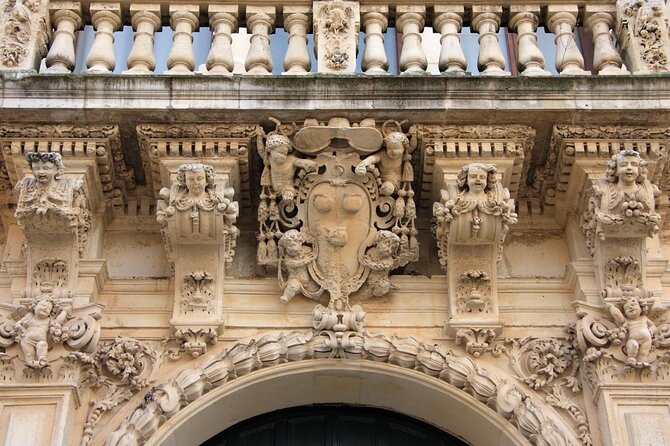
- Santa Croce façade meaning: Lepanto symbolism explained while you stand in front of it
- Included coffee or tea: a real pause, not just a photo stop
Why this Lecce walk hits the sweet spot
This tour is built for getting your bearings fast. You’ll walk through a tight loop of Lecce’s most recognizable public spaces, and each stop comes with a theme: Baroque spectacle, Roman survival, and how the city layered one era over another.
The pacing matters. At about two hours with short time windows at each stop, it works if you want context without burning your entire morning (or afternoon) trying to line up tickets and museum visits. And with a maximum group size of 15, you’re more likely to hear the guide clearly and get answers if you ask.
The “outside” focus also changes what the experience feels like. Instead of switching into exhibit mode, you stay in city mode—looking up at façades, tracing architectural details, and reading the symbolism carved into stone.
You can also read our reviews of more tours and experiences in Lecce.

Piazza del Duomo: Zimbalo’s bell tower and a cathedral façade that talks
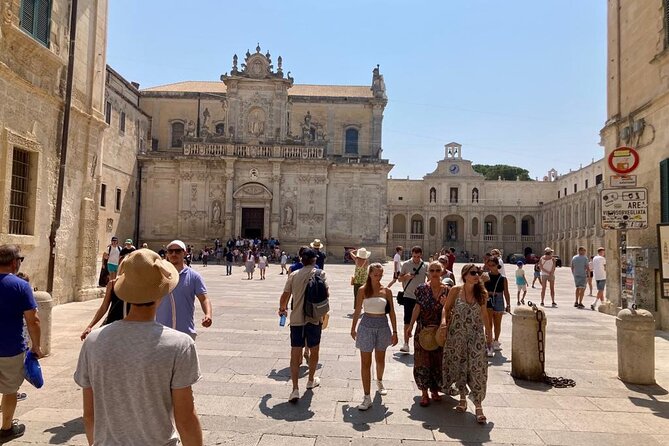
Your route opens in Piazza del Duomo, and it’s easy to see why guides love this start. The square feels like a stage: the buildings frame the view before you even get to the main monuments, and the Baroque transformation is basically the point.
On the left, you’ll spot the late 17th-century bell tower built by Giuseppe Zimbalo, topped with a majolica dome. That majolica detail isn’t just decoration; it’s the kind of visual signature that helps you recognize the period once you know what you’re looking for.
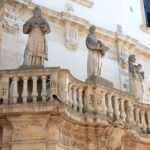
In the center, the Cathedral’s façade is described with a lot of specific imagery: a balustrade, the statue of the city protector Sant’Oronzo, and ornament that includes flowers, angels, and lanceolate points. Standing there with the guide’s explanations helps these details stop being “random baroque clutter” and start making sense as a whole design system.
You also get architectural side-glances that many visitors miss. The Episcopio (the bishop’s palace) has a portico in propylaea, which the tour calls out as an admirable work by Emanuele Manieri. Nearby, the Palazzo del Seminario shows rustication and an eclectic Baroque approach attributed to Giuseppe Cino.
Practical tip: don’t rush your eyes. Spend a minute scanning from top to bottom—tower, domes, then façade symbols—so you absorb more than just the biggest landmark.
Teatro Romano di Lecce: seeing Augustan-era seating from street level
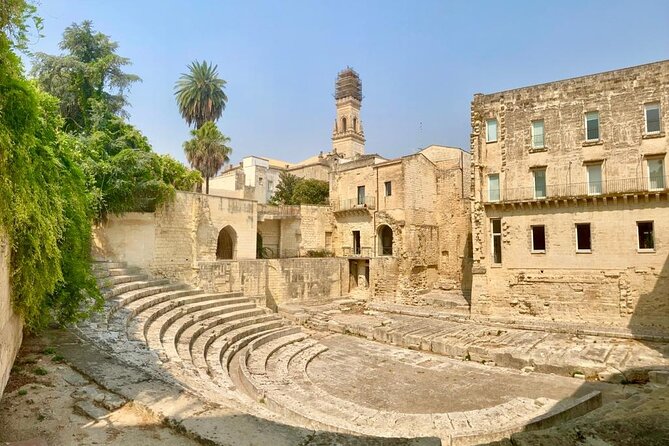
The next stop takes you from Baroque drama to Roman engineering. The Teatro Romano di Lecce is an ancient theater dating to the Augustan age, and the tour highlights a key story: over the centuries it was buried, then revealed through excavation in the 19th century.
What you gain here is context for why the site looks the way it does today. The theater isn’t presented as an isolated ruin; it’s framed by Baroque gardens and built-up spaces that connect the open terraces to the orchestra area and the proscenium.
Even if you don’t enter anything, you can still read the layout. You’re guided to see the view and understand how the theater would have worked as a public stage long before the Baroque buildings around it shaped what you see now.
Possible drawback: if you’re the kind of traveler who always wants interiors and full museum access, you might feel this stop is more about orientation than “deep excavation time.” The good news is that the story is still strong, and the time window is short enough that it won’t derail your day.
Piazza Sant’Oronzo: the city’s heart with Roman bones underneath
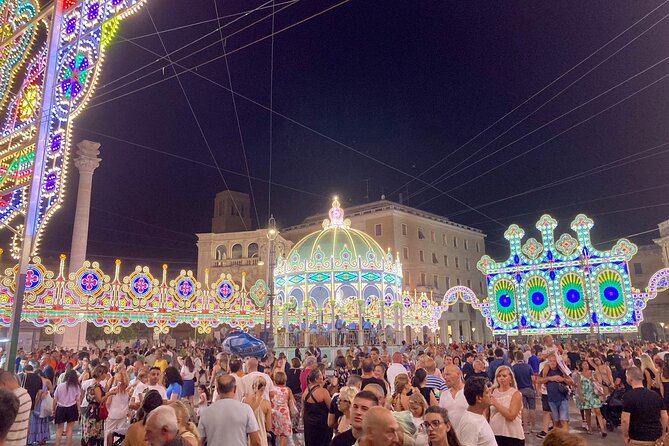
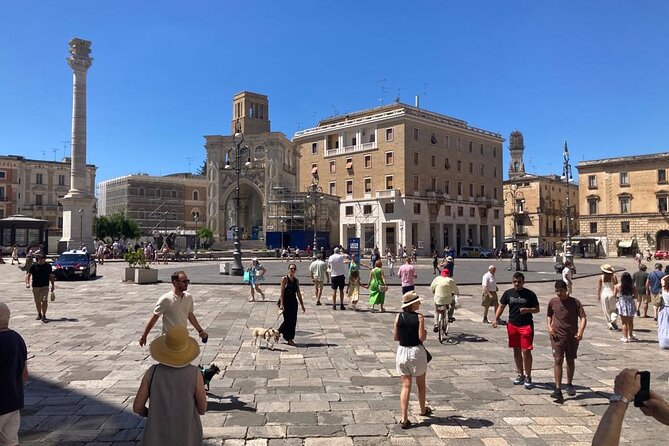
Piazza Sant’Oronzo is the city center in practice, and the tour treats it like a living layer-cake. The guide points out that the ancient Piazza dei Mercadanti of the 1700s still carries signs of the city’s past, including influence linked to the Maritime Republic of Venice.
As you stand in the square, you’re not just looking at one monument. You’re looking at a mix: the Palazzo del Sedile, which served as a seat for exhibitions and city assemblies, and the adjoining church of Saint Mark. The names matter here because they anchor you to civic life, not only religious life.
Another feature the tour makes impossible to miss is the Roman amphitheater beside the square. It’s only half revealed, and the tour frames it as a kind of gem set among Baroque, Art Nouveau, Rationalist, and Venetian palaces. That line alone explains what you’ll actually feel: the city didn’t freeze in one era. It kept building, and it kept using what was already there.
Practical tip: take one slow loop around the square if your group has a break. Even when you stay with the guide, walking a small semicircle helps you see how buildings “hold” the space.
Basilica di Santa Croce: Lepanto carved into a Baroque façade
The last major stop brings you to Basilica di Santa Croce, and you’ll approach it with a story goal. The façade is dedicated to the Battle of Lepanto, and the tour describes it as an ideal triumph of the Christian and Western European world.
That framing changes how you look at the outside surfaces. Instead of treating the façade like ornament overload, you’re encouraged to connect the details to a political and religious message the city wanted to project. The tour notes sumptuous decorations and many symbols that continue to fascinate and raise spirituality even today.
This is a stop where timing helps. You get about 20 minutes outside, which is enough to absorb the overall façade composition and then pick a few key details to focus on with the guide’s explanation. If you try to photograph everything, you’ll walk away with images but not much meaning. If you choose two or three sections to concentrate on, the stop sticks.
If you want more than the exterior, you’ll need to handle that separately. Church entrance tickets aren’t included, so treat the outside view as the core of the experience.


Coffee and/or tea break: a real reset, not filler
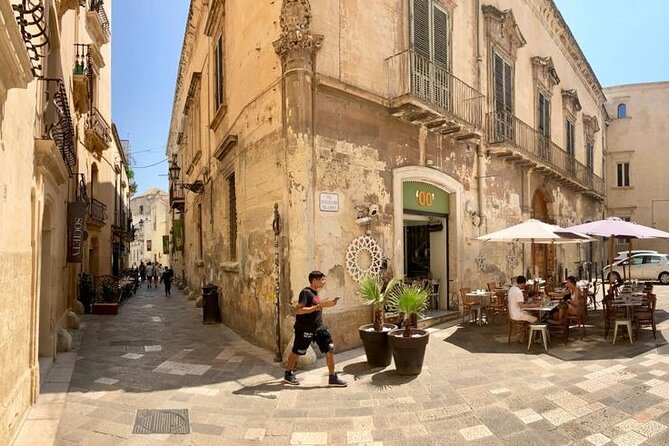
The tour includes coffee and/or tea, and that matters more than it sounds when you’re doing a walking route. It’s a chance to slow down, regroup, and let the architectural notes settle in.
One review-style detail that’s especially useful is the mention of an added stop for cake and an iced sweet almond coffee known as Caffé Leccese at 00 Doppiozero. Even if you end up choosing tea or a simpler pastry, this kind of pause is the moment when the tour becomes comfortable.
How to use it well:
- Ask Lorenzo for one or two quick recommendations for the rest of your day.
- If you’re tempted to sprint ahead for photos, wait until after the break so you don’t lose the thread of the guide’s explanations.
Pace, group size, and what to bring for a smooth walk
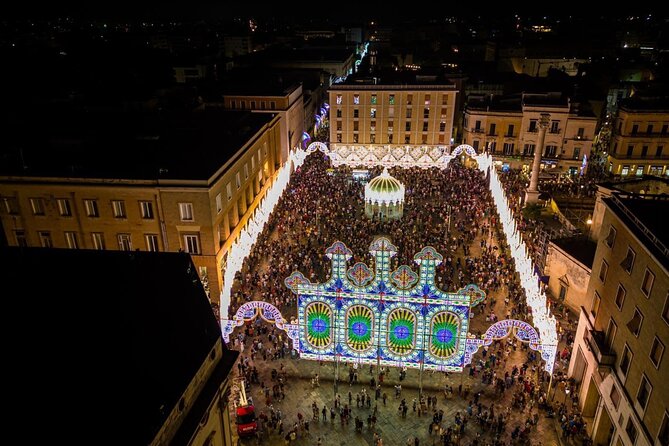
This is an easy-paced walking tour designed for most travelers. With a maximum of 15 people, it stays small enough for interaction, and the guide has time to speak to the group rather than racing through.
It lasts about two hours, and the stops are staggered in short chunks: around 20 minutes at Piazza del Duomo, 15 minutes at Teatro Romano di Lecce, 20 minutes at Piazza Sant’Oronzo, and about 20 minutes at Basilica di Santa Croce. That makes it a solid fit if you also want to wander independently afterward.
Weather is a real factor here. The experience requires good weather, and if it’s canceled due to poor weather, you’ll be offered a different date or a full refund. I’d treat this as a walking tour, so plan clothing for sun or sudden rain.
What to bring:
- Comfortable shoes for uneven old-street walking
- A light layer, especially if you’re traveling in shoulder seasons
- Your phone for the mobile ticket
Price and value: what $35.09 gets you in the real world
At $35.09 per person for an approximately two-hour tour, this is priced like a focused city-intro, not a long museum marathon. The big value piece is what’s included: the guided tour plus coffee and/or tea.
The not-included part is also important. Entrance tickets to churches and museums are not included, and the itinerary is mostly outside views. That’s not a bad thing—it simply tells you what kind of experience you’re buying. You’re paying for interpretation and route efficiency, not for paying into multiple ticketed interiors.
If you want a quick mental map of Lecce’s Baroque and Roman layers, you’ll likely feel this is money well spent. If you plan to spend most of your time inside churches and museum rooms, you’ll need extra ticket purchases on top.
One more value angle: the guide. Lorenzo stands out in the reviews for being animated, funny, and passionate, with strong local insight and a background in art and history. A great guide turns stone façades into something you can read, which is the whole point of a short introduction.
Who should book this Lecce tour (and who might skip)
Book this if:
- You want a guided introduction to Lecce’s most important central sites in about two hours
- You like walking tours with clear explanations and a fun delivery
- You enjoy Baroque architecture and want to understand symbols, not just admire them
Skip it or consider alternatives if:
- You’re mainly interested in museum interiors and long ticketed visits, because entrance tickets aren’t included and the visits are outside
- You only have time for one stop and you’re likely to rush anyway; this works best as a connected route
Also, if you like learning from a local voice, this is a strong match. The reviews highlight that Lorenzo is a Lecce native with excellent English and a knack for making the city story feel personal, even when you’re standing in front of something very formal.
Should you book Discovering Lecce?
Yes, if you want a practical, high-impact introduction to Lecce’s center without turning your trip into a ticketing project. The outside-first approach, short stop times, and included coffee make it feel light and doable, even on a busy travel day.
I’d especially book it if you’re the type who wants the “why” behind what you’re seeing—Sant’Oronzo statue placement, Lepanto symbolism, Augustan-era Roman theater context, and how Venice-era influences still echo in civic spaces. With Lorenzo guiding, those details don’t stay as facts. They become a way to see the city.
If you’re unsure, think of it this way: this tour helps you understand what you’re about to explore next. Even after the two hours are done, you’ll likely find yourself looking up at façades and noticing architectural clues you would’ve missed on your own.
FAQ
How long is the Discovering Lecce tour?
It runs for about 2 hours.
Where does the tour start and end?
It starts at Accademia di Belle Arti di Lecce, Via Giuseppe Libertini, 3, Lecce, and it ends at Basilica di Santa Croce, Via Umberto I, 1, Lecce.
Is the tour offered in English?
Yes, it is offered in English.
Do I need to buy entrance tickets for churches and museums?
No. Entrance tickets to churches and museums are not included, and the stops are listed as outside views.
What’s included in the price?
Coffee and/or tea and the guided tour are included.
Is there a mobile ticket?
Yes, you’ll receive a mobile ticket.
What’s the group size?
The tour has a maximum of 15 travelers.
What happens if the weather is bad?
The experience requires good weather. If it’s canceled due to poor weather, you’ll be offered a different date or a full refund.
Can I cancel and get a full refund?
Free cancellation is available up to 24 hours before the experience’s start time for a full refund.