REVIEW · LECCE
Lecce Historical Attractions Tour in Group (2h)
Book on Viator →Operated by Velo Service Lecce · Bookable on Viator
Two hours, zero confusion. This bike-forward tour is a smart way to see Lecce’s baroque façades and Roman leftovers in one compact loop with English narration.
I really like that it keeps the pace friendly: short stops for photos, then you’re rolling again before you feel tired or lost.
I love the practical setup: you get a bicycle and a helmet, plus light refreshment and a small local tasting during the ride. I also like the human touch—English-speaking guides such as Davide, Luna, Flore, and Cary bring the details to life, and the operation can run in multiple languages at once.
One thing to consider: church entrances aren’t included, so expect extra tickets if you want to go inside more than a quick exterior look. Also, the meeting spot at Velo Service can be a little tricky to spot at first, so arrive a few minutes early.
In This Review
- Key highlights worth planning for
- Why Lecce works so well on a 2-hour loop
- Price and what you actually get for $56.84
- Where you meet Velo Service Lecce (and how to avoid a mini scramble)
- The overall route: how the 2 hours “feels” in motion
- Stop 1: Piazza del Duomo—begin in Lecce’s grandest open space
- Stop 2: Cattedrale Maria Santissima Assunta e S.Oronzo—why the facade tells time
- Stop 3: Obelisco—bas-reliefs and the scars of old conflicts
- Stop 4: Porta Napoli—Lecce’s monumental entry gate
- Stop 5: Basilica di Santa Croce—the Lecce Baroque facade you’ll want to revisit
- Stop 6: Piazza Sant’Oronzo—an almost science-project tall column
- Stop 7: Anfiteatro Romano—Augustan-age remains in the center
- Stop 8: Chiesa di Santa Chiara—quick exterior look, good for future exploring
- Stop 9: Teatro Romano di Lecce—another Roman layer, shorter stop
- Riding comfort: helmets, mixed mobility, and the “everyone fits” approach
- Photo stops and pacing: how to make the most of 5–15 minutes
- Food and refreshment: the included tasting break actually matters
- Weather, heat, and keeping the day comfortable
- Who this tour is best for
- Should you book this Lecce Historical Attractions Tour?
Key highlights worth planning for
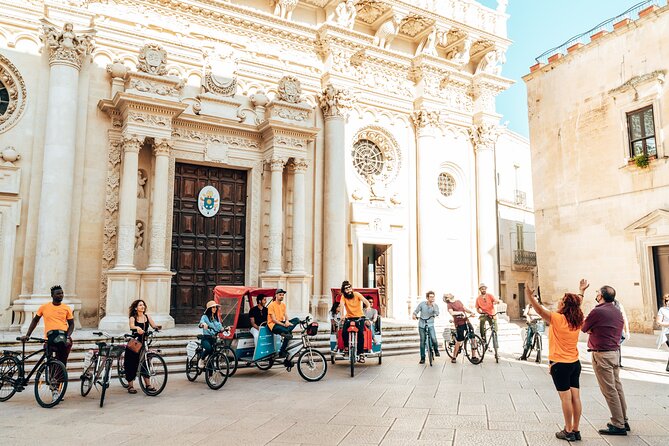
- Bike + rickshaw options: the tour is built to move different mobility levels through the same route
- Baroque facade coaching: you’ll get pointed explanations so carvings actually make sense
- Roman stops in the center: Augustan-era amphitheater and theater are reachable without transit
- Local tasting included: a small snack break with regional flavors (often pastry + coffee)
- Short, efficient timing: most stops are 5–15 minutes, great for an orientation day
- English available with flexibility: guides work in English, and the tour can run in two languages
Why Lecce works so well on a 2-hour loop
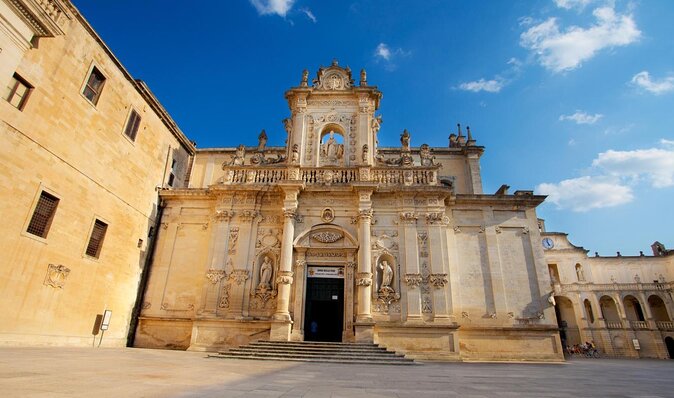
Lecce’s historic center is dense but walkable, which makes it a great match for a short guided loop. A bike tour lets you cover more ground without exhausting yourself on day one. The timing is also forgiving: the route is built around quick “look, learn, photo” stops rather than long museum-style sessions.
This is the kind of tour that helps you get your bearings fast. Once you’ve seen where the big squares and monuments sit, your later self-guided wandering feels easier. You’ll also notice how Lecce tells its story in layers: medieval structure, Baroque decoration, and then Roman architecture still hanging around in the middle of town.
You can also read our reviews of more tours and experiences in Lecce.
Price and what you actually get for $56.84
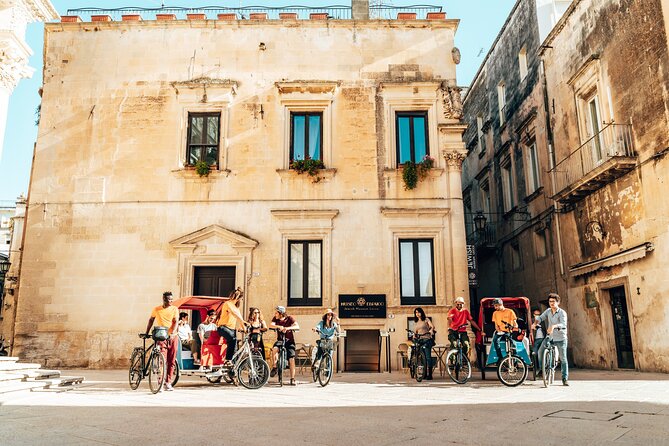
At $56.84 per person for about two hours, you’re paying for more than access to monuments—you’re paying for guidance, movement, and included food. The tour includes a professional guide, a bicycle, a helmet, and a light refreshment plus a snacks tasting of a local product. That matters because it removes the “where do we eat and what do we skip?” stress.
You’re also getting a small-group experience. The operator notes a small group size (max 20), and it also lists a maximum of 10 travelers in the additional details. Either way, you’re not stuck in a giant crowd where you can’t hear or maneuver for photos.
The main cost mismatch to watch: entrance fees to churches are not included. Many of the stops are exterior-focused, so you may be fine with the look-from-outside experience. If you want extra interior time later, plan for separate tickets.
Where you meet Velo Service Lecce (and how to avoid a mini scramble)
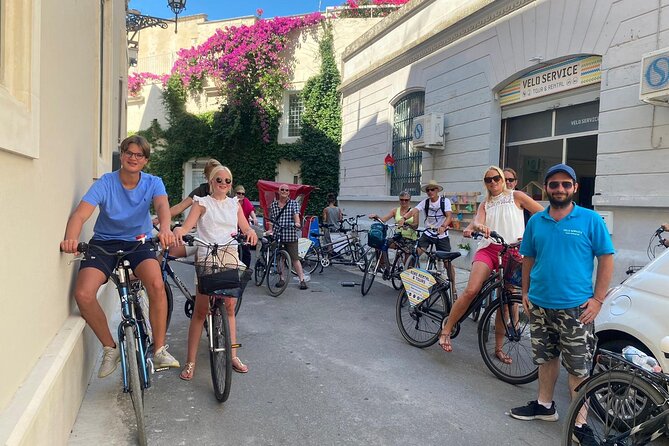
The tour meets at Velo Service Lecce, Vico de Argenteris 16a, Lecce and ends back at the same place. That “return to start” format is ideal when you want the rest of the day free—no hunting for a different drop-off.
Parking advice is provided by the operator, with a suggested list near the office and historic center. Since one rider found the meeting point hard to spot, I’d treat this like any good first-day orientation: arrive early, scan the immediate area, and use the provided map link on your phone.
Tip: if you’re traveling with multiple people, coordinate who has the mobile ticket ready. The tour uses a mobile ticket, so it’s one less thing to sort once you’re gathered.
The overall route: how the 2 hours “feels” in motion
The day moves in a simple rhythm. You start in a major square, then you cycle from monument to monument with a series of short stops: typically about 10 minutes each, with a couple of longer looks at the most decorated church façades.
That format fits people who want highlights without turning the day into an endurance test. It also means the guide’s job is mostly interpretation: pointing out what you’re seeing, why it matters, and where to look for specific details.
You’ll finish back at the meeting point, ready to go deeper on whatever caught your eye—maybe the baroque carvings, maybe the Roman layers, or maybe the food stop that’s part of the included tasting.
Stop 1: Piazza del Duomo—begin in Lecce’s grandest open space
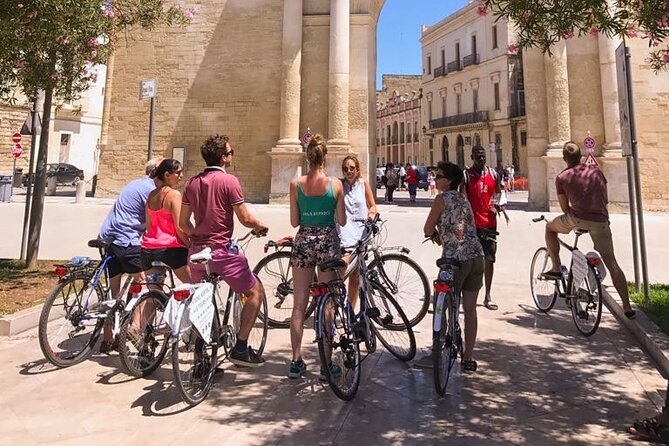
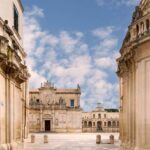
You start in Piazza del Duomo, reached by crossing the narrow, characteristic streets of Lecce’s historic center. The payoff here is that you begin with scale. Instead of easing into the city quietly, you open with a major square, which helps your later sightseeing make sense.
This stop is about 10 minutes, and admission is free. Translation: you can see the setting, take your first photos, and let the guide point out which directions the route will cover next.


Stop 2: Cattedrale Maria Santissima Assunta e S.Oronzo—why the facade tells time
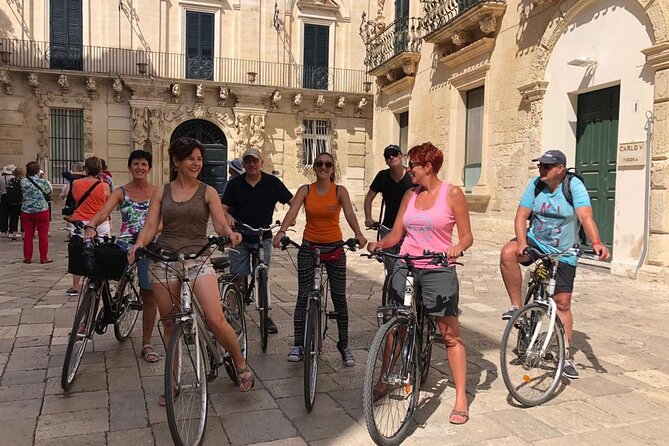
Next comes Cattedrale Maria Santissima Assunta e S.Oronzo. The big draw is the double facade, which spans centuries: it looks medieval, yet it also reflects later transformation toward the Baroque era. Even if you only spend a few minutes here, the guide’s commentary helps you “read” the building rather than just admire it.
This stop runs about 10 minutes, and church entry is not included. If you want a deeper interior visit, treat this stop as a strong exterior preview.
Stop 3: Obelisco—bas-reliefs and the scars of old conflicts
A short stop brings you to an obelisk where bas-reliefs tell the story of long conflicts that shaped culture and local economy. It’s a quick moment, but it adds something important: Lecce isn’t just decoration. There’s real human history carved into the stone.
Time is around 10 minutes, and admission is free. This is one of those stops where you benefit from a guide who explains what you’re looking at, since you might otherwise miss the narrative elements.
Stop 4: Porta Napoli—Lecce’s monumental entry gate
Then you’ll reach Porta Napoli, described as the city’s monumental entrance and often compared to a “Triumphal Arch.” It’s a classic kind of stop: the structure acts like a marker in your mental map of the city.
This one is free and quick, about 10 minutes. Even at a short stop, it’s useful because it shows you how Lecce functioned as a city with boundaries and controlled entrances—not just a pretty center.
Stop 5: Basilica di Santa Croce—the Lecce Baroque facade you’ll want to revisit
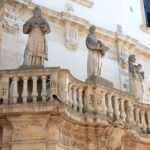
This is the headline. The Basilica di Santa Croce is treated as the masterpiece of Lecce Baroque, and the experience here is about seeing carvings as more than decoration.
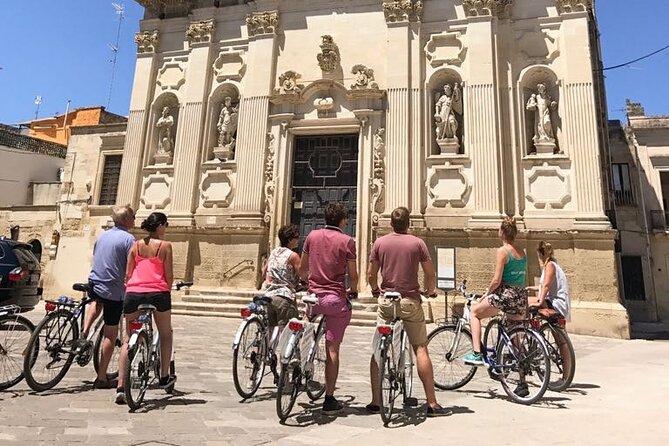
The timing is about 15 minutes, and while admission isn’t included, the visual impact from outside is the main event. With the guide’s help, you’ll learn to spot faces and strange animals carved on the Lecce stone. That kind of focused looking changes everything: you start noticing patterns, motifs, and the story-like feel of the ornamentation.
I like this stop because it gives you something concrete to chase after the tour. When you later return on your own, you’ll know what you already “unlocked” once with the guide’s pointers.
Stop 6: Piazza Sant’Oronzo—an almost science-project tall column
In Piazza Sant’Oronzo, you’ll find a column about 29 meters high topped by a statue of the city’s patron saint. The statue is noted as made in Venice in 1739, which adds a satisfying detail: Lecce’s art isn’t isolated—it connects to other parts of Italy.
This stop runs about 10 minutes, and admission is free. The height alone helps you orient quickly, especially if you’re planning to explore more Roman-era pieces after the tour.
Stop 7: Anfiteatro Romano—Augustan-age remains in the center
Next is the Anfiteatro Romano, a Roman amphitheater in the central area of Piazza Sant’Oronzo. The tour description notes it dates back to the Augustan age, placing it within a specific early imperial timeframe.
Time is about 10 minutes, and it’s free to view. Even without long explanations, seeing it in the middle of today’s city makes the Roman layering feel real. This stop is also a nice bridge: it connects the baroque sightseeing to something older and structurally different.
Stop 8: Chiesa di Santa Chiara—quick exterior look, good for future exploring
You’ll stop at Chiesa di Santa Chiara for about 5 minutes in Piazza Vittorio Emanuele II. It’s not the longest stop, and admission isn’t included, so consider it a “preview and move on” moment.
Still, short stops can be smart. If the church’s facade pulls you in, you’ll now know where it is for a later, more relaxed visit.
Stop 9: Teatro Romano di Lecce—another Roman layer, shorter stop
Finally, you reach the Teatro Romano di Lecce, a Roman monument in the historic center. The time is about 5 minutes, and admission is not included.
This closing stop is quick, but it ties the Roman theme together with the amphitheater. It also gives you a satisfying “last look” before cycling back to Velo Service.
Riding comfort: helmets, mixed mobility, and the “everyone fits” approach
The included equipment (helmet plus bicycle) makes the ride feel safer and more organized. And the operation clearly understands that people come with different bodies and energy levels.
In past experiences, the same tour concept has worked for riders using a rickshaw-style option as well as cyclists. One review also called out an accessible setup that didn’t separate “bike people” from people needing a different vehicle. Translation for you: you won’t feel like you’re stuck watching from the curb.
Practical take: if you’re unsure which option will work for you, ask when you confirm. The tour notes that most people can participate, and the small-group format helps the guides manage pacing.
Photo stops and pacing: how to make the most of 5–15 minutes
These are short windows. The upside is you won’t spend your vacation stuck waiting for one place to finish. The downside is you have to be ready to look quickly.
Here’s how to handle it:
- At the start of each stop, pick one thing you want to spot (facade motifs at Santa Croce, the bas-reliefs on the obelisk, the column height in Piazza Sant’Oronzo).
- If you care about a specific building, ask the guide to point out the best angle. The guide’s job is interpretation, and it helps you get more value out of a fast stop.
The route is also designed with the practical flow of cycling in mind. You’ll be moving between scenes without having to navigate the streets yourself.
Food and refreshment: the included tasting break actually matters
This tour includes light refreshment and a snack tasting of a local product. In past runs, the included break has featured local pastry and coffee—people specifically mentioned things like pasticciotto and caffe Leccese.
Why I think this is a smart inclusion: food anchors the city in the present. You’re not just staring at monuments; you’re also tasting what Lecce feels like today. And it gives you a small reset before the final Roman stops.
If you’ve been walking all day, that snack rhythm helps keep the tour from feeling purely “sightseeing mode.”
Weather, heat, and keeping the day comfortable
The tour operates in all weather conditions, and the operator notes that it may be rescheduled in case of a weather warning. That’s common sense for a bike tour—wet streets and safety don’t mix.
On hot days, the recommendation is straightforward: drink plenty of water, wear protective glasses, and use sunscreen. With a short tour, you might be tempted to skip sun care, but Lecce heat adds up quickly when you’re cycling between open squares.
If weather shifts mid-tour, the guide adjusts. One rider highlighted the tour as helpful when the weather was changing because the ride still covered the main sights without long delays.
Who this tour is best for
This is a great choice if:
- you’re in Lecce for a short time and want highlights fast
- you want a guided overview before you wander on your own
- you prefer movement over slow walking
- you have mobility differences and still want a unified experience with the group
It may be less ideal if:
- you want long church interiors or deep museum-style time (remember, church entrance fees are not included and many stops are exterior-focused)
- you hate quick photo stops and prefer slow pacing
Should you book this Lecce Historical Attractions Tour?
If you want a high-impact first look at Lecce—Baroque façades, Roman remnants, and a short food tasting—this is an easy yes. The included helmets, refreshment, and local snack reduce planning friction, and the short, efficient stops fit a tight itinerary.
I’d book it especially on your first day or when you want a guided route that helps you navigate the historic center without guessing. Just factor in that if Santa Croce or the cathedral pulls you in, you’ll likely want to schedule extra time (and tickets) for interiors after the tour ends.