REVIEW · FLORENCE
Leonardo Interactive Museum® Entrance Ticket
Book on Viator →Operated by Leonardo Interactive Museum® · Bookable on Viator
Leonardo’s machines you can actually test. I love the hands-on exhibits and the clear, kid-friendly layout of Leonardo’s inventions. I also love that you get multilingual explanations right beside the stations. One thing to watch: the museum can get crowded and noisy, so reading placards and hearing audio takes some patience.
This is a self-led ticket to the Leonardo Interactive Museum® in Florence, priced at $11.95 per person for about 1 to 1.5 hours of flexible visiting. You’ll get a mobile ticket and admission that’s designed to help you get in without wasting time.
If you’re craving a deep, traditional museum stroll (mostly paintings and artifacts in quiet rooms), this place is a different kind of experience. It’s more about how Leonardo’s ideas work—machines, models, and interactive puzzles—than about slow, reverent looking.
In This Review
- Key Things You’ll Notice Right Away
- Leonardo Interactive Museum: what your $11.95 really buys
- Getting in fast: mobile ticket, skip-the-line entry, and finding the right spot
- Earth, Water, Air, Fire: your self-guided route through Leonardo’s ideas
- More than machines: anatomy studies and backlit art reproductions
- Hands-on stations for kids, adults, and engineers with short patience
- Crowds, noise, and your best game plan for a calm visit
- Exhibits rules you’ll want to know before you step in
- How this fits into your Florence day plan
- So who should book this ticket (and who might skip it)?
- Should you book the Leonardo Interactive Museum ticket?
- FAQ
- How long should I plan to spend at the Leonardo Interactive Museum?
- Is there a guided tour included with the ticket?
- What languages are available for the exhibits?
- Is entry skip-the-line, and can I use a mobile ticket?
- Are kids allowed, and is there any special policy for children?
- Are food and drinks allowed inside the exhibit areas?
Key Things You’ll Notice Right Away
- Skip-the-line admission included, no extra commissions
- Self-guided visit with timed entry and a flexible route
- Four themes: earth, water, air, fire tied to Leonardo’s designs
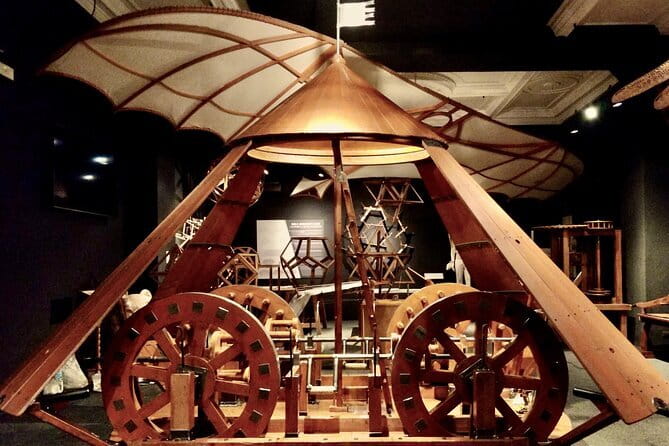
- Interactive stations built from Leonardo’s drawings, many to scale
- Anatomy studies + high-resolution, backlit painting reproductions
- Multilingual info (Italian, English, French, German, Spanish, Russian)
Leonardo Interactive Museum: what your $11.95 really buys
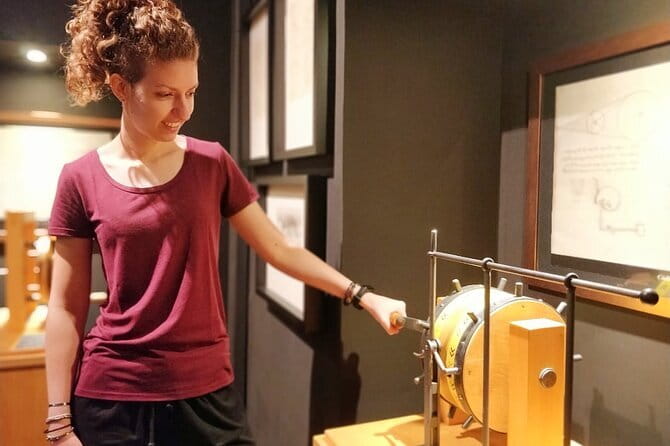
For $11.95, you’re not paying for a guided history lecture. You’re paying for access to a practical, try-it-yourself experience based on Leonardo da Vinci’s engineering mind.
The big value is that the museum is set up as “machines first.” Each section is built around Leonardo’s concepts, with models that are made from his designs and, where possible, built to scale. Instead of just reading about “possible inventions,” you get to see the ideas in action and understand how they might have worked.
You’ll also appreciate the comfort factor. The rooms are air-conditioned, with bathrooms on site. That matters in Florence, especially when the day is hot and you’re trying to keep kids happy without melting.
One more detail that affects value: there’s a museum shop on site where you can browse and buy books and souvenirs. It’s not the main reason to go, but it’s useful if your visit turns into a mini da Vinci obsession.
You can also read our reviews of more tours and experiences in Florence.
- Tuscany Day Trip from Florence: Siena, San Gimignano, Pisa and Lunch at a Winery
★ 5.0 · 21,634 reviews


Getting in fast: mobile ticket, skip-the-line entry, and finding the right spot
This ticket includes skip-the-line admission. That’s the main logistical win. You don’t have to hunt for the slow part of the process or wait through the worst of the queue.
You’ll receive confirmation at booking, and the ticket is mobile. Plan to have your phone ready at entry. The museum is also described as near public transportation, so you can fit this into a day that also includes other Florence sights.
One practical tip: some reviews complain about confusion caused by the pickup/entry location. So do yourself a favor—double-check the exact address and entry point listed on your confirmation before you walk over. In a dense tourist area, a “two minutes away” direction can turn into a 20-minute loop if the starting point is unclear.
Once you’re inside, you’ll have a self-guided visit. No guide needs to herd you along. That’s great for independent-minded travelers. It also means you’ll want to use your time on purpose, especially if it’s busy.
Earth, Water, Air, Fire: your self-guided route through Leonardo’s ideas
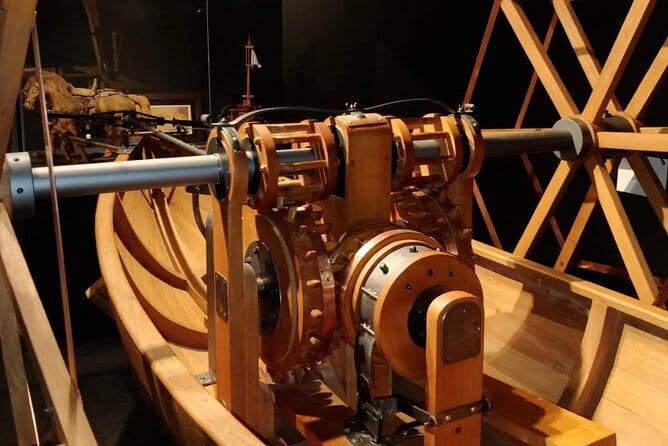
The heart of the museum is organized into four themed sections: earth, water, air, and fire. Think of these as Leonardo’s “domains” for invention. It’s not just categorizing themes for decoration—it shapes what you see and how you understand the inventions.
Across the rooms, you’ll notice the emphasis on the mechanics of ideas:
- models are built according to Leonardo’s designs
- the exhibits are designed so you can interact and follow cause-and-effect
- the descriptions help you connect the machine to Leonardo’s broader curiosity
The biggest benefit of this layout is that it keeps things moving. You’re not stuck in one display zone for too long. If your group has a short attention span (or a long one), you can still make a full circuit without losing the thread.
The main drawback is not the content—it’s the “flow.” Reviews mention there’s no sharply defined path and that it can be hard to follow chronology. If you care a lot about a story-by-story timeline, you may need to slow down and re-check placards as you go, or accept a more “browse and build understanding” pace.
More than machines: anatomy studies and backlit art reproductions
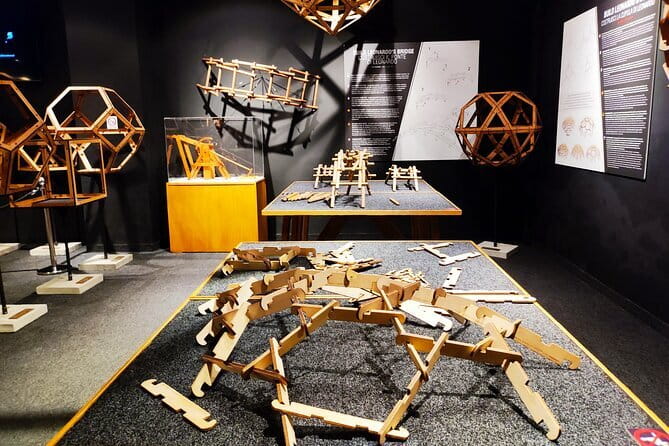
If you only came for flying ideas and gear-driven puzzles, don’t skip the other sections. The museum includes a dedicated area for Leonardo’s Anatomical Studies and a gallery of his paintings reproduced with high-resolution backlight technology.
This mix is one reason the museum works for both science lovers and art lovers. Leonardo wasn’t just an inventor who liked gadgets. He was also obsessed with how bodies work and how light can reveal form—two things that show up in those anatomical and art-focused displays.
The backlit painting reproductions add a modern “wow” factor. Instead of seeing a flat image, you see a presentation style that makes the details feel more vivid and legible. Pair that with your hands-on understanding from the machines, and the museum becomes easier to remember.
A quick heads-up: the museum’s vibe can be busy. Some exhibits may be crowded around interactive points, and the audio you’re guided toward can be hard to hear when the rooms are full. If you run into that, take advantage of a simple strategy: step out into a quieter area to listen, then return when you can focus on the physical displays.
Hands-on stations for kids, adults, and engineers with short patience
If your group includes children (or adults who still think like kids), this is where the museum earns its reputation. The exhibitions are designed to stimulate curiosity and make Leonardo feel practical, not distant.
The hands-on setup is a major theme in the experience. Many people love that the stations let you work through designs and models directly, not just watch them. That’s why families often have a smoother time here than in more traditional museums.
One specific kind of station that shows up in positive feedback: interactive builds where you can work together on structures like a bridge model. That sort of activity turns “Leonardo” into something you can physically manipulate. It’s also a nice way to keep multiple ages engaged at once.
That said, you should plan for crowd energy. Multiple reviews mention it can be crowded and noisy even with timed entry. If you’re the type who needs quiet to read, bring a strategy: pick a few key machines you really want to understand, then let the rest be “see it, try it, move on.”
And yes, there’s a bit of practical wisdom here: the museum is more successful when you treat it like a workshop, not a library.
- The Best tour in Florence: Renaissance & Medici Tales – guided by a STORYTELLER
★ 5.0 · 12,316 reviews






Crowds, noise, and your best game plan for a calm visit

Here’s the honest trade-off. The museum is compact and the interactive stations draw attention. When lots of people arrive at once, it can feel like everyone wants the same hands-on moments.
If the crowd factor bothers you, go in with expectations:
- you may need to wait briefly at popular interactive stations
- placards can be harder to read when people are clustered
- audio suggestions may be difficult to hear in the room
The good news is that the museum is designed for short loops. Even if you can’t linger at every display, you can still get a satisfying overview by sampling the main areas. Many visitors plan around 90 minutes, and that’s a realistic target if you want to see everything without turning it into a marathon.
If it’s noisy, use a simple workaround. One review notes that audio is suggested but can be easier to hear outside the museum area. So if the sound gets swallowed by chatter and camera clicks, don’t force it. Step aside, listen when you can, then return.
Exhibits rules you’ll want to know before you step in

Small rules can matter in places like this, because interactive exhibits turn into chaos fast.
In the exhibit areas, food, chewing gum, and beverages are prohibited. That’s not just about cleanliness—it also keeps hands-on stations usable and prevents sticky messes near models that visitors touch.
Kids must be supervised at all times. If a child causes problems, risks damage, or disturbs other visitors, staff may ask them to leave. That’s a strong hint: this museum works best when kids understand they’re entering a hands-on science space, not a playground.
Also note the age break: children under 5 have free admission. If you’re traveling with toddlers, you may still enjoy the museum, but you’ll likely need extra patience because the hands-on nature attracts attention and activity.
Finally, there’s a museum shop where you can browse books and souvenirs. If you want something to read on the ride home, this is the spot.
How this fits into your Florence day plan
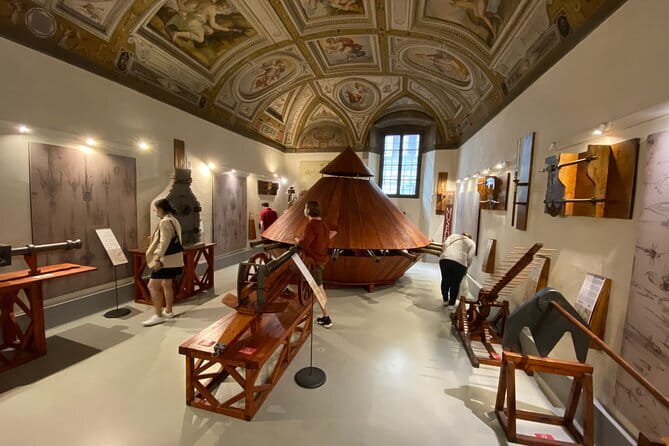
The Leonardo Interactive Museum is the kind of activity that balances well with Florence’s classics. You can pair it with sightseeing without getting stuck in another long line.
Timing is flexible. Many people spend about an hour to an hour and a half, which makes it easy to slot between other stops. Because it’s air-conditioned, it’s a smart choice when the weather is doing its best imitation of a hair dryer.
It also works well as a family “reset.” After a long walk around historic streets, the museum’s indoor, interactive format gives everyone a chance to do something other than look at stone and sculpted details.
One more pairing tip: if you’re already planning to see Leonardo’s work elsewhere in Florence, treat this as the “how it works” companion. This museum leans into engineering concepts, anatomy studies, and art presentation techniques—less into a silent, historical walking tour vibe.
So who should book this ticket (and who might skip it)?
You’ll be happiest here if you fall into one of these groups:
- families who want hands-on learning
- kids who learn by touching and trying
- adults who enjoy engineering, mechanisms, and model building
- art lovers who also like the science of observation and light
It’s also a solid choice if you prefer independence. The ticket is self-led with no guided tour included, so you can move at your group’s pace.
You might think twice if:
- you want a quieter, more traditional museum experience
- you’re sensitive to noise and crowding
- you expect a strictly guided timeline of Leonardo’s life
If you’re in the middle—art plus science curiosity—this place tends to click.
Should you book the Leonardo Interactive Museum ticket?
I think this ticket is a strong value if your goal is hands-on learning about Leonardo da Vinci’s inventions. For $11.95, you get skip-the-line admission, air-conditioned rooms, multilingual descriptions, and enough interactive stations to make the visit feel more like a workshop than a lecture.
My “book it” recommendation is strongest for families and engineering-minded visitors. If you’re okay with crowd energy and you treat the visit as an exploration (not a quiet museum marathon), you’ll likely have a good time.
If you’re unsure, here’s the deciding point: do you want to understand Leonardo by seeing how his ideas work? If yes, this is an easy win. And if plans change, the experience offers free cancellation up to 24 hours in advance for a full refund.
FAQ
How long should I plan to spend at the Leonardo Interactive Museum?
Plan for about 1 hour to 1 hour 30 minutes. That’s enough time to see the main areas and do the interactive stations without rushing.
Is there a guided tour included with the ticket?
No. This is a self-led admission ticket. A guided tour isn’t included.
What languages are available for the exhibits?
The museum provides detailed exhibit information in Italian, English, French, German, Spanish, and Russian. Multimedia displays also provide additional information.
Is entry skip-the-line, and can I use a mobile ticket?
Yes. The ticket includes skip-the-line admission and is provided as a mobile ticket.
Are kids allowed, and is there any special policy for children?
Yes. Children under 5 have free admission, and children must be supervised at all times. Staff may ask anyone who causes damage or disturbs others to leave.
Are food and drinks allowed inside the exhibit areas?
No. Food, chewing gum, and beverages are prohibited in the exhibit areas.
You Might Also Enjoy




More Tour Reviews in Florence
- Tuscany Day Trip from Florence: Siena, San Gimignano, Pisa and Lunch at a Winery
★ 5.0 · 21,634 reviews - The Best tour in Florence: Renaissance & Medici Tales – guided by a STORYTELLER
★ 5.0 · 12,316 reviews