REVIEW · FLORENCE
Medici Legends & Renaissance Wonders: Florence Small Group Tour
Book on Viator →Operated by All Around Florence · Bookable on Viator
Medici Florence makes the city click fast. This tour is a guided hit-list with a Medici lens, linking power, patronage, and Renaissance image-making across the prettiest corners of the center. I like that it stays small (max 15) and moves with purpose, so you get oriented without feeling dragged from stop to stop.
My second big win is the guide quality and pacing. Guides like Manuel and Martina have been praised for turning architecture into story, with details you’d miss on your own (plus a slower, easy-to-follow rhythm). One thing to consider: this is a streets-and-landmarks experience, so if you want a museum-style, very deep Medici immersion, you’ll probably still want an extra Medici-focused visit.
In This Review
- Key points worth your time
- A Medici Lens on Florence’s Main Landmarks
- Who This 1h45 Small-Group Walk Is For
- Basilica di San Lorenzo: Medici Power Begins in a Church
- Biblioteca Medicea Laurenziana: Clement VII and Michelangelo’s Statement
- Cappelle Medicee: The New Sacristy and Michelangelo’s Role
- Palazzo Medici Riccardi: A Palace Built for the Banking Family
- The Duomo Complex: Dome, Campanile, Baptistery, and the UNESCO Core
- Campanile di Giotto: The Sculpture-Heavy Side of Gothic
- Palazzo Vecchio and Piazza della Signoria: Civic Florence After the Church
- Ponte Vecchio: The Arno, Shops, and Continuity
- Palazzo Pitti and the Road Toward Uffizi Art
- Pace, Stops That Feel Short, and How to Get More From Them
- What $119.77 Really Buys (and Ticket Reality)
- Should You Book the Medici Legends & Renaissance Wonders Tour?
- FAQ
- How long is the Medici Legends & Renaissance Wonders: Florence Small Group Tour?
- What is the group size limit?
- What language is the tour offered in?
- Where does the tour start and end?
- Are admission tickets included for the sights?
- What’s included in the tour?
- Is tipping included in the price?
- What happens if weather is poor?
Key points worth your time

- Medici storytelling through Florence’s icons, not just a generic walking tour
- Small group size (15 max) for a more personal feel
- Whisper system included, helpful on busy squares and near traffic
- Fast, efficient route designed for time-poor first-timers
- Major stops around the Duomo and old civic core, plus the walk to the Arno
A Medici Lens on Florence’s Main Landmarks
Florence can feel like sensory overload: stone, crowds, art, and big-ticket sights packed into a small area. What makes this tour work is the thread. Instead of treating each building like a separate postcard, you connect them to the Medici family’s big idea: rule well by projecting culture, faith, and legitimacy.
You start by seeing the Medici not just as patrons of art, but as people building an image you can physically walk through. Churches become stages. Libraries become proof of status. Palaces become arguments in stone. Even the big public spaces feel different once you understand what the Medici were trying to signal.
This is why I’d treat it as an orientation tour. You finish with mental labels for the city: which places are about power, which ones are about devotion, and which ones are about art collecting and display.
You can also read our reviews of more tours and experiences in Florence.
- Tuscany Day Trip from Florence: Siena, San Gimignano, Pisa and Lunch at a Winery
★ 5.0 · 21,634 reviews

Who This 1h45 Small-Group Walk Is For
This tour fits best if you’re:
- In Florence for a short window and want the essentials in a single morning-ish block
- A first-timer who wants context before you do bigger museum days
- Traveling with kids around 10 and up, since the pacing and story format tend to keep attention
It also works well if you like to ask questions. Several guides on this route are described as attentive and willing to answer a long list—useful when you’re trying to place names like Clement VII, Michelangelo, Arnolfo di Cambio, or Giotto into a real geographic map in your head.
If you’re traveling with a hearing challenge, plan to be strategic. The tour includes a whisper system, but one review noted the sound system may need improvement and that seniors can struggle with street noise. When you get your receiver, test it quickly and stay close enough to hear clearly as you walk.
Basilica di San Lorenzo: Medici Power Begins in a Church
Your route kicks off at Basilica di San Lorenzo, a major church in the heart of Florence’s market district. It matters here because it’s the burial place of principal Medici members, spanning from Cosimo il Vecchio through Cosimo III. That turns a big church stop into something more political than you might expect.
This isn’t the kind of building you understand by looking once. Even in a short stop, the value is in what the guide helps you notice: where the Medici placed their legacy, and how religious space became a permanent brand. The Medici were creating continuity—one generation reinforcing the next—so the church reads like a family timeline in stone.
A practical note: admission is not included for this stop, so you should assume you’re looking mainly from outside or in limited ways depending on what’s possible during your visit. Build in extra time on a separate day if you want to linger longer inside.
Biblioteca Medicea Laurenziana: Clement VII and Michelangelo’s Statement
Next comes the Biblioteca Medicea Laurenziana, tied directly to Medici influence through the patronage of the Medici pope Clement VII. The key idea is simple and smart: the library was meant to show the Medici had moved beyond merchants into a world of clergy and intellect.
Even the fact that it’s linked to Michelangelo signals what you’re dealing with. It’s renowned for its architecture designed by him and is cited as an example of Mannerism. That means you’re not just seeing a collection—you’re seeing an attitude, a style that breaks from strict classical balance to create energy and tension.
If you’re the kind of traveler who enjoys details, this is a great stop for you. A guide can point out how the building itself performs its message. If you prefer a slow museum pace, remember the stop here is brief, so your best bet is to save deeper reading and access for another time.
Cappelle Medicee: The New Sacristy and Michelangelo’s Role
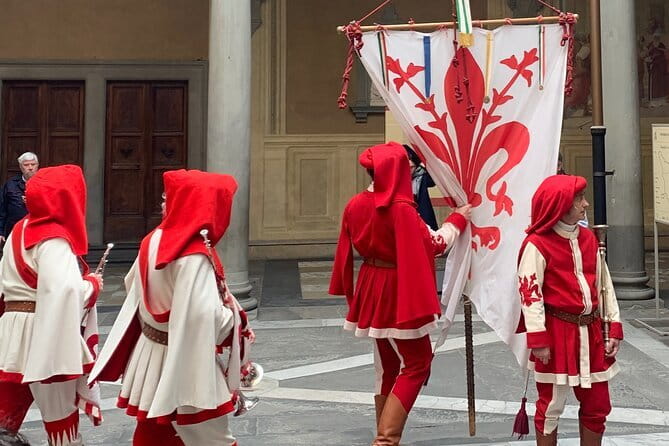
The Cappelle Medicee are built as extensions to Brunelleschi’s 15th-century church, with construction spanning the 16th and 17th centuries. Their purpose is explicitly tied to celebration: the Medici family, the patrons of the church, and the Grand Dukes of Tuscany.
The standout in this area is the Sagrestia Nuova, designed by Michelangelo himself. This turns the chapel stop into a high-impact encounter with Renaissance ambition. If you’ve ever wondered why Medici patronage feels so tied to “who gets to be remembered,” this is where you feel that concept in your bones.
Admission is not included, and the stop is short. That doesn’t make it less valuable—it just means you’ll want to decide ahead of time whether you’ll later pay for a longer look.
- The Best tour in Florence: Renaissance & Medici Tales – guided by a STORYTELLER
★ 5.0 · 12,316 reviews


Palazzo Medici Riccardi: A Palace Built for the Banking Family
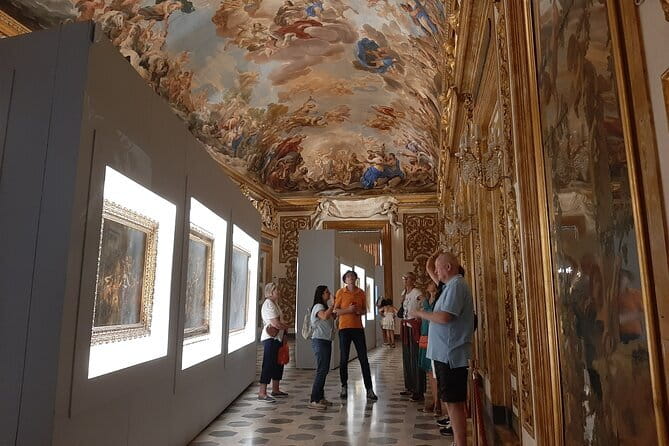
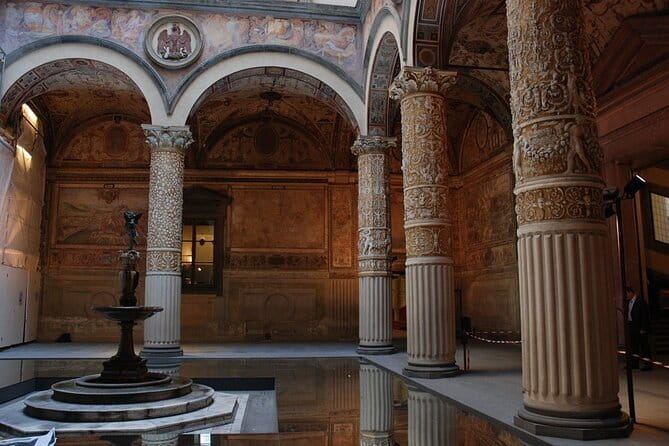
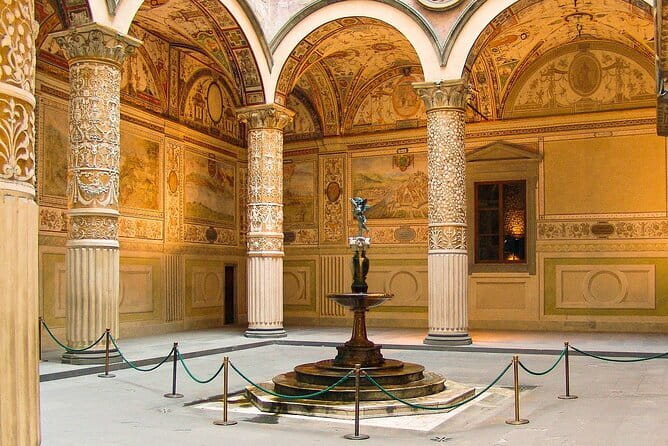
Then you move to the Palazzo Medici Riccardi, built between 1444 and 1484 for Cosimo de’ Medici, head of the Medici banking family. That date range is a clue: this is early in the family’s rise, when wealth still needs to be turned into political staying power.
A palace like this isn’t only about architecture. It’s about transition. You’re watching the Medici convert money into authority, and authority into a physical presence. Even from a quick stop, you can understand the basic pitch the building makes: we are not temporary players; we are here to shape Florence.
Admission isn’t included here either, so again think “street-level understanding” first. If the building hooks you, plan a separate visit later when you can slow down.
The Duomo Complex: Dome, Campanile, Baptistery, and the UNESCO Core
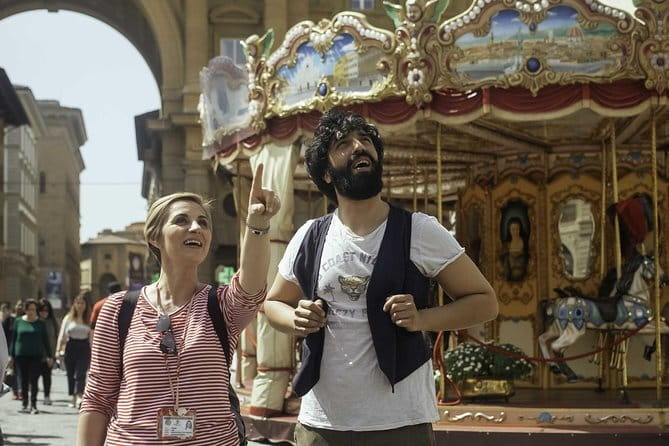
From there the tour heads into the Duomo complex area, and it’s a classic reason Florence is famous. The cathedral is the Cattedrale di Santa Maria del Fiore, begun in 1296 in Gothic style to a design by Arnolfo di Cambio. This entire complex—including the Baptistery and Giotto’s Campanile—sits in Piazza del Duomo and is part of the UNESCO World Heritage Site covering Florence’s historic center.
Here’s the value of seeing all three related landmarks in one guided sweep:
- The cathedral shows scale and ambition
- Giotto’s Campanile explains the decorative logic of Florentine Gothic
- The Baptistery gives you the deeper time layer, since it was constructed between 1059 and 1128 in Florentine Romanesque style
You’ll also pause at the Cupola del Brunelleschi. It’s described as one of the biggest mysteries in art and architecture of its time, and it remains the largest brick dome ever constructed. Even if you’re not a technical architecture buff, this is the stop where people stop walking just to stare up.
Admission is not included for these sights on this tour, and each is allotted only about minutes. That’s actually okay. You’re not here to master the cathedral. You’re here to get your bearings so your future ticketed visits make sense.
Campanile di Giotto: The Sculpture-Heavy Side of Gothic
Giotto’s Campanile is adjacent to the cathedral and the Baptistery, and it’s described as a showpiece of Florentine Gothic architecture. The guide focus here is likely on the tower’s rich sculptural decorations and polychrome marble encrustations.
If you’ve only seen the Duomo from far away, this is where the details matter. Florentine Gothic tends to reward close viewing—your eye needs landmarks to follow, and the tower provides them through ornament that reads almost like a narrative strip.
Because the stop is short and tickets aren’t included, treat this as a taste. If you come away wanting more, that’s a good sign. It means you’ll enjoy spending time here on your own later.
Palazzo Vecchio and Piazza della Signoria: Civic Florence After the Church
Next you shift from sacred to civic with Palazzo Vecchio, the town hall of Florence. It’s a massive fortress-palace, one of the most impressive town halls in Tuscany, and it anchors the square scene. In front you’ll see the copy of Michelangelo’s David statue, and you can also connect it to what’s nearby at the Loggia dei Lanzi.
Then comes Piazza della Signoria, an L-shaped square in front of Palazzo Vecchio. It’s the meeting place of Florentines as well as tourists, and it also acts as a gateway to the Uffizi Gallery.
This is where the Medici lens pays off again. The Medici were shaping not only taste in art but power in government. Piazza spaces are political tools. From this corner of town, you can start understanding why Florence feels like it runs on art and debate at the same time.
Again, the stop is brief and admission isn’t included, but you’re getting the map link between the city hall world and the museum world.
Ponte Vecchio: The Arno, Shops, and Continuity
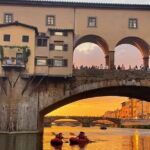
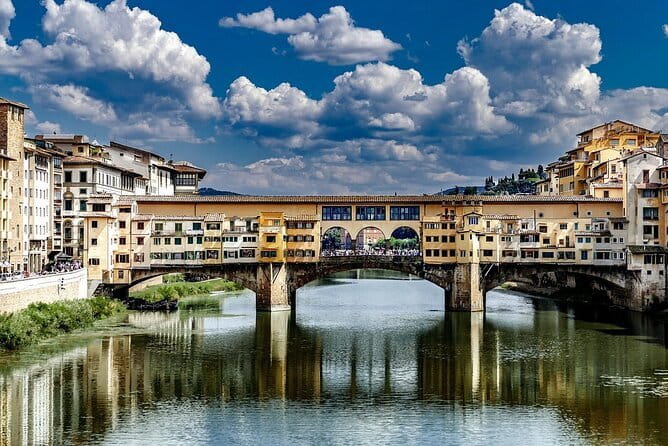
Your route ends at Ponte Vecchio, the Old Bridge over the Arno River. It’s described as medieval and as the oldest bridge of its kind in Florence, known especially for shops built along it.
The shop history is part of what makes this bridge more than a pretty walk. It notes that butchers, tanners, and farmers initially occupied the shops. Today, the tenants are jewelers and art dealers. That’s a cultural shift you can feel when you compare what kinds of people historically used the crossing versus who uses it now.
Ponte Vecchio itself is free, so it’s a great payoff moment at the end of the tour—no ticket math, just a stroll and some photos.
If you’re ending here, plan an extra 20 to 30 minutes after the tour. The bridge is a great place to regroup, spot details you missed during the walk, and decide what you want to revisit.
Palazzo Pitti and the Road Toward Uffizi Art
After the civic core, the tour connects you to residential power with Palazzo Pitti. The Medici bought it in 1549 and it became the chief residence of ruling families of the Grand Duchy of Tuscany. Over time it grew as a treasure house as later generations amassed paintings, plates, jewelry, and luxurious possessions.
This stop helps explain a big concept: collecting isn’t only about money. It’s about building a dynastic lifestyle that can display wealth as taste. It’s also how art becomes a political instrument—something you can show off to visitors and use to reinforce your position at court.
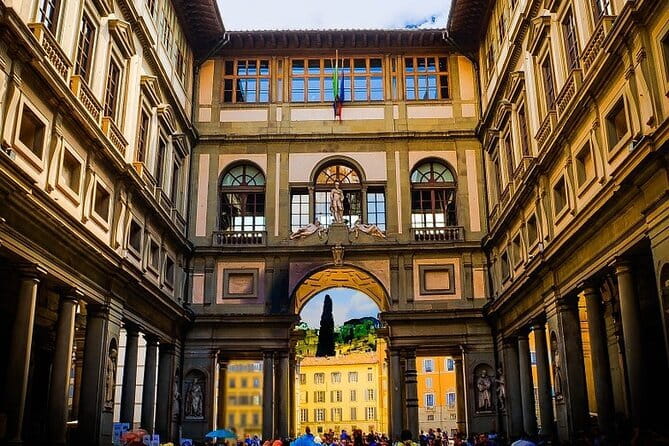
From there, you reach Gallerie Degli Uffizi, one of Italy’s most important museums and the most visited. It’s also described as one of the largest and best-known collections of Renaissance paintings, with works by Michelangelo, Leonardo da Vinci, Raphael, Botticelli, and other masters. You’re also told the museum spans over 80 halls and covers art from the 12th up to the 16th century.
Important practical point: Uffizi admission isn’t included on this tour. So what you get here is a guided orientation to the museum’s significance and what you’ll want to look for later. If you’re doing Uffizi on a separate day, this tour can help you feel more confident about where to spend your time.
Pace, Stops That Feel Short, and How to Get More From Them
Because this tour is compact—about 1 hour 45 minutes—and many stops are quick, you’ll want a smart strategy. Think of each location as a story starter, not a full visit. The guide’s job is to give you the why. Your job is to remember what you want to see up close later.
This is also where the group size matters. With a maximum of 15 people, you’re less likely to be lost in the crowd shuffle. You can hear directions, track the route, and even ask a question when the guide pauses at the right moment.
One practical note from feedback: street noise can swallow audio, so if you care about hearing every word, don’t hang back. Stay near the guide when possible, and make sure your whisper system is working before you start moving through the busier sections.
What $119.77 Really Buys (and Ticket Reality)
At $119.77 per person for about 1h45, you’re paying for three things:
- A licensed guide with a Medici narrative thread
- A small group experience (max 15)
- A whisper system to help you follow along
You’re not paying for site entry tickets. Most stops explicitly list admission tickets not included. That means you’ll want to budget separately for places like the Duomo complex components, the Medici-related buildings, and the Uffizi entry.
The good part is that this tour can still be worth it even if you don’t go inside everything on the same day. It helps you decide which museums and churches are priorities. If you’re overwhelmed in Florence, this kind of guided structure can save you from spending your limited energy on the wrong sights.
If you’re the type who likes to plan ahead, booking earlier can help. This tour often gets booked about 58 days in advance, which is a hint that dates can fill up around peak times.
Should You Book the Medici Legends & Renaissance Wonders Tour?
Yes, if you want a fast way to understand why Florence looks the way it does—and how the Medici turned money and politics into art and architecture. I’d especially recommend it as an early stop on your trip, because it gives you labels for later self-guided wandering and helps you make better choices on bigger museum days.
I’d hesitate if your main goal is a deep Medici museum study. This route is strongly themed, but it’s still a walking tour. You’ll get the connections and context, not the full depth of every museum collection.
If you’re flexible and ready to treat it as an excellent orientation, book it. It’s one of those tours where the city starts telling its own story the moment you understand the thread.
FAQ
How long is the Medici Legends & Renaissance Wonders: Florence Small Group Tour?
It runs for about 1 hour 45 minutes.
What is the group size limit?
The tour has a maximum of 15 travelers.
What language is the tour offered in?
The tour is offered in English.
Where does the tour start and end?
It starts at Caffè Scudieri Firenze, Piazza di San Giovanni, 19R, 50123 Firenze FI, Italy, and ends at Ponte Vecchio, 50125 Firenze FI, Italy.
Are admission tickets included for the sights?
No. Admission tickets are not included for the stops listed, except Ponte Vecchio is marked free.
What’s included in the tour?
You get a licensed tour guide, a small group, and a whisper system.
Is tipping included in the price?
No. Tips and gratuities are optional and not included.
What happens if weather is poor?
The tour requires good weather. If it’s canceled due to poor weather, you’ll be offered a different date or a full refund.
If you want, tell me your travel dates and whether you plan to visit the Uffizi or the Medici museums separately—I can help you build a smart 1–2 day plan around this tour.
You Might Also Enjoy

More Tour Reviews in Florence
- Tuscany Day Trip from Florence: Siena, San Gimignano, Pisa and Lunch at a Winery
★ 5.0 · 21,634 reviews - The Best tour in Florence: Renaissance & Medici Tales – guided by a STORYTELLER
★ 5.0 · 12,316 reviews