REVIEW · SICILY
Underground Catania
Book on Viator →Operated by Etna 'Ngeniousa · Bookable on Viator
Catania has a second city underground. This tour pulls you under the Duomo area to connect what you see above with the underground layers of Catania’s volcanic life. I especially like how the experience is guided by an archaeology-focused storyteller, turning tunnels and rock-cut spaces into a timeline you can actually follow.
The main thing to think about is pace. It’s usually smooth, but at least one guide experience was noted as a bit slow for quick walkers—so if you want a brisk march, plan for a more conversational rhythm and ask your guide to keep things moving.
In This Review
- Key highlights worth planning for
- Why Underground Catania feels like a time machine
- Where you meet near the Duomo and how the 2 to 3 hours works
- Stop 1: Terme Achilliane beneath Piazza Duomo
- Stop 2: Basilica Cattedrale di Sant’Agata and the city’s rebuild-and-faith story
- Stop 3: A Putia dell’Ostello and the Amenano underground river
- Stop 4: Chiesa di San Gaetano alle Grotte in an ancient lava flow cave
- Guides, group size, and why you can actually ask questions
- Price and value for a 2 to 3 hour underground history walk
- When to go, what to wear, and who this tour suits best
- Should you book Underground Catania?
- FAQ
- How long is the Underground Catania tour?
- Where does the tour start and end?
- Is the tour offered in English?
- What is the group size limit?
- Which stops include admission tickets?
- Is the tour private for your group?
- Do I need a mobile ticket?
- Can I get a free cancellation refund?
- Is the tour suitable for most people, and are service animals allowed?
Key highlights worth planning for
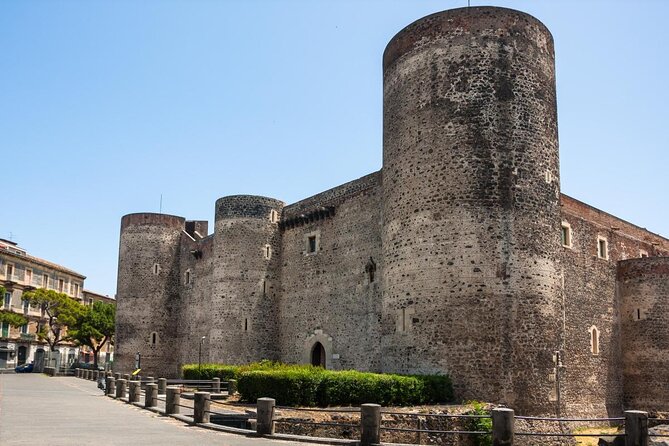
- Roman thermal remains under Piazza Duomo at Terme Achilliane, dating to the III–IV century AD
- A cathedral tour with context, linking Norman-era roots to Baroque reconstruction tied to Sant’Agata
- A Putia dell’Ostello and the Amenano underground river, including a sliding-cave viewpoint where water still runs
- Greek and Roman reuses of lava rock, plus catacomb traditions connected to St. Agatha at San Gaetano alle Grotte
- Small group up to 8 for questions, pauses, and a more personal pace
- A cool break from heat, since several stops are underground
Why Underground Catania feels like a time machine
Catania’s story isn’t only written in buildings. It’s written in levels: lava flows, repaired spaces, and waterways that got pushed underground when the city changed. That’s the big idea behind this tour. You’re not just seeing “cool caves.” You’re learning why those caves, baths, and chapels exist where they do.
What makes it work is the structure. The route moves from Roman plumbing and thermal rooms, up to the city’s main religious landmark, and then back below ground again into river passages and lava caves used across eras. You’ll get the sense of a city constantly adapting—especially to volcanic events and earthquakes—without drowning in dates.
And because this is a small group (max 8), you can actually ask follow-up questions. In past experiences with guides such as Oreste, Maria, and Matilde/Mathilde, the tone tends to be animated and responsive—so the tour becomes a conversation, not a lecture.
You can also read our reviews of more tours and experiences in Sicily.



Where you meet near the Duomo and how the 2 to 3 hours works
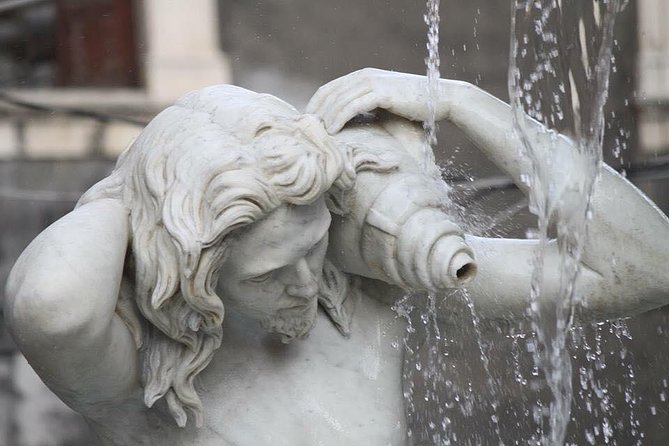
You start at Piazza del Duomo, 7, 95131 Catania CT, Italy. The tour ends at Piazza Stesicoro (P.zza Stesicoro), 95100 Catania CT, Italy. Expect about 2 to 3 hours overall.
This timing is practical for a day in Catania. You’re getting a big dose of “below the surface” before or after the main sightseeing rush. Also, with underground sections plus church interiors, the tour can feel like a break from sun and heat—something a lot of people value when the afternoon is hot.
Because it’s offered in English and capped at 8 travelers, it’s a good fit if you want your guide’s attention and not just background narration. Also note: a mobile ticket is used, and the tour allows service animals. The description says most travelers can participate, which fits the general nature of the walking and site visits.
Stop 1: Terme Achilliane beneath Piazza Duomo
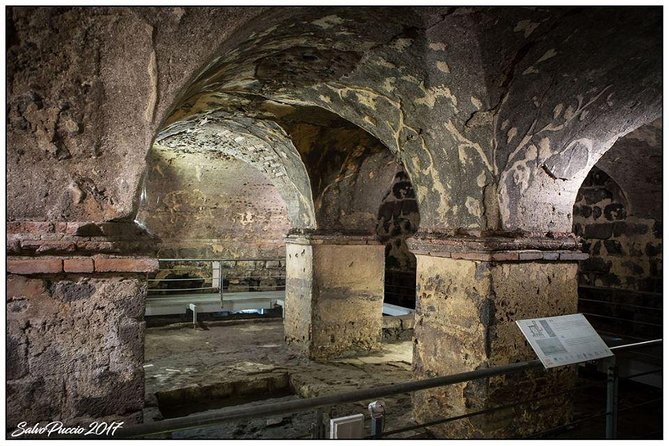
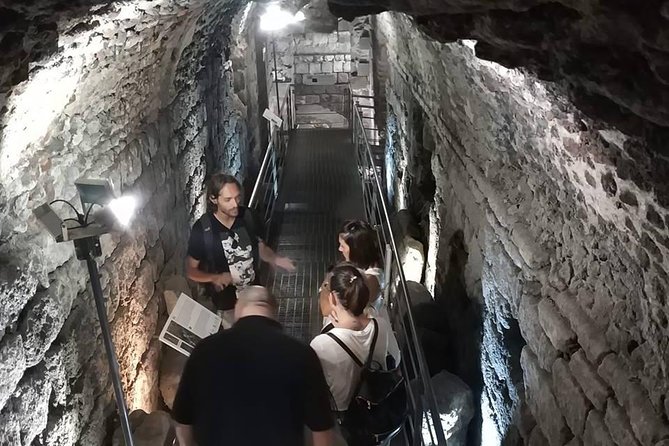
The tour starts underground with Terme Achilliane, a thermal complex that dates to the III–IV century AD. These baths were once spread across a wider zone, including the area around Piazza Duomo. Today, the portion you can access sits just below the cathedral area, which is exactly why this stop matters: it’s one of those “how did they fit all this here?” moments.
What I like about this first stop is that it sets the pattern for the rest of the tour. Roman Catania wasn’t only about temples and streets. It was also about water systems, rooms designed for heat and routine, and architecture built to be used daily. Seeing what remains beneath the modern city helps you read Catania like a palimpsest—layer on layer.
Admission ticket is included for this stop, and the time on-site is about 20 minutes. Drawback? If you’re expecting huge chambers everywhere, this is more about archaeological access to a specific surviving section. Still, that’s part of the charm: you’re learning to “see” the city even when only fragments are available.
Stop 2: Basilica Cattedrale di Sant’Agata and the city’s rebuild-and-faith story
Next you’re back above ground (for a key stop) with the Basilica Cattedrale di Sant’Agata. This is the heart of Catania’s sacred and civic identity, tied to the city’s story around Liotru and Sant’Agata. You’ll hear how the site evolved from a Norman-era church to the current Baroque cathedral, shaped by repeated destruction and reconstruction over the centuries.
This stop is valuable for one reason: it gives you context for everything you’ll see underground. When a city is hit by earthquakes and volcanic activity, people don’t just rebuild walls. They rebuild meaning. Here, faith and architecture are intertwined, and the guide’s job is to connect the underground traces to the above-ground landmarks.
The stop runs about 20 minutes, and admission is free for this part. It also gives you a chance to regroup mentally before the tour moves back into rock-cut and river-like spaces.
One consideration: this is still a church setting, so expect quieter attention to the environment. If you like asking questions, this is a great moment—guides tend to connect design details and historical shifts to what later happened below.
Stop 3: A Putia dell’Ostello and the Amenano underground river
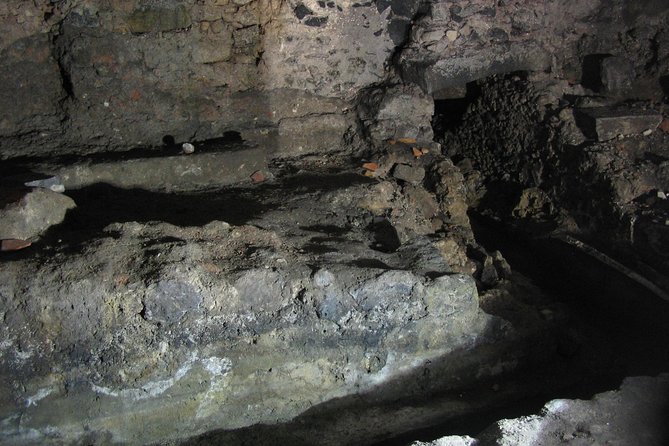
Now the tour gets seriously interesting. A Putia dell’Ostello centers on the Amenano, an underground river that runs beneath Catania’s historic center. The story here is both simple and dramatic: the Amenano originally fed the Lake of Nicito, but eruptions, earthquakes, and wars reshaped how the city and its water systems looked over time.
What you’ll do at this stop is not just look at a water story from afar. You visit a sliding cave where a branch of the river still flows. That detail is what makes this stop feel different from a typical underground walk. You get a physical relationship to water and terrain—not only the idea of it.
The time here is about 10 minutes, with admission included. In the reviews, people described big “wow” moments and being surprised by the hidden-access feel of these spaces. That reaction makes sense. Most visitors to Catania have no reason to hunt for an underground river with a sliding cave connection, yet it sits under the daily map of the city.
If you’re short on energy, this is still a great stop because it’s brief. If you love water systems and how cities adapt to geology, you’ll probably want to slow down for questions right here.





Stop 4: Chiesa di San Gaetano alle Grotte in an ancient lava flow cave
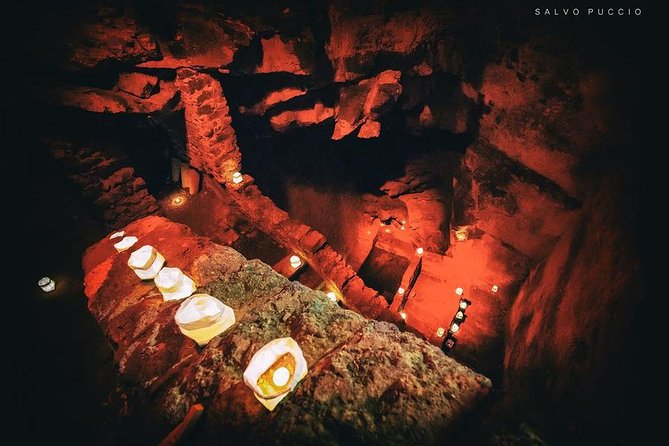
The final stop is Chiesa di San Gaetano alle Grotte, one of the most striking places in Catania’s underground network. This site is built into an ancient lava flow cave—and it has been repurposed again and again.
The tour explains the long chain of reuse: the cave was used in Greek times as a cistern, and later the Romans adapted it as a catacomb space. Then there’s the tradition tied to St. Agatha. The account connects the cave to the first deposition of Saint Agatha, with a small church reportedly present as early as 262. Today, the crypt preserves remains of ancient frescoes and decorations carved directly into the living rock.
You’ll spend about 20 minutes, and admission is included. This stop tends to be the emotional closer because it combines geology, survival, and faith. One review-style detail that’s helpful for you: people often mention how the guide connects these underground rooms to the broader effects of earthquakes and volcanic events—so the cave becomes part of the bigger “why” of Catania.
Practical note: this is an underground church/cave setting. Go in with the mindset of viewing slowly. If your guide offers time for lingering, take it. The carved surfaces and preserved decorations are the kind of thing you notice more when you pause.
Guides, group size, and why you can actually ask questions
The tour is designed for private-group style attention, with a maximum of 8 travelers. In plain terms: this setup supports real interaction. When groups are small, you don’t lose your questions to the next stop. You can ask about Etna’s influence, the logic of layering in a volcanic city, or how specific sites were reused across eras.
From past guide experiences highlighted by different guide names—Oreste, Maria, and Matilde/Mathilde—the through-line is that the guides bring the city to life with strong storytelling and patient answers. If you enjoy history but hate long lectures, this is a good match. If you’re into archaeology and how people adapted to natural forces, it’s even better.
Another plus: some guides have shown flexibility when circumstances change, like weather or time-of-day shifts. Since you’ll be walking between underground and semi-underground spaces, that responsiveness matters. It’s also why you should show up ready with your own interests: ask what era you want to focus on, and most guides will shape the discussion around it.
Price and value for a 2 to 3 hour underground history walk
The price is $96.79 per person for about 2 to 3 hours. That’s not the cheapest tour in Sicily, so you should think about value in terms of access and expertise, not just minutes.
Here’s the value math that makes sense for this experience:
- Access to underground spaces that are hard to find or navigate on your own. The tour is built around sites you wouldn’t casually stumble upon.
- Tickets included for major underground stops (Terme Achilliane, A Putia dell’Ostello, and San Gaetano alle Grotte). That trims cost versus paying separate admissions.
- A guide who connects the dots between lava geology, water systems, religious landmark history, and the long timeline of reuse. That kind of contextual storytelling is what turns “dark rooms” into a coherent city story.
If you’re coming to Catania specifically to understand how the city survives and rebuilds under volcanic pressure, you’re likely to feel the price is fair. If you only want a quick surface-level look at a couple of famous monuments, you may feel it’s too focused. But for the right traveler, this is exactly the kind of experience that changes how you see the city once you go back outside.
When to go, what to wear, and who this tour suits best
This tour fits best if you like:
- history tied to place (not just dates on a screen)
- volcanic geography and how cities build over shifting ground
- underground spaces like lava caves, catacombs, and old water routes
- a small group format where your questions don’t vanish
It also works well as a heat escape, since multiple stops are underground. If you’re visiting during warmer months, that alone can be a big win.
What to wear: you’re walking between major points and spending time in cave-like interiors. Comfortable shoes are a must, and dress for being in cooler conditions underground even if it’s warm above. You’ll also appreciate bringing a small layer, since temperatures can feel different underground.
Who might skip? If you’re not interested in layers and reuse—Roman baths, Greek cistern function, later Christian traditions—this might feel a bit specialized. Also, if you need a very fast, no-stopping pace, keep in mind the tour’s conversational rhythm can vary.
Should you book Underground Catania?
Book it if you want a Catania experience that goes beyond the obvious and gives you a connected storyline: baths, churches, an underground river, and a lava cave with centuries of reuse. The small group size (up to 8) and the guide-led explanations—often praised for strong storytelling by people who were with guides like Oreste, Maria, and Matilde/Mathilde—are exactly what make the underground feel understandable, not random.
Skip it if your goal is only top-shelf surface sightseeing and you don’t care about underground architecture or geology. In that case, you’ll probably prefer a more straightforward walking tour above ground.
FAQ
How long is the Underground Catania tour?
It runs about 2 to 3 hours.
Where does the tour start and end?
It starts at Piazza del Duomo, 7, 95131 Catania CT, Italy, and ends at Piazza Stesicoro (P.zza Stesicoro), 95100 Catania CT, Italy.
Is the tour offered in English?
Yes, it is offered in English.
What is the group size limit?
The tour has a maximum of 8 travelers.
Which stops include admission tickets?
Admission is included for Terme Achilliane, A Putia dell’Ostello, and Chiesa di San Gaetano alle Grotte. Admission for the Basilica Cattedrale di Sant’Agata is free.
Is the tour private for your group?
It’s described as a private tour exclusively for your group, with the overall experience capped at up to 8 travelers.
Do I need a mobile ticket?
Yes, the tour uses a mobile ticket.
Can I get a free cancellation refund?
Yes. Free cancellation is available if you cancel up to 24 hours in advance for a full refund.
Is the tour suitable for most people, and are service animals allowed?
The description says most travelers can participate, and service animals are allowed.