REVIEW · ROME
Appian Way, Catacombs and Aqueducts Park Tour with Top E-Bike
Book on Viator →Operated by Topbike Rental & Tours Di Ciro Muratori Societ Societa' Inaccomandita Semplice · Bookable on Viator
Pedal through old Rome’s quiet roads. This Appian Way and aqueducts e-bike tour turns major sights into a smooth loop of parks, ruins, and stops you can actually enjoy without arriving wrecked. I really like that it uses electric assist, so the day feels manageable even when you are riding on uneven ground. I also like the small group size, which makes it easier to follow instructions and get real answers from guides like Arina, Stefan, and Lorenzo. One consideration: you do need bike confidence, because you will mix in city traffic connectors and some bumpy paths.
If you picture the Appian Way as a simple walk, this tour is smarter. You’ll cover about 17 miles (27km) with roughly 60% off-road, and the bike setup is designed for comfort and safety (including anti-puncture tires and a mandatory helmet). The one drawback is simple: this is not for brand-new cyclists or anyone expecting a flat, easy stroll; you’ll work around tight spots and occasional crowds.
In This Review
- Key things that make this tour worth your time
- Appian Way by e-bike: what the day really feels like
- Choosing between 4 hours and 6 hours (and how that changes the catacombs)
- Starting at Porta San Sebastiano: the day’s ancient “front door”
- Via Appia Antica: where Rome gets quieter fast
- Catacombe di San Callisto or San Sebastiano: what guided time adds
- Circus of Maxentius: a big structure that feels oddly cinematic
- Mausoleo di Cecilia Metella: funerary monument with real presence
- Villa dei Quintili and Santa Maria Nova: included only on the 6-hour route
- Parco degli Acquedotti: aqueducts that make water feel physical
- Terme di Caracalla: why baths mattered as social space
- Traffic, bumps, and the kind of fitness you actually need
- E-bikes, helmets, and why safety feels real on this route
- Photo stops, pacing, and how to get the best out of the day
- Value check: is this price fair for what you get?
- Who should book the Appian Way e-bike tour?
- Should you book this tour?
- FAQ
- How long is the Appian Way, Catacombs and Aqueducts Park tour?
- What is included with the e-bike?
- Is a catacombs visit included?
- Which catacombs does the 6-hour tour include on Wednesdays?
- How much of the route is off-road?
- How much of the ride is in the city?
- What about traffic and safety?
- Is the tour suitable for children?
- Do I need to be a confident cyclist?
- What is the cancellation policy?
Key things that make this tour worth your time
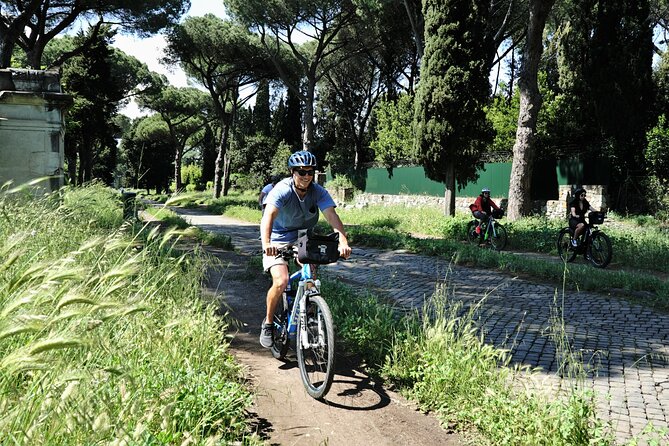
- Electric-assist e-bikes help you enjoy ruins and parks without punishing your legs
- Two duration options let you choose between a shorter route and a catacombs-focused day
- Small groups (max 10) make navigation and Q&A feel relaxed
- A mix of city connectors and park riding keeps it practical while still peaceful
- Catacombs access is guided only on the 6-hour version
Appian Way by e-bike: what the day really feels like
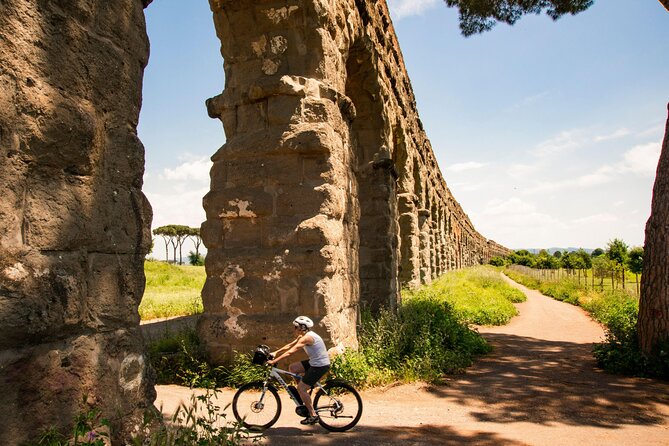
Rome can feel nonstop. This tour is different because it gets you outside the heavy crowds and into the stretches where the ancient world still shows through. The big win is that you are traveling by bike through the Appian Way Park and Aqueducts Park, not just arriving for a quick photo. You get the sense of distance—how these monuments link together across suburbs—while staying in motion.
The e-bike is not just a convenience. It changes the whole rhythm. Instead of saving your energy for walking, you can slow down at stops, listen, and then roll on. Most of the route is planned to avoid traffic, but you are not in a car-free bubble the entire time. You will ride some carefully chosen city streets to connect parks, so you should go in ready to pay attention.
Also, the logistics are built for sanity. You return to the same meeting point, and the itinerary is paced in short segments: brief looks at monuments, then a couple longer ride blocks and one guided catacombs visit (on the longer option). That makes it feel like a sightseeing day, not a forced march.
You can also read our reviews of more tours and experiences in Rome.


Choosing between 4 hours and 6 hours (and how that changes the catacombs)
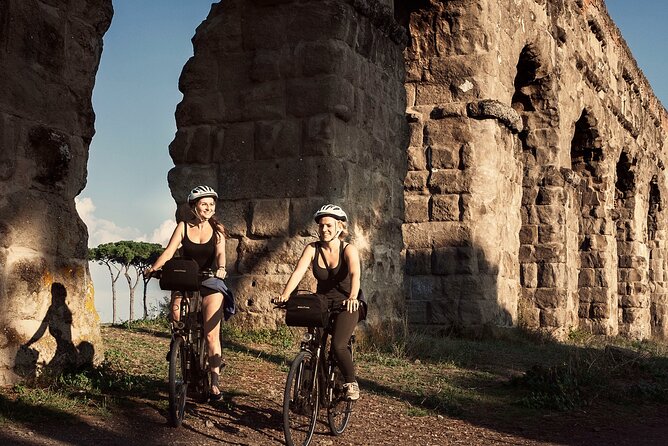
Both versions start the same way and follow the Appian Way corridor, but the big difference is what you do with the catacombs.
The 4-hour tour includes a short pause at Catacombe di San Callisto. On Wednesdays, that stop is not included in the 4-hour option. That means if catacombs are a must for you, you may want to pick the 6-hour schedule instead, even if you’re trying to fit the day into a tight itinerary.
The 6-hour tour includes a guided visit of the catacombs for about 45 minutes. The guide is with you through the important areas and explains what you are looking at. On Wednesdays, the 6-hour option swaps to Catacombs of San Sebastiano instead of San Callixtus. If you’re visiting around a holiday season, note that on Easter Sunday (April 5, 2026) the catacombs are closed, so the 6-hour tour won’t be running.
If you want value in one sentence: the 6-hour option is for people who don’t just want to see the entrance, but want the underground story with guidance.
Starting at Porta San Sebastiano: the day’s ancient “front door”
Your ride begins at Via Labicana, 49, and the first major scene is Porta San Sebastiano. This gate sits inside the 3rd-century Aurelian Walls. It’s a powerful starting image because it reminds you that the Appian Way wasn’t just a road—it was a gateway for travel, movement, and power.
This stop is quick, but that’s part of the design. You’re not stuck waiting for a long introduction. You pass through the gate and then start shifting into the Appian Way proper, where the scale changes and the road starts to feel more like a historical corridor than a modern street.
Via Appia Antica: where Rome gets quieter fast
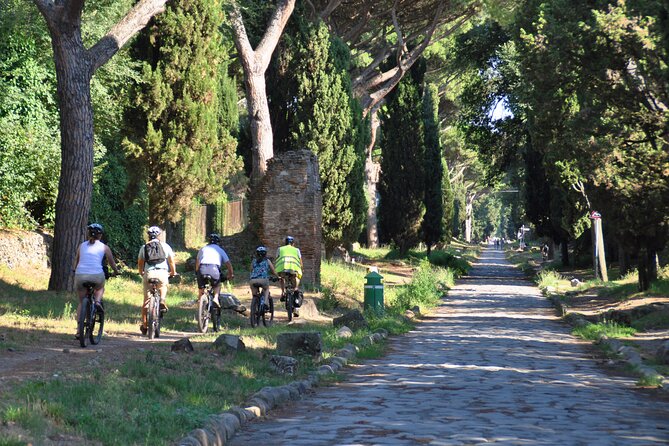
Once you roll onto the Appian Way, the experience changes from city-to-country in a way you can feel. The route gradually shifts from a more ordinary Roman street into a preserved ancient thoroughfare, inside the broader Appian Way Park.
This is where you’ll start understanding why biking works so well. The Appian Way is about distance—seeing the long line of ruins and the way the road cuts through landscape. On foot, it’s easy to lose time to fatigue. On a bike, you keep moving and you still get repeated moments to pull in close to landmarks.
The roads here are also where you’ll notice that the bikes are built for the route. You’ll be on chosen surfaces, often with uneven ground. It’s not extreme, but it is not perfectly smooth either.
Catacombe di San Callisto or San Sebastiano: what guided time adds
Catacombs are one of those places where a little guidance can make a huge difference. The underground world is complex, and without context it’s easy to miss what you’re seeing.
On the 4-hour tour, you get a short pause at Catacombe di San Callisto. On the 6-hour tour, you get a guided visit of the catacombs for about 45 minutes. That extra time is the difference between seeing the site and understanding it. You’ll also move as part of a group through areas that can feel tight and dim, so it helps to have a guide managing the pace and the path.
Also, if you’re planning around specific days: on Wednesdays, the catacombs included in the 6-hour tour switch from San Callixtus to San Sebastiano. On Easter Sunday, the 6-hour tour doesn’t run because the catacombs are closed.



Circus of Maxentius: a big structure that feels oddly cinematic
After the underground world, the Circus of Maxentius gives you a strong visual reset. You’ll see remnants of an Imperial complex built in the 4th century A.D., including a villa, a mausoleum, and a circus—a chariot racetrack setting.
This stop is brief, but it’s meaningful. It shows how Rome combined entertainment, power, and architecture into the same setting. Even from ruins, you can get a sense of grandeur, and the guide’s job here is to connect the dots between what is left and what once functioned.
Mausoleo di Cecilia Metella: funerary monument with real presence
Next is Mausoleo di Cecilia Metella e Castrum Caetani, one of the largest and best-preserved buildings on the Appian Way. It’s a 1st-century A.D. funerary monument consecrated to the memory of a young girl from a patrician family.
This stop is short, but it’s an easy one to remember. It’s one of those ruins that still has weight in the landscape. If you like architecture that feels both personal and monumental, this is the kind of place you’ll picture later when you’re back in central Rome comparing everything you’ve seen.
Villa dei Quintili and Santa Maria Nova: included only on the 6-hour route
If you choose the longer tour, you also visit Villa dei Quintili and Santa Maria Nova. This is a sprawling 2nd-century private villa complex tied to two of the richest brothers in Roman Imperial history.
This is not a quick blur. It helps break the day into more than just road-and-ruin. You get a sense of elite life and scale—how large properties shaped the Roman countryside. If you’re already doing a lot of major-city sightseeing during your trip, this stop helps you balance the day with a different type of Rome.
Parco degli Acquedotti: aqueducts that make water feel physical
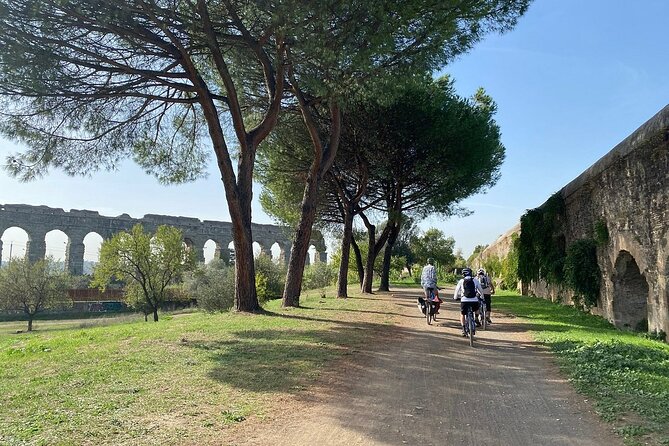
Now you enter Aqueducts Park, and it’s one of the best parts of the day because the scenery and the explanation match. You see colossal aqueducts and you hear how the system worked: a huge water supply built for ancient Rome, using underground sections and arched structures.
This is where listening matters. The aqueducts are massive, but without context they can just look like impressive stone. With the guide’s explanation, you start thinking about the city as an engineering problem that got solved at huge scale.
You’ll also appreciate the break from city stress here. Even though there is traffic at times when connecting between areas, this park portion is part of the reason people book this tour in the first place.
Terme di Caracalla: why baths mattered as social space
On the 6-hour tour, you also get to see the thermal baths of Caracalla from a good vantage point. Baths weren’t only about hygiene. In Roman life, they were a social and cultural hub—places where people gathered, talked, and spent time.
This stop gives you a different angle on Roman daily life. It’s not a battlefield or a temple. It’s a place for routine and community, seen through stone and scale.
Traffic, bumps, and the kind of fitness you actually need
Here’s the practical truth: about 40% of the route is in the city. You ride carefully selected streets, but traffic is unavoidable in those connectors. The other 60% of your ride takes place in parks with no traffic.
The surface can be bumpy, and the tour difficulty is intermediate. It’s described as difficult with a child seat or a child extension mounted on the bicycle. The bike equipment also has a weight limit of 300 lbs (136 kg), and the tour isn’t recommended if you aren’t confident on a bike.
If you have back or neck problems, pay attention. One review-style lesson here: this ride can feel rough at times because the ground isn’t always smooth.
E-bikes, helmets, and why safety feels real on this route
The bikes come with anti-puncture tires, which is quietly important on any road trip. You also receive a helmet (mandatory), plus a front bag and a biodegradable water bottle.
The safety setup is part of why the tour works for mixed groups. Routes are planned with limited access to traffic. Even when you hit narrow paths, the idea is to move in a controlled way and keep you off the kind of chaos that would turn a relaxing day into a stress test.
One more point: the company runs a maximum of 10 travelers. That’s big enough to feel fun and social, but small enough for the guide to manage spacing and make sure everyone can follow the pace.
Photo stops, pacing, and how to get the best out of the day
This is a moving tour with short stops. That means you should plan on quick photos rather than long hanging-around sessions. If you are worried about getting shaky shots while riding, you’ll do best by focusing on stopping moments and letting the bike carry you to the next view.
The pace is usually friendly, but you are still traveling. If you want your day to feel like a casual stroll, you may feel rushed. If you want a structured ride that keeps you seeing more, it’s a strong fit.
Also, the guide does a lot of the value work: the explanations connect the monuments to each other, so the day feels coherent instead of like separate roadside stops.
Value check: is this price fair for what you get?
At $102.79 per person, you’re paying for more than a bike rental. You’re paying for the guided route, the planning that keeps you mostly out of traffic, the helmet and e-bike gear, and—if you choose it—the guided catacombs visit on the 6-hour option.
Compared with doing this area alone, the cost feels reasonable because transportation and navigation are the headache. The route covers about 17 miles (27km), with a big portion off-road, and it strings together Porta San Sebastiano, Via Appia Antica, major ruins, the Aqueducts Park, and optional baths and catacombs. You’re not trying to piece together separate tickets and logistics while also trying to ride safely.
If you care most about engineering views and aqueduct scenery, the shorter option can still be worthwhile. If catacombs are a top priority, the 6-hour tour is the better value because you get guided underground time.
Who should book the Appian Way e-bike tour?
This is a great match if you:
- Want a day outside central Rome without feeling trapped in a vehicle
- Like ruins and architecture, but also want time to enjoy parks and scenery
- Are comfortable biking at an intermediate level, including some uneven ground
- Want a small-group guide who can answer questions
It may not be the best fit if you:
- Are new to bikes or not confident riding in tight spaces
- Have serious mobility limitations or feel uncomfortable with bumpy terrain
- Need a fully car-free, flat route the whole time
Should you book this tour?
I’d book it if you want a practical way to experience the Appian Way corridor and Aqueducts Park without spending your vacation in a queue or on a tiring walking loop. The e-bike setup and small group size are the magic combination here, and the catacombs guidance on the 6-hour version is worth your attention if that’s a must-do.
If you’re on the fence, pick the 6-hour option when catacombs matter to you, and choose the 4-hour option when you want a lighter day but still crave the Appian Way scenery.
FAQ
How long is the Appian Way, Catacombs and Aqueducts Park tour?
It runs for about 4 to 6 hours, depending on which duration you choose.
What is included with the e-bike?
You get a top quality e-bike with anti-puncture tires, a helmet (mandatory), and a front bag with a water bottle. You also get a local expert guide.
Is a catacombs visit included?
It depends on the version. The 6-hour tour includes a guided visit of the catacombs. The 4-hour tour includes a short pause at Catacombe di San Callisto, and on Wednesdays that stop is not included in the 4-hour tour.
Which catacombs does the 6-hour tour include on Wednesdays?
On Wednesdays, the 6-hour tour visits the Catacombs of San Sebastiano instead of those of San Callixtus.
How much of the route is off-road?
You cover about 17 miles (27km), with roughly 60% off-road.
How much of the ride is in the city?
About 40% of the route takes place in the city. The remaining 60% is in parks where you encounter no traffic.
What about traffic and safety?
The tour follows carefully planned routes with limited access to traffic. Some traffic is unavoidable on the city connectors, but the park sections are designed for calmer riding.
Is the tour suitable for children?
For children aged 5-8 years, a child extension (child streamliner) is provided. Children aged 9 and above can ride autonomously on an appropriately sized e-bike.
Do I need to be a confident cyclist?
The tour is not recommended if you are not self-confident on a bike. It’s listed as intermediate difficulty, and some parts can be bumpy.
What is the cancellation policy?
You can cancel for a full refund up to 24 hours before the experience starts. Changes within 24 hours of the start time are not accepted, and if the minimum number of travelers is not met, you may be offered an alternative date or a full refund.