REVIEW · FLORENCE
Basilica Santa Croce: Walking Among the Masters of Florence
Book on Viator →Operated by Star Florence · Bookable on Viator
Florence’s famous church rewards a guided walk.
I loved how the official certified guide makes the artwork feel connected—so you’re not just staring at masterpieces, you’re following the stories. I also liked that you get a radio system and a set route through the interior, crypt, and the cemetery, which keeps the hour moving instead of wandering. The main drawback is simple: the dress code is strict, and if you show up with uncovered knees or shoulders, you can be turned away.
Santa Croce is one of those places where everything matters: the paintings, the chapels, the tombs, even the scars from the 1966 flood. And with a small group capped at 20, you can ask questions without shouting over other people.
In This Review
- Key highlights you’ll actually notice
- A quick start at Dante’s Monument: Santa Croce’s setting matters
- Entering Santa Croce: Giotto and Gaddi, with stories you can follow
- The tomb section: where Florence gathers its most famous minds
- Donatello’s crucifix and Brunelleschi’s Chapel of Fools
- The 1966 flood story: damaged paintings and careful restoration
- After the interior: exterior marble, bell tower, crypt, and 16 chapels
- Price and value: what $58.05 buys in a short, high-impact hour
- Dress code and timing: the two things that can ruin your day
- Should you book the Santa Croce Basilica walking tour?
- FAQ
- Where does the Santa Croce tour start?
- How long is the tour?
- What’s the language of the tour?
- What’s included with the ticket price?
- Is there a dress code?
- Does the tour run in bad weather?
- How large are the groups?
- What happens if I’m late to the start time?
Key highlights you’ll actually notice
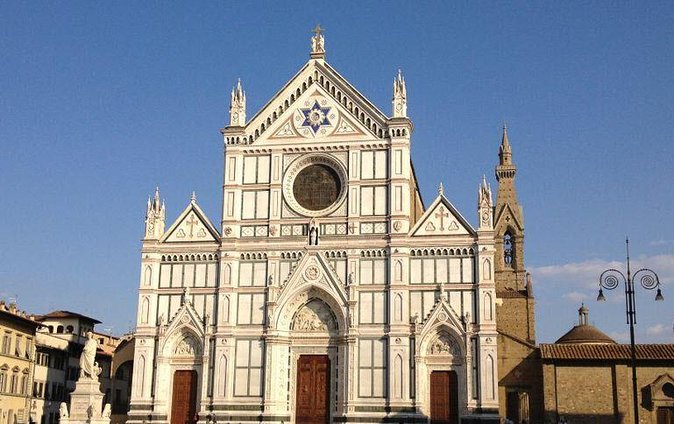
- Main square context: you start at Piazza di Santa Croce, tied to the June Calcio Storico Florentino tradition.
- Giotto and Gaddi on your radar: you’ll know what to look for in the Bardi and Peruzzi chapels and in the Cappella Maggiore (with frescoes dated to 1380).
- Renaissance names, not just dates: Donatello’s crucifix and Brunelleschi’s Chapel of Fools come with clear explanations.
- Tombs in one concentrated visit: you’ll see the resting places of major figures such as Michelangelo, Galileo, Machiavelli, and Rossini.
- Flood damage and restoration you can point to: you learn what was destroyed in 1966 and how it was restored.
- More than the church: the route includes the exterior façade, bell tower, crypt, and 16 chapels.
A quick start at Dante’s Monument: Santa Croce’s setting matters
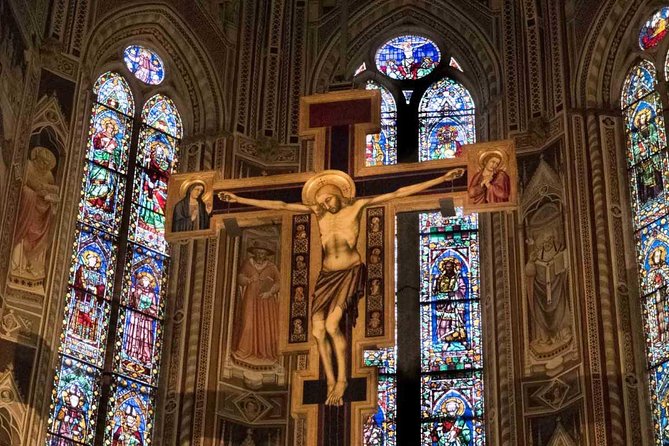
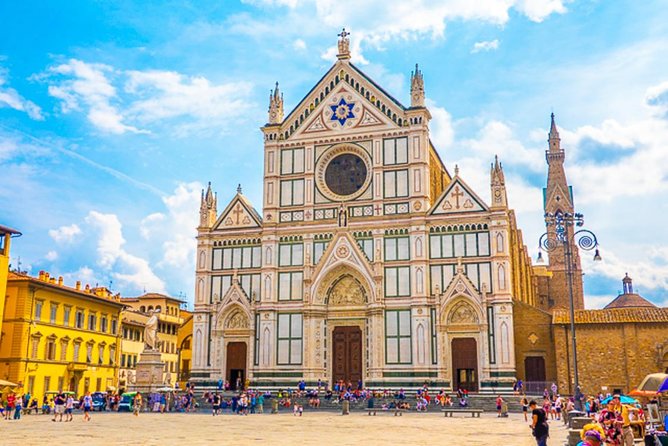
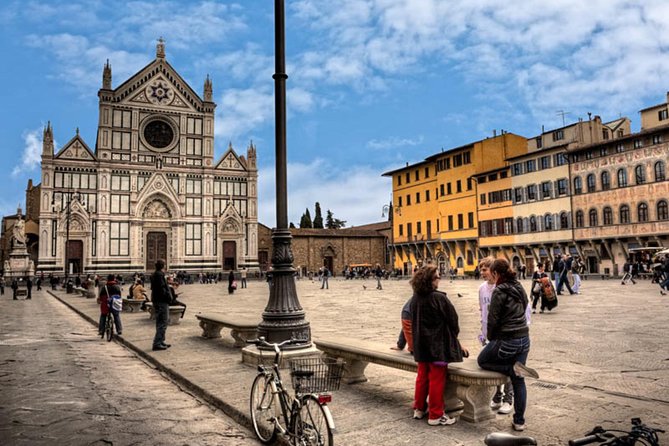
The tour begins at the Monument to Dante Alighieri in Piazza di Santa Croce. Even before you step inside, the guide helps you get your bearings fast: this square isn’t just scenery—it’s part of Florentine tradition. In June, it hosts Calcio Storico Florentino, the famous medieval-costume soccer spectacle.
That orientation changes how you experience the basilica. Instead of arriving cold, you understand the space as Florence understood it: civic life meeting religious art at full volume. It’s also a practical win, because once you’re inside, you’ll know where you are and why that matters.
You can also read our reviews of more tours and experiences in Florence.
- Tuscany Day Trip from Florence: Siena, San Gimignano, Pisa and Lunch at a Winery
★ 5.0 · 21,634 reviews


Entering Santa Croce: Giotto and Gaddi, with stories you can follow
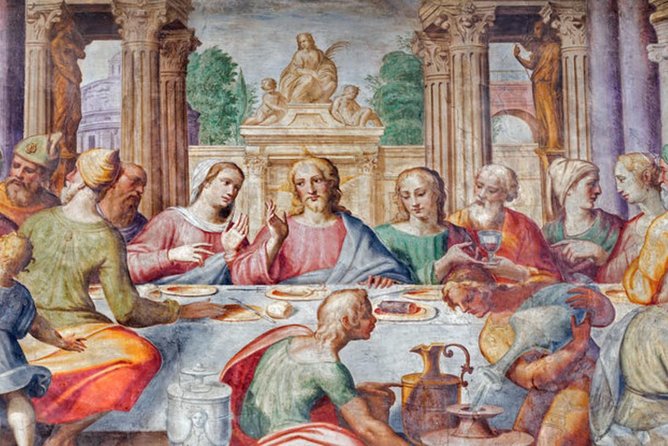
When you enter the basilica, you’ll spend time on the visual storytelling that makes Santa Croce famous. One standout is the Cappella Maggiore, where frescoes by Gaddi (dated to 1380) are used to tell the story of Santa Croce. The guide’s job here is crucial: the paintings are impressive on their own, but they’re far easier to appreciate when you know what scene you’re looking at and what role it plays.
You’ll also be pointed toward fresco work associated with Giotto in the Bardi and Peruzzi chapels. Again, you’ll see the art whether you have a guide or not. With a guide, you’ll stop treating it like a random collection of famous names and start reading it like a sequence—what’s happening, who the figures are, and why the chapel matters in the bigger plan.
If you care about how Florentine art developed, this section is where the tour pays off. You’re not just collecting photos; you’re collecting meaning.
The tomb section: where Florence gathers its most famous minds
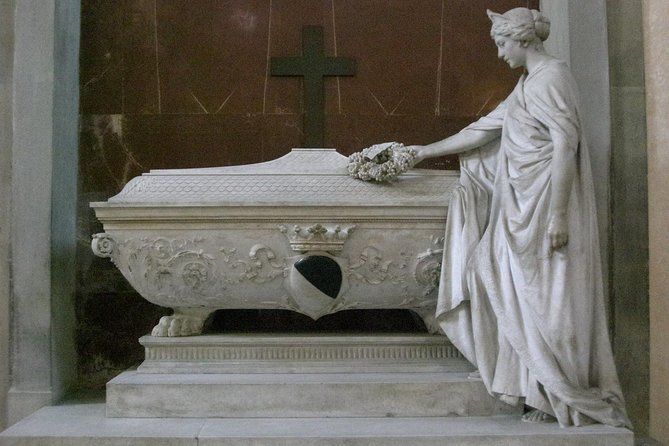
A big reason people book Santa Croce is the concentration of famous burials. You’ll see the monumental cemetery area and learn about the church as a place of remembrance, not only worship. Inside, you’ll get context for why these figures ended up here and what it signaled in Florence.
From the names highlighted on this tour, you can expect to encounter tombs linked with Michelangelo, Galileo, Machiavelli, and Rossini. The guide’s explanations help you connect the dots between art, politics, science, and culture—so the church becomes a kind of one-stop map of influential Italian life.
One practical detail: tomb areas can feel visually busy. The value of the guided hour is that you’re guided toward the details that matter and away from the feeling of wandering from plaque to plaque.
Donatello’s crucifix and Brunelleschi’s Chapel of Fools
Santa Croce has its share of famous artists, but the tour does a good job turning “I know that name” into “I understand what it meant here.” Donatello’s work is a key stop, including Donatello’s crucifix, described as one of the Renaissance jewels you shouldn’t rush past.
Then there’s Brunelleschi’s Chapel of Fools, which is a clever choice because it reminds you that this is not a single-style museum. Florence loved humor, symbolism, and surprise inside sacred spaces. When the guide explains the architecture and concept, the chapel feels intentional instead of odd.
This is also the part where a strong guide makes the biggest difference. Some guides are simply good at storytelling; others are good at answering the extra questions that pop up when you’re standing in front of something you didn’t fully understand five minutes earlier. If your guide happens to be someone like Matteo, Elena, Raphael, or Marcello (names that have come up in past groups), you’re likely to get a lively, question-friendly experience.
The 1966 flood story: damaged paintings and careful restoration
One of Santa Croce’s real-world chapters is the tragic 1966 Florence flood. The tour doesn’t treat it like a museum trivia item. You’ll be shown how artworks were damaged and how restoration efforts were carried out afterward.
This matters because it changes how you look. Freshly restored sections can look different from older work, and without context you might assume it’s all from the same era. With the flood story in your head, the church feels more human: art survives, breaks, repairs, and continues.
If you like seeing evidence of history rather than only reading about it, this is a worthwhile piece of the hour.
- The Best tour in Florence: Renaissance & Medici Tales – guided by a STORYTELLER
★ 5.0 · 12,316 reviews




After the interior: exterior marble, bell tower, crypt, and 16 chapels
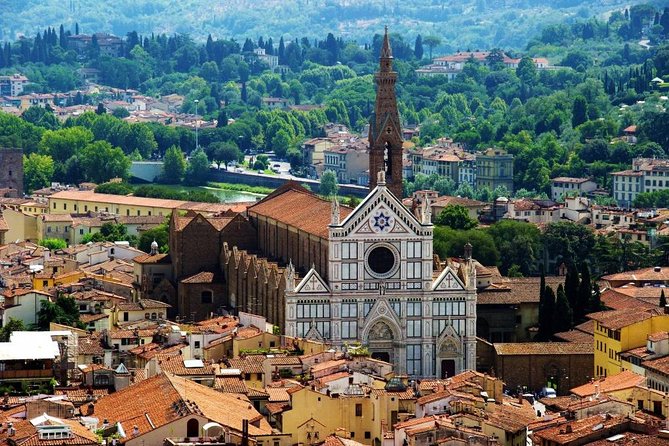
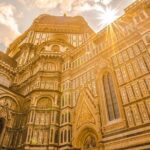
Santa Croce doesn’t stop at the nave. After the interior, you’ll learn about the exterior, including its polychrome marble façade—the kind of façade you’d normally pass without thinking if you weren’t in a structured route.
From there, the tour expands into some of the areas that many casual visits skip: the bell tower, crypt, and 16 chapels. In about an hour, that’s a lot of ground—but it works because the guide keeps the focus tight and the walking purposeful. You’ll also have a chance to return to anything you want to see again once the guided portion ends.
If you’re the type who likes “all the key rooms, efficiently,” this structure is exactly what you want. If you prefer slow, unstructured browsing, you might feel a little rushed—though the tour is still short enough to let you slow down after.
Price and value: what $58.05 buys in a short, high-impact hour
At about $58.05 per person for roughly one hour, the price looks steep on paper. But the value is real when you consider what’s included: an official certified guide, entrance tickets with reservations, and a radio system so you don’t miss explanations.
Also, the church is busy in peak seasons. Having reservations means you’re not spending your limited vacation time in ticket lines if you can avoid it. One review phrase stuck with me in spirit: if you’re there in summer, “beat the line” is the difference between enjoying the day and starting it frustrated.
One other value point: the tour caps at 20 travelers. That keeps the experience more personal than big-bus sightseeing, especially in tight church spaces where everyone wants to look at the same wall.
If you’re hunting for pure bargain travel, this might not be for you. But if you want the best chance to see the right things in the right order, it’s a smart use of time.
Dress code and timing: the two things that can ruin your day
Santa Croce is a place of worship, so you need a proper outfit. The rule is clear: no shorts and no sleeveless tops. Knees and shoulders must be covered for both men and women. If you don’t comply, entry can be refused—and the tour won’t be rescheduled or refunded.
Timing also matters. If you arrive after the tour start time, you won’t be able to join, and you won’t get a reset date. That’s not the operator being difficult; it’s how scheduled entry and group movement works.
On a more positive note, the tour operates in all weather conditions, so you can plan without worrying that rain will cancel the day. Just dress appropriately so you can stand and walk comfortably.
Should you book the Santa Croce Basilica walking tour?
Book it if you want the fastest way to understand what you’re seeing. This tour is built for people who like art and want the connections: Giotto and Gaddi in context, Donatello and Brunelleschi explained clearly, and the flood restoration story put into human terms. It’s also a strong fit if you care about famous burials and want more than a quick glance at names.
Skip or reconsider if you’re mainly interested in drifting and reading every plaque slowly on your own. The guided hour is structured, and you’ll be moving through interior areas, crypt, cemetery, and chapels in a set flow. Also think twice if you tend to arrive late or travel with clothing that doesn’t meet the dress code.
Overall, if you can follow the simple outfit rules and you’re okay paying for a guide plus reserved entry, this is one of the more efficient ways to experience Santa Croce at full meaning.
FAQ
Where does the Santa Croce tour start?
It starts at the Monument to Dante Alighieri, located in Piazza di Santa Croce, 50122 Firenze FI, Italy.
How long is the tour?
The tour runs for about 1 hour (approx.).
What’s the language of the tour?
The tour is offered in English.
What’s included with the ticket price?
You get an official certified guide, a radio system to hear the guide, and entrance tickets with reservations.
Is there a dress code?
Yes. You must cover knees and shoulders. That means no shorts and no sleeveless tops. Refusal of entry due to dress code means you won’t be rescheduled or refunded.
Does the tour run in bad weather?
Yes. It operates in all weather conditions, so dress appropriately.
How large are the groups?
The tour has a maximum of 20 travelers.
What happens if I’m late to the start time?
If you arrive after the tour start time, you won’t be able to join the tour and you won’t be refunded or rescheduled.
You Might Also Enjoy

More Tour Reviews in Florence
- Tuscany Day Trip from Florence: Siena, San Gimignano, Pisa and Lunch at a Winery
★ 5.0 · 21,634 reviews - The Best tour in Florence: Renaissance & Medici Tales – guided by a STORYTELLER
★ 5.0 · 12,316 reviews