REVIEW · ROME
Colosseum and Roman Forum Sightseeing Area Night Walking Tour
Book on Viator →Operated by What About Tours · Bookable on Viator
Night makes Rome feel close.
This Colosseum and Roman Forum area walk hits the sites after dark, when the light turns ruins into something you can actually read with your eyes. It’s also budget-friendly in a way few Rome tours are, since it’s essentially a tip-supported format with panoramic viewpoints rather than paid monument entry.
My favorite part is the photo-first route. You stop at the best sightlines for the Colosseum and the Forum, so you’re not just passing famous buildings, you’re framing them. I also like how the guides work the crowd with stories and answers, and you’ll see that reflected in real guide names like Simone, Jacob, and Max.
One drawback to think through: this is not an inside visit. You’ll see the Colosseum and Forum from outside, and you’ll still need separate entry tickets if you want to go in.
In This Review
- Key things that make this night walk worth your time
- Why a Colosseum-area night walk feels different
- Getting oriented fast: Largo Argentina after dark
- Capitoline Hill’s “wow” square and the Marcus Aurelius tie-in
- Roman Forum viewpoints without the ticket stress
- Trajan’s Market: the “shopping mall” comparison that helps
- Arch of Constantine: the Christian emperor and the political message
- The Colosseum: best outside viewing for the right kind of trip
- Guide quality, pacing, and the tip-only format
- What you should bring and how to plan your evening
- Who this tour is best for
- Should you book the Colosseum and Roman Forum night walking tour?
- FAQ
- Is the Colosseum entry ticket included?
- How long is the tour?
- What language is the tour offered in?
- Is it a ticket for the mobile phone?
- Where do I meet the guide?
- Where does the tour end?
- Is it a tip-based tour?
- How big is the group?
- What kind of walking should I expect?
- Are any stops free to enter?
- Can I cancel for a refund?
Key things that make this night walk worth your time
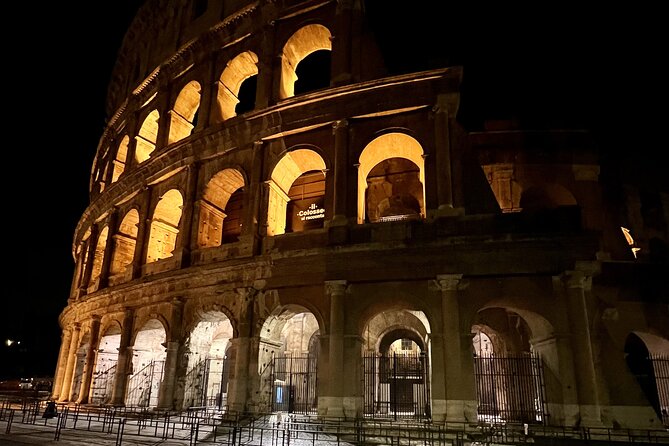
- Night photo viewpoints that focus on the Colosseum and Forum silhouettes, not just passing stops
- Licensed guide storytelling with time to answer questions and keep the pace easy enough for a relaxed evening
- Early Roman urban life stop at Insula dell’Ara Coeli, a rare look at multi-story apartments from almost 2,000 years ago
- Capitoline Hill art and symbolism at Michelangelo’s Piazza del Campidoglio with a Marcus Aurelius reference point
- Commerce and power in one route through Trajan’s Market and the Arch of Constantine
- Small group size (max 25), which helps you find your footing and keep the group together
Why a Colosseum-area night walk feels different
Rome has a daytime mode and a night mode. At night, the crowds thin out, the stones look darker and older, and your brain stops treating the ruins like postcards and starts treating them like places where real people lived and ruled.
This tour is built around that shift. You’re not here to race through ticket lines. You’re here to see the shapes, find the best angles for photos, and understand what you’re looking at without needing to enter every monument.
And since the format is tip-based, you’re not paying a big fixed cost for access that you might not even want. You’re paying mainly for a guide who can translate Rome’s layers into something you can follow in real time.
You can also read our reviews of more tours and experiences in Rome.
Getting oriented fast: Largo Argentina after dark
Your evening starts at Piazza dei Calcarari, and the first big historical jolt is Area Sacra di Largo Argentina. This is a cluster of ancient ruins tied to the late Republic, and it’s famous for two different reasons at once: temples from Ancient Rome and Pompey’s court—plus the grim note that Julius Caesar was assassinated here.
At night, this stop works because you can slow down. You’re not stuck squinting at distant walls. A good guide helps you connect what you see (ruins that look scattered) to what mattered politically (space that was tied to major events).
Time is short here, around 15 minutes, so come with the expectation that you’re getting a fast, sharp foundation. If you try to treat this like a full museum visit, you’ll feel rushed. But if you treat it like a storytelling opening, it clicks.
Capitoline Hill’s “wow” square and the Marcus Aurelius tie-in
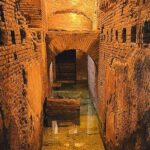
Next, you’re headed to Insula dell’Ara Coeli—an important reminder that ancient Rome wasn’t just temples and emperors. This area shows how Romans lived in multi-story apartments nearly 2,000 years ago, tucked beside Capitoline Hill.
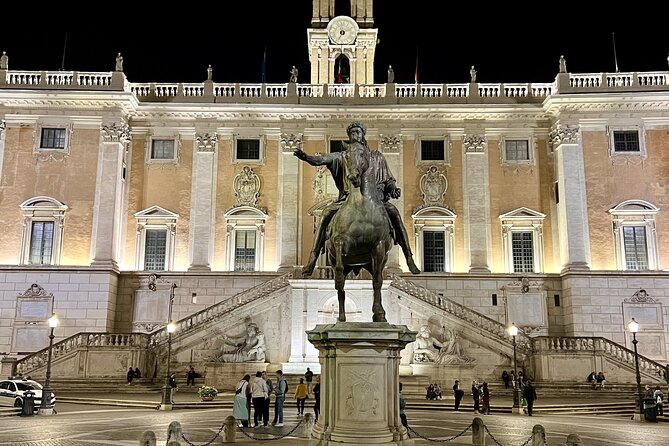
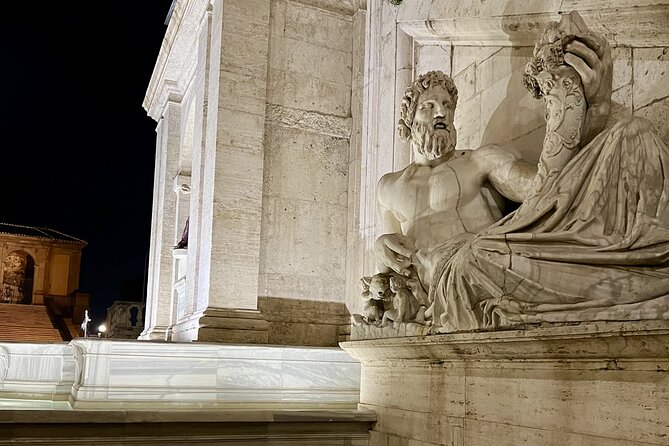
Then you move to Piazza del Campidoglio, designed by Michelangelo. The square’s oval layout and the central bronze reference to Marcus Aurelius make it feel like a stage set. If you’ve ever wondered why Renaissance planners cared so much about ancient Rome, this is one of those moments where the answer feels visual.
A final quick stop focuses on the Replica Statua Equestre di Marco Aurelio. It’s not just a statue moment. It’s a bridge to how Marcus Aurelius became a symbol of Stoic discipline and reflection—especially through his writings collected as Meditations.
For me, this section matters because it stops history from being abstract. You go from assassination and politics to daily life and philosophy within a few short steps, and the night setting makes the contrasts easier to feel.
Roman Forum viewpoints without the ticket stress
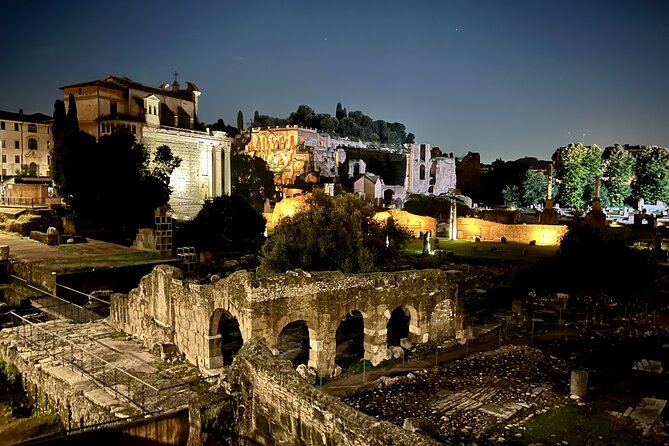
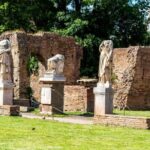
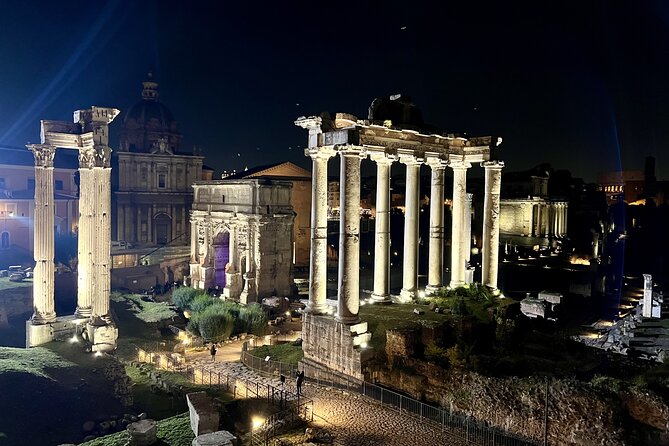
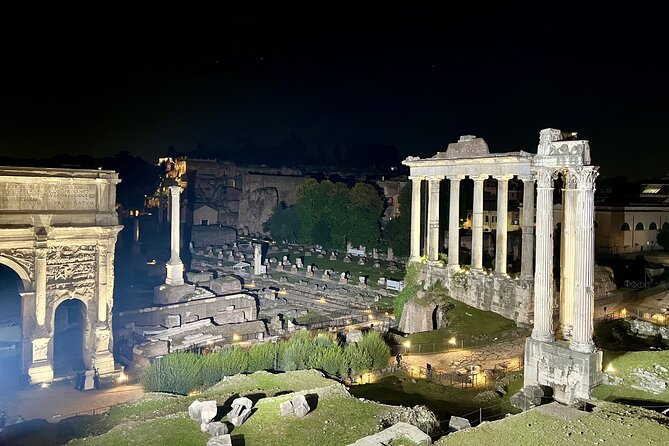
The tour then shifts into the Roman Forum zone, with an important reality check: you view the Foro Romano from outside, and you don’t get entry included. That means you won’t walk the interior paths like someone on a full excavation visit.
But here’s what you gain. The guide can point out the logic of the place: temples, arches, and marketplace areas that were once the everyday center of power and politics. You’re learning how the empire’s machinery looked on the ground.
You’ll also get a stop at the Forum of Augustus. Augustus transformed the Republic into the Empire and helped usher in the Pax Romana, a period remembered for stability. When someone explains that transition while you’re standing near the remains, the scale stops being theoretical.
If you want to go inside the Forum or the Colosseum, you’ll need separate entry tickets. If you want a high-impact night overview that helps you make sense of what’s outside your line of sight during daytime chaos, this is a smart compromise.
Trajan’s Market: the “shopping mall” comparison that helps
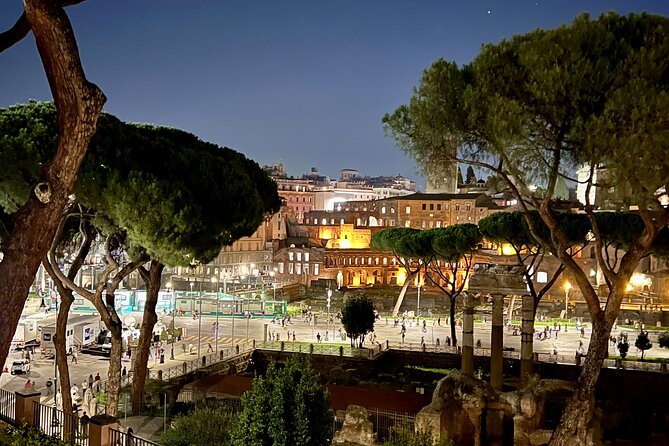
Trajan’s Market is next, and it’s one of those stops that makes the Roman world feel surprisingly familiar. You’re looking at a multi-level complex often described as an early version of a shopping mall, with over 150 shops and offices mentioned in the tour description, built around 110 AD.
Even if you don’t care about economics, the architectural idea is the point: Rome scaled commerce vertically and wrapped daily life into stone corridors. That’s a theme you’ll keep seeing across the tour—Rome as a system, not just a pile of monuments.
Because this segment is short, you shouldn’t expect a full floor-by-floor breakdown. Instead, focus on the arches and the stacked layout. Once you see that once, you’ll understand why Romans built places where people didn’t just work. They moved, shopped, and interacted in the same public footprint.

Arch of Constantine: the Christian emperor and the political message
The Arch of Constantine is a quick but meaningful stop. Constantine is described here as Rome’s first Christian emperor, and the context offered connects two huge shifts: the rise of Christianity and the move of the empire’s center toward Constantinople.
Arches are propaganda in stone. They compress a political story into a single frame you can stand under and look at. At night, that framing feels more dramatic because your eyes don’t have competing details from daytime signage and modern crowds.
This stop is about learning the “why,” not collecting every inscription detail. Let the guide connect it back to the bigger story of how Rome’s identity kept changing while the empire’s architecture kept broadcasting authority.
The Colosseum: best outside viewing for the right kind of trip
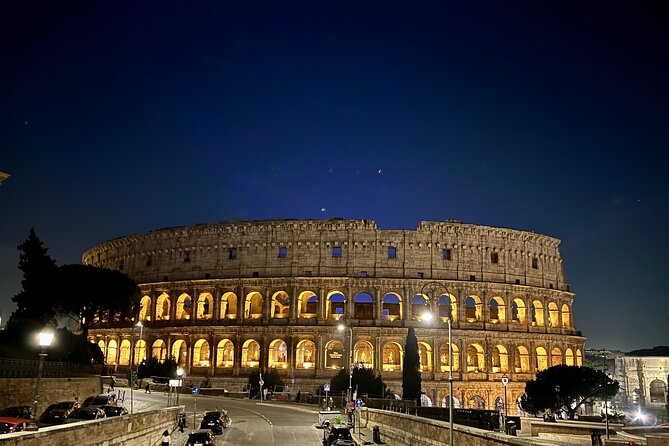
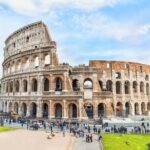
The final major moment is the Colosseum. You’ll come to the end in front of the monument at Piazza del Colosseo, and you’ll see why the building is still a global icon.
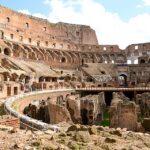
One key note: this is not an internal visit. The tour doesn’t include entrance tickets for the Colosseum, and it doesn’t take you inside. So you won’t be walking the arena floor or using the full interior experience.
What you will do is get something more practical for many people: guidance to panoramic photo views of the Colosseum and the surrounding Forum area from outside. The tour description even highlights that the sights are about views, not entry.
And once you understand what you’re looking at—spectacles that once reached up to 80,000 spectators—the outside walls suddenly stop looking like a backdrop. They become a diagram of mass entertainment and political power.
If you’re the type who wants your Colosseum visit to feel staged and efficient, this tour pairs well with doing entry later on a separate day. If you’re the type who hates lines and wants to feel the place quickly, this tour can be a perfect first taste.
Guide quality, pacing, and the tip-only format
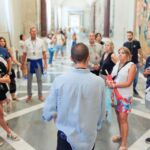
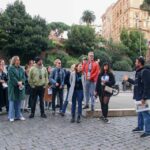
This tour is capped at 25 travelers, which is the sweet spot where you can still ask questions without the group splintering. And the average duration is about two hours, so you can treat it as a great evening anchor without sacrificing your dinner plans.
The reviews data you’re given supports a pattern: guides bring humor, answer questions clearly, and keep the group moving even when weather turns. One guide name that shows up repeatedly is Simone, and another is Jacob. Max and Jacopo are also mentioned, along with Ivana being credited for showing good picture spots.
Since it’s tip-based, I’d think of this as paying for interpretation more than for access. If you’re hoping to buy a cheap ticket and treat it like you also got paid entry, you’ll feel mismatched. If you’re hoping to connect the dots and see the Colosseum and Forum area in a guided, photo-friendly way, you’ll probably feel it was a smart use of time.
The price is listed as $3.87 per person, which is exceptionally low for a guided two-hour experience. That doesn’t automatically mean it’s low-value; it usually means the main cost is carried through your tipping and not through a big ticket price.
What you should bring and how to plan your evening
You’re walking and standing for around two hours, with moderate physical fitness recommended. Nights in Rome can be cooler than you expect, and rain happens. One of the guide accounts you’re shown is specifically about continuing in cold rain, so plan for weather rather than hoping for perfect conditions.
Wear shoes you trust. You’ll be on uneven sidewalks and you’ll stop often for photo angles and explanation. If you rely on fashion sneakers with no grip, save yourself the stress.
For photos, bring what you use consistently. The tour is set up for photography at night, but you still need a camera setup you can operate quickly while you’re also listening.
Who this tour is best for
This is a strong fit for:
- First-time Rome visitors who want a fast, guided orientation in the Colosseum/Forum area
- People who prefer outside viewpoints over museum-style stops
- Travelers on a tight budget who still want a licensed guide and a story-led walk
- Anyone who likes connecting politics, daily life, and philosophy through the same route
It may not be your best match if you specifically want to go inside the Colosseum and Forum complex during this time slot. Since the tour focuses on outside views, your “wow” factor may feel incomplete if inside access is your top priority.
Should you book the Colosseum and Roman Forum night walking tour?
If your goal is to understand what you’re looking at and to get great nighttime views without paying for entry, I’d book it. The route gives you a guided way to move from the assassination context at Largo Argentina to daily life at Insula dell’Ara Coeli, then to the Forum logic, then to Trajan’s Market and the Arch of Constantine, and finally to the Colosseum exterior.
Before you commit, make one clear decision: do you want inside access during your Colosseum visit? If yes, plan separate tickets for entry on another day. If no, and you’d rather spend your time learning the story and getting photos with fewer crowds, this night format is a solid value.
FAQ
Is the Colosseum entry ticket included?
No. The tour does not include the entrance ticket to the Colosseum or the Roman Forum, and it does not include internal visits. You’ll see monuments from outside.
How long is the tour?
It’s listed at about 2 hours.
What language is the tour offered in?
The tour is offered in English.
Is it a ticket for the mobile phone?
Yes, you receive a mobile ticket.
Where do I meet the guide?
The tour starts at Piazza dei Calcarari, 00186 Roma RM, Italy.
Where does the tour end?
It ends in front of the Colosseum at Colosseum, Piazza del Colosseo, 1, 00184 Roma RM, Italy.
Is it a tip-based tour?
Yes. It’s described as tip-only, meaning the guide works for your tips alone.
How big is the group?
The tour has a maximum of 25 travelers.
What kind of walking should I expect?
Moderate physical fitness is recommended. You should expect walking and standing for about the length of the tour.
Are any stops free to enter?
Some stops are described as free, such as Area Sacra di Largo Argentina and Insula dell’Ara Coeli. Other major areas like the Roman Forum and Colosseum are noted as not included for admission tickets.
Can I cancel for a refund?
Yes. It offers free cancellation up to 24 hours in advance for a full refund.