REVIEW · SICILY
Guided tour of the salt pans of Trapani and the Salt Museum
Book on Viator →Operated by Saline Culcasi - Riselva del Mare - Museo · Bookable on Viator
White salt, blue sea, and a walk in time. This guided trip around the Trapani salt pans and the WWF reserve shows you how Sicilian sea salt is made, in a place where colors really do look unreal. Then you step into the Museo del Sale to connect the working saltworks to the people who kept it going.
I love the hands-on part of the salt pan walk—seeing the tanks, then collecting salt with your own hands as you follow the process. I also love the museum stop inside an ancient baglio, where you learn how long salt work has shaped this coast, including an ancient mill from the 1400s.
One consideration: getting there is easiest with a car (or a taxi). The meeting point is in Paceco, and it’s not set up with public transport from Trapani, so plan extra time and cost if you’re relying on rides.
In This Review
- Key highlights
- Salt Pans Near Trapani: why this short tour hits hard
- Walking the Riserva Naturale Saline di Trapani e Paceco
- Museo del Sale: the 1400s mill inside an ancient baglio
- Understanding the salt process you can actually picture
- English tour experience: pace, guides, and how to follow along
- Price and value: is $21.77 a fair deal?
- Getting to the salt pans from Trapani: plan your transport early
- Should you book the Saline Culcasi salt pans and Museo del Sale?
- FAQ
- FAQ
- Where is the meeting point for this tour?
- How long does the tour last?
- Is the guided tour available in English?
- Is this a private tour or do I share with other groups?
- What’s included in the ticket price?
- What happens if the weather is poor?
- Can most people join, and are service animals allowed?
Key highlights
- 50-minute walk around the salt pans with views of sea, clay, and pale salt tanks
- WWF reserve setting with protected plants and birds, plus water that mirrors the sky
- Salt-making steps you can follow, including collecting salt with your hands
- Museo del Sale in a historic baglio with an ancient 1400s mill
- Two-guide setup during the English experience, with one guide easier to follow than the other
- Small tasting to cap off what you just learned
Salt Pans Near Trapani: why this short tour hits hard
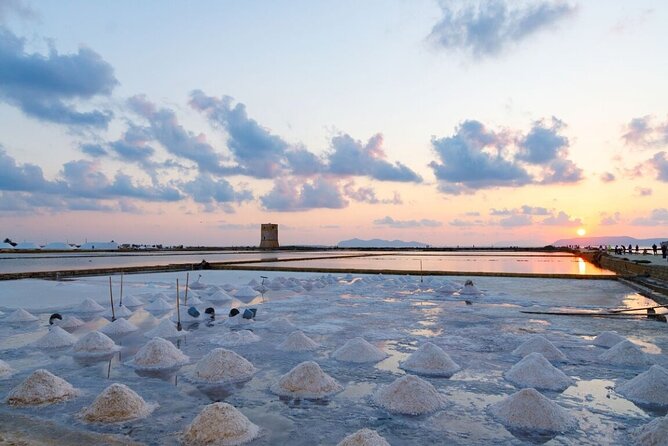
Sicily has plenty of big-ticket sights, but salt is the kind of local story you don’t forget. Here, it’s not an exhibit behind glass. You’re walking in an active salt environment, where sea water gradually turns into the white crust people use every day.
What makes this tour feel worth it is the flow. You start outdoors, with a guided route that shows you the geometry of the pans and the way water, clay, and salt change shade. Then you move indoors to the Museo del Sale and the 1400s mill, where the saltworks become a human story—work, family, tools, and generations of know-how.
The time is reasonable too. At about 1 hour 15 minutes total, it fits neatly into a day in Trapani without stealing your whole afternoon. And you don’t just hear facts—you see what they’re talking about. That’s the difference between a pass-by photo stop and an actual experience.
You can also read our reviews of more tours and experiences in Sicily.


Walking the Riserva Naturale Saline di Trapani e Paceco

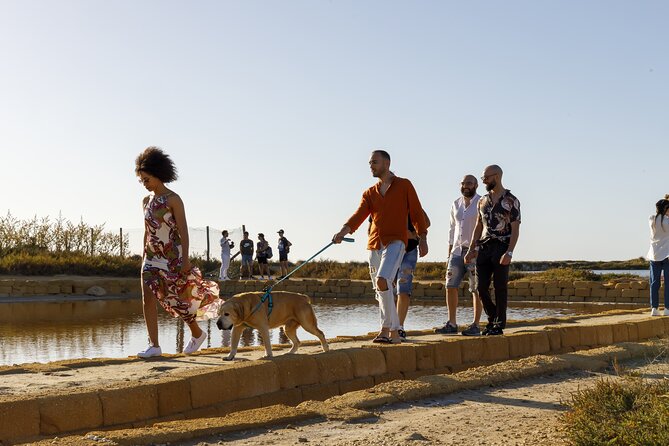
Your first stop is out in the Riserva Naturale Saline di Trapani e Paceco. This is your chance to take a relaxed walk along the perimeter of the salt pans. The guide points out the “palette” that makes these places so distinctive: whites for the salt, blues from the sea, gray clay, and the pink tones you can sometimes see around the tanks.
The route follows the edges of the reserve until you reach the banks where the water can look like a mirror. On a clear day, the effect is practical as well as pretty—you get a better read on the pans’ layout and how water moves through the salt production system.
This walk also helps you understand the logic of salt farming. Instead of a classroom explanation, you’re following the process step by step as you move through the area. You’ll see how sea water is transformed into salt in the tanks, and you get a small “hands-on” moment by collecting salt with your own hands.
A WWF reserve setting matters here. The area includes protected plants and birds, so you’re not just visiting a factory. You’re walking through a living landscape with rules and boundaries meant to protect the ecology. That adds a quiet kind of realism—this is work that has to coexist with nature.
One practical tip: wear shoes you’re okay with getting a little dusty. Salt environments aren’t muddy like a wet swamp, but you’re walking on ground that can be dry and pale. Light-colored surfaces also hide scuffs, so you’ll want footwear that won’t mind the texture.
Museo del Sale: the 1400s mill inside an ancient baglio
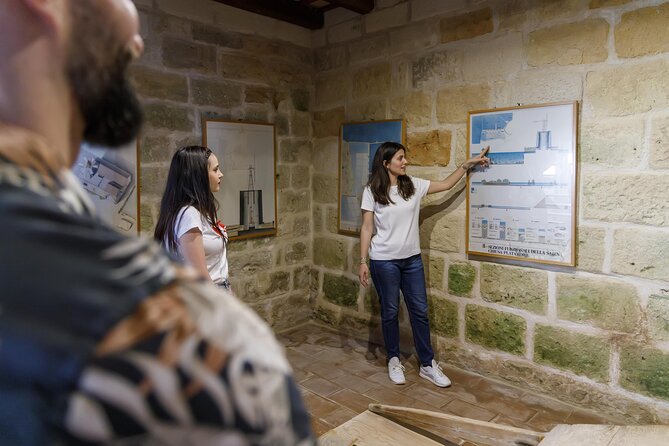
After the outdoor walk, you head to the Museo del Sale for a guided look at the history behind the saltworks. The museum sits inside an ancient baglio, which is a traditional rural complex. That building alone changes the feel of the visit—you go from open sky and sun to enclosed rooms where the story of salt feels more grounded.
This part of the visit focuses on two things:
1) the production work itself (the tiring, repetitive labor salt pan life required), and
2) the family history—how one family ran the saltworks for generations.
A standout detail is the ancient mill from the 1400s. Even if you’ve never thought about milling or water handling, it gives you a sense of how long the region has been refining the “salt economy.” You start connecting the dots between what you saw outside (tanks, water movement, salt forming) and the tools people built to manage it.
The museum visit is also where you can get the most “aha” moments about what salt pan operations looked like before modern convenience. Tools on display help you picture how labor translated into something as simple as a kitchen pantry staple.
You may also see references to classic water-lifting methods used in saltworks, including the Archimedes screw, which one guide style highlights as especially interesting. It’s the kind of detail that makes you rethink how much engineering went into something as basic as moving water between stages.
Timing matters in museums. If there are many people in the same space, hearing can get tricky, especially when there are multiple guides. If you’re sensitive to sound, position yourself where the guide can see you and you can clearly hear the main explanations.
Understanding the salt process you can actually picture
The best part of this tour isn’t just that salt is discussed. It’s that you can picture the transformation.
On the salt pan walk, the guide shows you the sequence: sea water enters, conditions change in the tanks, and salt forms. You’re walking along the perimeter and then toward the banks where the water reflects the sky. That visual cue helps your brain understand that production depends on water behavior—flow, evaporation, and how different surfaces hold or release moisture.
Then the museum connects that outdoor “system” to the human side: the work cycles, the tools, and the long-term family operation. It’s the difference between knowing that salt comes from the sea and understanding how much structure and labor turn that sea water into consistent crystals.
Also, don’t skip the small tasting if it’s offered during your tour. In a short experience like this, that moment gives your learning a quick sensory anchor. It’s not going to replace a Sicilian food tour, but it can help salt feel real instead of abstract.
If you like photos, you’ll get plenty. The white tanks against sea blue can look almost too perfect. But my advice is to prioritize the guide’s explanation over the camera sprint. A lot of the beauty is tied to what stage of production you’re seeing, and that context helps your photos mean something later.
English tour experience: pace, guides, and how to follow along
This is offered in English, and you’ll be with a private group—only your group participates. That’s a big plus in a setting like this, because you can ask quick questions and the guide can adapt the tempo to your comfort.
The tour is built in two parts: about 50 minutes for the salt pan walk (with admission included) and about 25 minutes for the museum (also with admission included). In total, it lands around 1 hour 15 minutes.
From an experience-logic standpoint, the split makes sense. Outdoors, you need time for walking, photos, and visual explanations. Indoors, you need time for the museum story and artifacts. Keeping both parts guided means you’re not left to guess what you’re looking at.
One detail I’d plan for: the English experience may be shared between two guides. One guide is often described as speaking English very well, while the other may have a stronger Italian accent. That doesn’t usually ruin the trip, but it does mean you should stay close to the front and don’t tune out when the second guide steps in.
If you’re the type who learns best by hearing the key points clearly, arrive a few minutes early so you can get a spot where you’re not partially blocked.
And yes, this tour is designed for a broad range of ages. It’s not an extreme hike. You do walk, though, so bring a layer. Even near the sea, air can feel cool if the wind kicks up.



Price and value: is $21.77 a fair deal?

At $21.77 per person, this tour sits in the “small price, big meaning” category—especially because admission is included for both stops. You’re paying for two guided experiences: the salt pan walk in the reserve plus the Museo del Sale visit and the ancient mill setting.
That matters. If the museum entry were extra, or if the outdoor part were just a self-guided stroll, the value would drop. Here, you get guided context for the production process and the historical framing. The museum isn’t just a building where you wander; it’s guided and tied directly to what salt pan work looked like.
Also, the format helps you avoid wasted time. You’re not assembling a puzzle of separate tickets, shuttle decisions, and unclear meet-up points. The tour has a clear start and ends back at the meeting point.
The only real value-eraser is transport. If you’re coming from Trapani without a car, you may need to pay for a taxi to and from the Paceco meeting area. That taxi cost isn’t part of the tour price, so it can change the math. If you already have a car, or you’re okay budgeting for a short ride, the $21.77 feels like a solid deal for what you learn and see.
As for timing, the salt pans can look especially good near sunset. One common recommendation is to choose a later time slot—around 6 pm—so you can enjoy the sunset effect. Even if the exact timing varies by day, aiming for golden light pays off.
Getting to the salt pans from Trapani: plan your transport early
Here’s the practical truth: the meeting point is in Paceco. Start is listed as Via Salina Chiusa, 1, 91027 Paceco TP, Italy, and the ticket redemption point is VIA CHIUSA – NUBIA, 91027 Paceco TP, Italy. The tour ends back at the meeting point.
What that means for you: Trapani’s center isn’t the same as Paceco. You should expect a drive, and you should expect that you may need a taxi if you don’t have your own car. One visitor specifically called out that without a car, this can feel like a hassle because public transportation isn’t a reliable option for reaching this location.
One more helpful detail: you’ll want to buffer your schedule. Even with a short drive, you don’t want to arrive rushed. Salt pans are best viewed with time, not just “get there, get out.”
If you’re organizing your day, I’d treat this as a primary plan, not a side errand. Slot it when you can comfortably handle the ride there and back, and you’ll enjoy it more.
Should you book the Saline Culcasi salt pans and Museo del Sale?
Book it if you want a real sense of place—salt production as a working system, not a static “museum object.” You’ll walk a reserve route, see how water turns into salt in the tanks, and then connect that outdoor process to the museum’s story of tools and family labor. With admission included at both stops and an English-guided format, the value is strong.
Skip or reconsider if transport is your weak point. If you don’t have a car and taxis add up fast for your budget, check whether that extra ride cost still makes sense for you. Also, if you’re extremely sensitive to hearing in crowded indoor spaces, choose your spot carefully during the museum portion.
My final take: this tour is short, but it teaches you something you can carry into the rest of Sicily. After seeing how salt is made here, even everyday salt feels like part of a coastal culture—one that has been working for a long time.
FAQ
FAQ
Where is the meeting point for this tour?
You start at Via Salina Chiusa, 1, 91027 Paceco TP, Italy. The activity ends back at the same meeting point. Ticket redemption is listed at VIA CHIUSA – NUBIA, 91027 Paceco TP, Italy.
How long does the tour last?
The tour is about 1 hour 15 minutes. It typically breaks down into around 50 minutes for the salt pan part and about 25 minutes for the Museo del Sale.
Is the guided tour available in English?
Yes. This experience is offered in English.
Is this a private tour or do I share with other groups?
It’s private. Only your group participates.
What’s included in the ticket price?
Admission tickets are included for both the salt pan stop and the Museo del Sale. A small tasting is mentioned as part of the experience.
What happens if the weather is poor?
This tour requires good weather. If it’s canceled due to poor weather, you’ll be offered a different date or a full refund.
Can most people join, and are service animals allowed?
Most travelers can participate. Service animals are allowed.