REVIEW · ROME
Rome: Colosseum Gladiator’s Arena and Roman Forum Group Tour
Book on GetYourGuide →Operated by Tour in the City - Travel Agency Rome - · Bookable on GetYourGuide
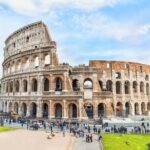
The Colosseum feels personal when you stand inside. This group tour gets you onto the arena floor, then strings together the Roman Forum and Palatine Hill while the stories are still fresh in your head. It’s a tight 2.5-hour loop through Rome’s most famous power spots.
I especially love two things here: the fast-track entrance with a special gladiator-access route, and the view from the arena floor that lines up directly with the underground areas. You also get headsets, so you can focus on the guide’s combat stories instead of craning your neck.
One thing to plan for: security can mean a 20–30 minute wait at the metal detectors, even with skip-the-line entry. And you’ll walk with some stairs, so it’s not a great match if mobility is an issue.
In This Review
- Key moments that make this tour worth it
- The Gladiator Entrance: Porta Libitinaria Changes the Mood
- Meeting at Piazza di San Clemente (and Getting Oriented Fast)
- Entering the Colosseum: Fast-Track Isn’t a Magic Spell
- Arena Floor Access: The View That Actually Hits
- First and Second Rings: From Stage to System
- The Roman Forum: Where Power Felt Like Daily Life
- Palatine Hill: Seeing Where Emperors Wanted to Be
- How the Guides Make It Work (Sam, Serena, and the Rest of the Crew)
- Price and Value: What $27 Buys You in Real Terms
- Timing, Pace, and What to Pack for the Day
- Who Should Book This Tour—and Who Might Want Another Option
- Should You Book This Gladiator + Forum Tour?
- FAQ
- How long is the tour?
- Where do I meet the tour group?
- Is this tour in English?
- Does the tour include skip-the-line entrance?
- Do I get access to the Colosseum arena floor?
- Which parts of the Colosseum do you visit?
- What’s included besides the Colosseum?
- Are backpacks or large bags allowed inside?
Key moments that make this tour worth it
- Arena-floor access that puts you in the same space as the gladiators
- Gladiator entrance route via Porta Libitinaria for a more authentic arrival
- First and second rings with a guide who explains how the spectacle worked
- A “look down on the undergrounds” moment from the arena floor
- Forum + Palatine Hill finish right where Roman emperors lived and ruled
- Small group size (up to 25) plus headsets for easier listening
The Gladiator Entrance: Porta Libitinaria Changes the Mood
Rome’s Colosseum can be a blur. Crowds push you along like a checklist. This tour tries to fix that by starting you in the Colosseum experience before you even reach the main arena.
The standout is the special access from the gladiator entrance at Porta Libitinaria. Instead of the usual “queue, shuffle, look, move on” flow, you enter in a way that matches the theme. Even if you’re not a gladiator fan, it works. You feel like you’re arriving for an event, not just sightseeing.
The group stays reasonably sized (up to 25), which matters at the Colosseum. Big groups turn history into crowd control. Here, you’re more likely to stay oriented and hear the guide as you move between major viewpoints.
This is also one of the better “value per minute” ways to do the Colosseum, because the tour doesn’t stop at the exterior. It turns the building back into a working stage—safely, obviously, but with the right perspective.
You can also read our reviews of more tours and experiences in Rome.
Meeting at Piazza di San Clemente (and Getting Oriented Fast)
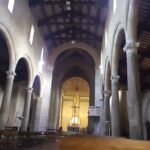
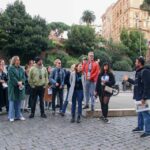
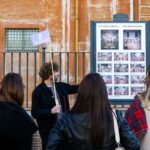
The tour starts at Piazza di San Clemente, in front of Basilica San Clemente. Staff members hold a signboard that reads Tour in the City.
You’ll end right back at the same meeting point. That’s helpful in Rome, where “one more stop” can easily multiply into missed plans. If you’re building your day around this, you can treat it as a contained block of time.
Plan for easy walking shoes. This is an indoor-outdoor mix with steps inside the Colosseum and paths around the Forum and Palatine Hill. You’ll be okay if you’re used to city walking, but don’t plan on wearing flimsy sandals and hoping for the best.
And do bring your passport or ID. Security in Rome is strict, and you’ll need photo ID for the checks.
Entering the Colosseum: Fast-Track Isn’t a Magic Spell
Yes, you get fast-track entrance and a separate entrance. That’s the point. The goal is to avoid the worst of the long lines that can eat up half your visit.
Still, don’t ignore the reality on the ground: you’ll pass through metal detectors, and waiting time can be 20–30 minutes to clear security. The good news is you’re not stuck in the main queue. The less-good news is you should build a little buffer into your mindset.
This is exactly where the tour’s pacing helps. A big line ruins the feeling. Here, you’re more likely to step into the Colosseum while your excitement is still intact.
Tip: arrive a few minutes early. The meeting point is easy enough, but Rome has a way of making you re-check streets because you’re distracted by gelato scents.
Arena Floor Access: The View That Actually Hits
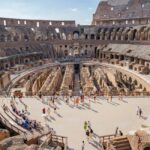
The heart of the experience is simple: you go into the Colosseum and make it to the arena floor. Not just a viewpoint from the edge—actual space in the arena where thousands once watched executions and animal hunts.
The emotional effect is hard to fake. When you’re down at ground level, the building stops being a photo. It becomes an engine built for spectacle.
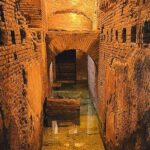
Then comes the clever detail: from the arena floor, you get a view directly above the undergrounds. That’s the part many people miss because they only look outward. The underground system is where the staging happened—machinery, animals, and performers coming in and out as the show demanded.
This is also where a good guide makes a difference. You’re not just looking at stone. You’re hearing how the combat stories worked, how timing mattered, and how the Colosseum was built for movement and drama.
As an extra layer, guides in this operator’s orbit have been described as making things visual. For example, Serena has been praised for using reconstruction images on an iPad to help you picture what you’re not seeing anymore. If you get a guide with that style, you’ll benefit a lot from the “I can see it” effect.
First and Second Rings: From Stage to System
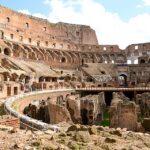
After the arena floor, the tour continues with visits to the first and second rings. That’s important. The Colosseum isn’t just a big circle; it’s a structure with logic.
At these levels, you can better grasp how Romans organized the crowd. You also start to understand the building’s engineering genius—the idea that it wasn’t built slowly as a monument. It was built fast enough to become a functioning theater of power.
Your guide will tie it all together with combat stories and context, including the entertaining theme of emperors who somehow got involved in the arena mythos—stories that make the history feel less like a lecture and more like a political drama with swords.
A lot of the strongest Colosseum tours do the same thing: they connect architecture to human behavior. Here, you get that in an organized sequence, so you don’t spend your time just pointing out features.
Also, the tour uses headsets, which I really appreciate. Inside the Colosseum, acoustics and noise can make you strain to hear. Headsets keep you from giving up halfway through the explanation.
And yes, there’s a downside: stairs. You’ll deal with them at multiple points. If you’re someone who gets worn out quickly, pace yourself and take the tour as an active sightseeing day, not a light stroll.

The Roman Forum: Where Power Felt Like Daily Life
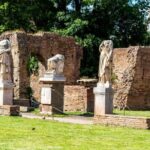
Once the Colosseum experience is done, the tour shifts to the Roman Forum with a guided walk of about one hour. This is where the Colosseum stops being “just a building” and starts being “part of a society.”
The Forum is chaotic in the best way—ruins, open space, and the sense that everyone’s walking through history without knowing it. Your guide helps you see the Forum as a living center of politics, law, and public life. Instead of wandering, you move with a plan.
You’ll pick up context for how the Romans used architecture to signal status. You’ll also understand why the next stop matters so much.
If you’re the type of traveler who likes the “why this place mattered” part, you’ll enjoy the Forum segment. It tends to answer the question: so what did Romans think they were watching when they watched gladiators?
Palatine Hill: Seeing Where Emperors Wanted to Be
Then you move on to Palatine Hill, about 45 minutes. This is the hill tied to the idea of elite living and imperial authority. It’s one of those places where even fragments feel meaningful because of the viewpoint and the sheer association with leadership.
The guide frames Palatine Hill as the neighborhood where Roman emperors lived, which gives the ruins a job. Instead of guessing which building belonged to whom, you get a narrative around power, residence, and status.
Palatine is also a useful way to end. The Colosseum is dramatic and loud; the Forum is civic and political; Palatine is personal and imperial. The emotional tone shifts in a satisfying way.
Practical note: weather matters on these open-air segments. Heat can hit hard. If your tour happens in warm conditions, do what the guide recommends for pacing, hydration, and shade opportunities.
How the Guides Make It Work (Sam, Serena, and the Rest of the Crew)
This tour lives and dies by the guide’s storytelling. The good news: the reviews give you a strong pattern of engaging presentation.
People have praised guides like Sam and Maximus for leading groups smoothly through multiple levels and keeping the experience informative and entertaining. Others—like Serena—are noted for making the tour fun and using reconstruction images to explain what you can’t easily picture from ruins alone. Fernando and Stephano have been called out as passionate and especially worth it for arena access.
Names come and go, but the recurring theme is consistent: guides turn the Colosseum into a story you can visualize, then carry that momentum into the Forum and Palatine Hill. If you’re on the fence about paying for a guided format here, this is the part that matters most.
Price and Value: What $27 Buys You in Real Terms
At $27 per person, you’re paying for three things that are hard to assemble on your own without effort:
1) Colosseum ticket + guided interpretation
You’re not just seeing the building. You’re getting context that turns stone into a functioning spectacle.
2) Skip-the-line with special entrance access
That’s not guaranteed at every price point. Here, you’re using a separate route that’s built for efficiency, even if you still clear metal detectors.
3) Forum + Palatine Hill included
A lot of ticket-only plans leave you with an extra day (or extra bookings) to cover the big second act. This gives you both sides in one guided loop.
Think of it as paying to save time and get the “how to read this place” layer. Rome has plenty of self-guided options, sure. But the Colosseum is not a casual site. It’s crowded, confusing, and massive. A guided plan helps you avoid the common mistake: spending all your energy finding your next photo spot instead of understanding what you’re looking at.
Timing, Pace, and What to Pack for the Day
The tour runs about 2.5 hours (exact start times vary), with the Colosseum portion around 75 minutes, then Roman Forum 1 hour, and Palatine Hill 45 minutes.
That structure is smart. You get the arena moment first, when you’re most energized. Then you transition to the Forum and Hill before you’ve burned out completely.
What to bring:
- Passport or ID card (required for security checks)
- Comfortable shoes (you’ll walk and climb)
- Sunscreen (especially for the Forum and Palatine)
What not to bring:
- Large bags, backpacks, luggage, or suitcases
The Colosseum doesn’t provide bag check here, so you can’t count on storing items after security.
- Selfie sticks (not allowed inside)
- Pets
- Unaccompanied minors
If you’re used to bringing a backpack for day trips, adjust your setup for this day. Pack light. Bring only what you truly need for a short Roman morning/afternoon.
Who Should Book This Tour—and Who Might Want Another Option
This is a great fit if you want:
- Arena-floor access without the headache of ticket chaos
- A tour that ties together the Colosseum with the Roman Forum + Palatine Hill
- A guided format that keeps you oriented and helps you interpret what you see
It’s less ideal if:
- You have mobility impairments or use a wheelchair. This tour is listed as not suitable for wheelchair users and those with mobility challenges.
- You’re hoping for a super slow, minimal-walking experience. There’s a moderate amount of walking and stairs.
If you’re bringing kids, it can work well because the Colosseum theme is naturally engaging, and the guide’s explanations tend to be story-based. Still, you’ll want to make sure your kids can handle the stairs and the time spent moving through security.
Should You Book This Gladiator + Forum Tour?
If your main goal is to see the Colosseum in a way that feels more than ceremonial—with arena access and a smart guided flow—this tour is a strong choice.
I’d book it if you want:
- A plan that gets you into the Colosseum quickly
- The arena-floor view over the undergrounds
- A second half that actually matters, not just a quick stop at the Forum
I’d think twice if:
- You’re very sensitive to security lines and waiting, since metal detectors can still take 20–30 minutes
- You need full accessibility accommodations
Overall, for $27 and a 2.5-hour guided format that covers Colosseum + Forum + Palatine with headsets and arena access, it’s priced like a practical upgrade—not a luxury add-on. If you want Rome’s biggest power stage plus the place where emperors lived, this is one of the cleaner ways to do it.
FAQ
How long is the tour?
The tour lasts about 2.5 hours, with the Colosseum visit guided for around 75 minutes, followed by about 1 hour at the Roman Forum and 45 minutes on Palatine Hill.
Where do I meet the tour group?
Meet at Piazza di San Clemente, in front of Basilica San Clemente. Staff will have a signboard that says Tour in the City.
Is this tour in English?
Yes. The live tour guide provides the tour in English.
Does the tour include skip-the-line entrance?
Yes. You use a separate entrance with fast-track entry, though you still must go through metal detectors.
Do I get access to the Colosseum arena floor?
Yes. The tour includes being inside the Colosseum and visiting the arena area, with a view directly above the undergrounds.
Which parts of the Colosseum do you visit?
You visit the first and second rings after spending time on the arena floor.
What’s included besides the Colosseum?
The tour also includes guided visits to the Roman Forum and Palatine Hill, plus the necessary Colosseum ticket and headsets.
Are backpacks or large bags allowed inside?
No. You can’t bring luggage, large bags, backpacks, or suitcases. The Colosseum does not provide a bag check, and selfie sticks are not allowed. A small bag may be possible, but large items will be a problem.