REVIEW · POMPEII
Explore Pompeii with an Archaeologist
Book on Viator →Operated by Askos Tours · Bookable on Viator
Pompeii hits harder with an expert. This tour is built for speed and clarity: skip-the-line admission helps you get inside without burning your morning, and you’ll get stop-by-stop explanations from an archaeologist guide. I also like that the group stays small enough to ask questions as you walk. The main drawback to plan for is that Pompeii can get crowded, so hearing (even with devices) may be a little harder at peak times.
I’d call this a smart “greatest hits” format. For $35.67 per person you cover a lot of ground in about 2 hours, with Pompeii admission included, and you finish still able to explore on your own. If you want a slow, room-by-room Pompeii deep dive, this may feel fast and you may want extra time afterward.
In This Review
- Key Things I’d Notice on Day One
- Stepping In at Porta Marina Superiore With Skip-the-Line Tickets
- How the 2-Hour Plan Actually Covers Pompeii’s Most Important Stops
- Foro de Pompeya and Basilica: The Civic Heart in Plain Terms
- Lupanar and Granaries of the Forum: Daily Reality With Contrast
- Houses of Menander and the Faun: Seeing Private Space Without Getting Lost
- Stabian Baths, Via dell’Abbondanza, and Thermopolium VI: Life at Street Level
- Teatro Grande and Casa dei Vettii: Ending on Culture and Home Details
- What to Wear and Bring for Pompeii’s Uneven, Hot Walking
- Price, Value, and Why an Archaeologist Guide Changes the Trip
- Should You Book This Pompeii Archaeologist Tour?
- FAQ
- How long is the Pompeii archaeologist tour?
- Does the price include Pompeii admission?
- Is this a skip-the-line tour?
- Where do I meet the guide?
- Is there a headset during the tour?
- Can I cancel for a full refund?
Key Things I’d Notice on Day One
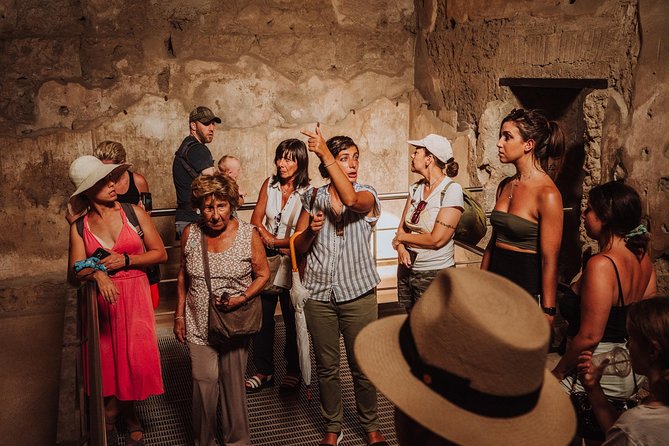
- Small-group pacing (max 20 per guide) gives you room to ask questions instead of just listening.
- Skip-the-line admission is the simple value: less waiting, more looking.
- Archaeologist-led commentary turns ruins into a story you can actually follow.
- Headsets for groups of 16+ help you hear clearly during the walk.
- A tight highlight route covers public spaces, homes, baths, and even a brothel site.
Stepping In at Porta Marina Superiore With Skip-the-Line Tickets
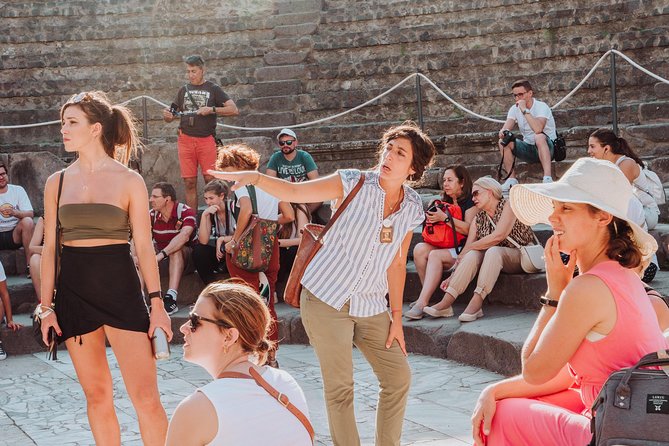
Your tour begins at Via Villa dei Misteri, 2, then you’ll meet your guide at the Pompeii entrance called Porta Marina Superiore. The guide holds a sign for Askos Tours at the main entrance, so you’re not wandering around guessing who’s with what group.
The biggest practical win here is skip-the-line admission. Pompeii’s gates and entry zones can slow you down even when you show up early. When you pre-arrive with the right ticket setup, you spend your time inside the park instead of hovering by a queue.
One more detail I appreciate: you’re not stuck with a loud crowd and no sound support. The tour uses headsets for groups of 16 or more, which usually makes a big difference on a walk where you’re turning corners and following your guide from one spot to the next. At the same time, Pompeii gets loud, and if the day is packed, you might still find yourself leaning in a bit.
You can also read our reviews of more tours and experiences in Pompeii.



How the 2-Hour Plan Actually Covers Pompeii’s Most Important Stops
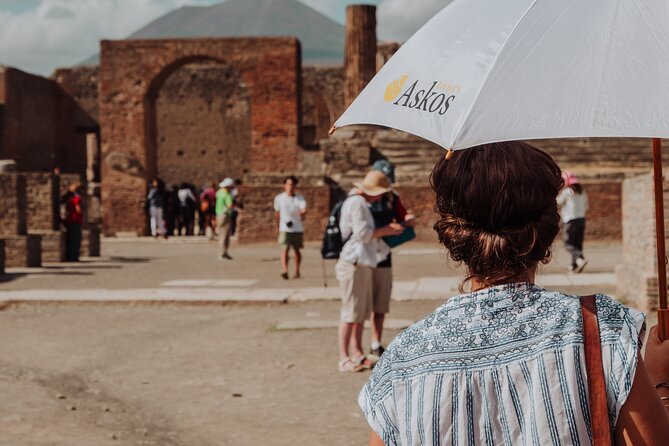
This is an about-2-hour route designed to hit a lot of key areas without turning the day into a long, exhausting mission. The tour moves in timed chunks, with frequent stops where the guide explains what you’re seeing and what it likely meant to people living here.
Here’s the rhythm you can expect: you’ll start with the core entry and public areas, then move into major landmark buildings and residential spaces, and finish with a cultural stop in the theater area. The payoff is that you get the “shape” of Pompeii fast: civic life, private life, and entertainment all show up in one outing.
The consideration: Pompeii is huge, and 2 hours can only sample so much. Even when the guide is sharp and the pacing is good, this format won’t cover every corner, every excavation area, or every room you might hope to see. If you’re the type who likes to linger and read everything slowly, treat the tour as your launchpad, not your full visit.
Foro de Pompeya and Basilica: The Civic Heart in Plain Terms
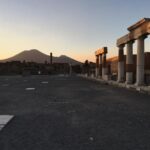
After meeting at Porta Marina Superiore, you’ll walk into the Foro de Pompeya, the main square. This is where the city’s public face comes into view, and it’s a great first stop because it orients your brain. Once you understand the square, the rest of Pompeii makes more sense as a connected city, not random ruins scattered over a field.
Next comes the Basilica, described on this tour as the court house. This stop helps you see how law and authority fit into daily city life. Even if you’re not a legal-history person, a good archaeologist guide can make the layout and function easier to grasp with real, human scale.
This is also where small-group value shows up. If you’re curious—about what people did in these spaces or how the buildings relate—you can ask and get a direct answer. On a big bus tour, that kind of question usually dies on the vine.
Lupanar and Granaries of the Forum: Daily Reality With Contrast
Then you move to the Lupanar, the brothel. It’s one of those “Pompeii is not sanitized” stops that grabs attention because it’s so specific. The value here is contrast: after civic spaces and the court house, you get pulled into a very different slice of city life.
Right after that is a more practical, grounded stop: the Granaries of the Forum. Food storage changes how you picture a city. Without the “big building vibes,” your imagination gets anchored to everyday needs like supply, planning, and what it took to keep people fed and moving.
If you like your Pompeii tour to feel balanced—public vs. private, dramatic vs. practical—this combination is a win. And because you’re hearing explanations right at each stop, it’s easier to remember later when you’re walking around on your own.
Houses of Menander and the Faun: Seeing Private Space Without Getting Lost
The tour continues into two major residential stops: the House of Menander and the House of the Faun. These aren’t just pretty structures to glance at. They help you understand how Pompeii’s wealth and domestic life would have looked and functioned.
What I like about including both is that they give you a wider snapshot of how homes could feel different from one another. The guide’s job is to keep it clear and interpret what the buildings were for, so you’re not left standing there trying to guess what you’re looking at.
You do have to go with the flow on pacing. Each stop is brief, so you get a guided overview rather than a long read of every surface. The good part is that you finish the walk with a set of mental bookmarks—places you’ll recognize when you return later.
Also, plan for walking shoes. Pompeii sites involve uneven ground and a lot of footwork, which can feel like more of a workout than a gentle stroll.


Stabian Baths, Via dell’Abbondanza, and Thermopolium VI: Life at Street Level
After the homes, the tour shifts to the Stabian Baths (Terme Stabiane). Baths tell you a lot about daily routines and social habits. Even without getting too technical, the archaeologist-led commentary helps you connect why a bath complex mattered inside a city.
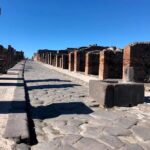
Then you head to Via dell’Abbondanza, the street stop on this route. Streets are where you start to feel the city’s layout. This stop is listed as admission free within the tour structure, so it’s a nice reset in the middle of heavier-ticket stops.
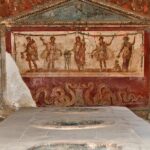
Next is Thermopolium VI, a stop that’s all about street life and everyday consumption. When Pompeii is presented like a museum, it can feel distant. Stops like this bring you back to the fact that the ruins were once active places, used by real people for routine needs.
If you’re traveling with kids, this part often lands well because it’s concrete: street, shop-like setup, and places tied to daily routine. That’s also where your questions can help steer the guide’s explanation, especially if you want the human side of Pompeii rather than only architectural terms.
Teatro Grande and Casa dei Vettii: Ending on Culture and Home Details
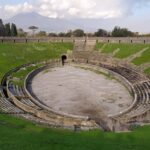
The tour then reaches Teatro Grande, the theatre. Even though it’s a ruin, you can still grasp why a theatre matters: it’s where community shows and gatherings would happen. This stop gives the tour a cultural ending, which feels like a natural close to the mix of civic, private, and street-life areas.
Finally, you’ll visit Casa dei Vettii, the House of Vettii. This last stop is important because it changes your perspective. After seeing the square, law area, entertainment spaces, baths, and street stops, a residential site at the end helps you connect the dots between public life and private life.
You’ll be done with the guided portion after arriving at Piazza Esedra. That finish matters because it often makes self-exploration easier—you can keep going without needing to retrace your steps back to the start.
What to Wear and Bring for Pompeii’s Uneven, Hot Walking
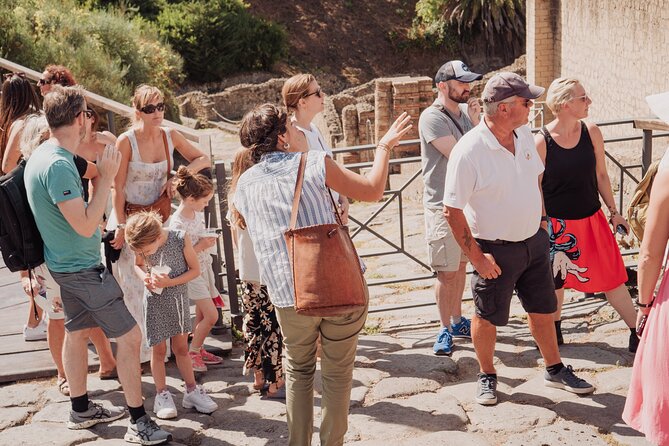
Bring the right gear and the tour feels easy. Skip it, and you’ll feel it by stop three.
From experience shared on this kind of outing, I’d plan for heat and sun. People recommend bringing a fan for summer days and a refillable water bottle—there are water points (fountains) you can use during your visit. An umbrella or hat can also save you when the sun gets intense.
Clothes and footwear matter more than you think. Pompeii surfaces are uneven, and you’ll be moving across multiple stops with consistent walking. If you’re prone to sore feet, comfortable shoes aren’t a nice-to-have; they’re part of the tour quality.
Sound can also be a factor. Even with headsets, crowded conditions can interfere with hearing. If you’re sensitive to noise or struggle to hear explanations in loud environments, arriving earlier in the day can help, and keeping your guide in your line of sight matters.
Price, Value, and Why an Archaeologist Guide Changes the Trip
At $35.67 per person, you’re not just paying for entry. You’re paying for a curated route plus dedicated guidance from an archaeologist guide, with Pompeii admission included. That combo is what makes this feel like value instead of just a ticket.
The small group size (max 20 people per guide) is a big part of why it’s worth considering. In a crowd, tours become one-directional: you watch, you don’t ask. Here, the setup is designed for questions, and you get more direct answers because the guide isn’t handling a herd.
Also, this format uses mobile ticketing, which reduces friction at the gate. You’ll still want to arrive with enough time to check in smoothly, but it’s generally less stressful than paper chaos.
One balanced note: if your ideal Pompeii day is slow, silent, and deeply reflective, a 2-hour “many highlights” model may not fully match your style. But if you want to get oriented quickly, hit major sights, and leave with a clear picture of the city, this is a practical and cost-smart way to do it.
Should You Book This Pompeii Archaeologist Tour?
Book it if you want a guided, structured Pompeii visit that covers the biggest highlight zones in about 2 hours, with skip-the-line admission and archaeologist explanations at each stop. It’s also a strong choice if you like asking questions and you prefer a group that stays under 20.
Consider something longer or different if you know you’ll want lots of time to linger in buildings, read everything on your own, or you prefer a slower pace that doesn’t move from one highlight to the next on a fixed schedule.
If you’re short on time, arriving for the first time, or you want the ruins explained in a way you can remember, I’d say this is one of the better bets.
FAQ
How long is the Pompeii archaeologist tour?
It runs for about 2 hours.
Does the price include Pompeii admission?
Yes. Pompeii admission fees are included in the tour price.
Is this a skip-the-line tour?
Yes. It includes skip-the-line admission tickets to help you beat standard wait times.
Where do I meet the guide?
You start at Via Villa dei Misteri, 2, and you meet the guide at the main entrance of the archaeological park at Porta Marina Superiore. The guide will be holding a sign for Askos Tours.
Is there a headset during the tour?
Headsets are provided for groups of 16 or more.
Can I cancel for a full refund?
Yes. Free cancellation is available up to 24 hours in advance for a full refund. If you cancel less than 24 hours before the experience starts, the amount paid is not refunded.