REVIEW · POMPEII
Pompeii Private Tour with an Archaeologist and Skip The Line – 3 hours
Book on Viator →Operated by ELIANA SANDRETTI · Bookable on Viator
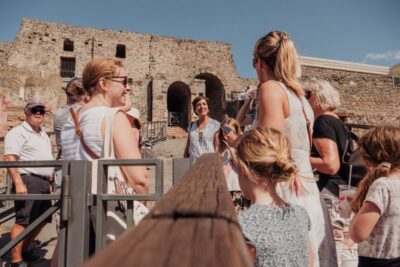
Pompeii starts making sense fast with an archaeologist. This private 3-hour walk has a tight route and real context, so you stop seeing ruins as random rocks and start seeing a working city. I especially love the Skip-the-line option (when requested ahead of time) and the way the guide can shape the pacing around your questions and interests. One thing to plan for: the Pompeii park entry fee is not included, so you’ll need to buy tickets separately and sort the skip-the-line request in advance.
You meet at Hortus Pompei by Porta Marina Superiore, then the tour winds through major highlights and ends back near Porta Marina Inferiore. It’s offered in English, and you’re in a true private group, not a cattle line. Expect a lot of walking over stones and uneven paths, so wear good shoes and keep expectations realistic about steps and slick spots.
If you want the best value, treat this like a guided route plus interpretation—then follow your guide’s lead to the right spots without wasting time trying to decode the site on your own.
In This Review
- Key highlights that make this Pompeii tour work
- Pompeii Private Tour with an Archaeologist: what you’re really paying for
- What’s included (and what isn’t)
- Meeting point at Hortus Pompei: start simple, then move fast
- The Pompeii route, stop by stop (and what you should look for)
- Stop 1: Pompeii Archaeological Park (Porta Marina Superiore → Porta Marina Inferiore)
- Stop 2: Odeon / Teatro Piccolo (small theater)
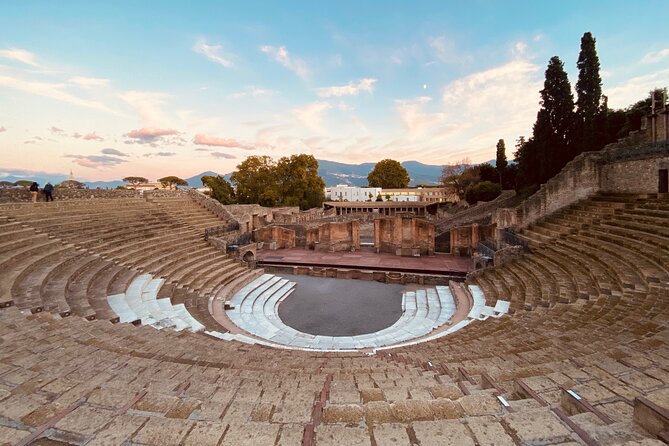
- Stop 3: Teatro Grande (large theater)
- Stop 4: The main street of Pompeii
- Stop 5: Granai del Foro (archaeological deposit)
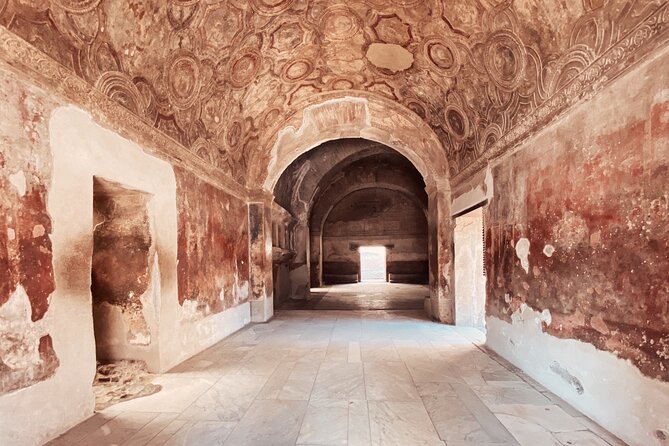
- Stop 6: Stabian Baths (Terme Stabiane)
- Stop 7: Forum (Foro di Pompei)
- Stop 8: Pompei La Basilica (court of justice)
- Stop 9: Temple of Jupiter (Jupiter)
- Stop 10: Quadriporticus of the theatres (gladiators’ barrack)
- Stop 11: Lupanar (brothel area)
- Stop 12: Temple of Venus
- Stop 13: Casa del Poeta Tragico (Cave Canem mosaic)
- Stop 14: Macellum (meat and fish market)
- Stop 15: Edificio di Eumachia (wool market)
- Stop 16: Casa del Menandro (houses: frescoes and mosaics)
- Stop 17: Termopolio di Vetuzio Placido (take-away shop & fast food)
- Stop 18: Fullonica di Stephanus (laundry)
- Stop 19: Final temple stop
- Skip-the-line and tickets: the one part to get right
- The guides are the secret sauce: Amadeo, Luisa, Eliana, Roberto
- Walking reality check: steps, uneven ground, and slippery spots
- Value: is $302.32 per group worth it?
- Who this Pompeii private tour suits best
- Should you book this Pompeii archaeologist tour?
- FAQ
- How long is the Pompeii Private Tour with an Archaeologist?
- Where does the tour start and end?
- Is this tour private?
- What language is the tour in?
- Are entrance tickets to Pompeii included?
- Does the tour include skip the line access?
- Is a mobile ticket used?
- What else is included besides the guided walking?
- What if weather is bad?
- Cancellation terms are included?
Key highlights that make this Pompeii tour work
- Private pacing so you can ask questions and pause for the views you care about
- Skip-the-line help available when you request it in advance
- A route built around daily life: theaters, baths, forum, markets, and homes
- English-speaking specialized archaeologist guide who connects buildings to people
- Two major theaters in one run (Odeon and Teatro Grande) without feeling rushed
- Stops that match how you’d wander on your own, just with a plan and context
Pompeii Private Tour with an Archaeologist: what you’re really paying for
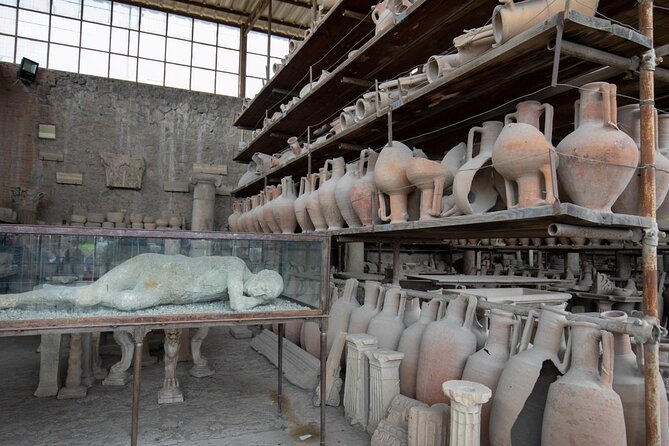
Pompeii is famous, but it can also feel chaotic. Streets split, buildings overlap, and it’s easy to miss what matters. This is where a specialized archaeological guide pays off. You’re not just touring. You’re learning how to read the city—its public spaces, private homes, and the practical rhythm of life before 79 AD.
The price is listed at $302.32 per group for about 3 hours, and the format is private (only your group). For one person, it can still feel like a splurge. But value jumps if you’d otherwise hire a guide, buy tickets last-minute, and waste time figuring out where to go first.
You can also read our reviews of more tours and experiences in Pompeii.
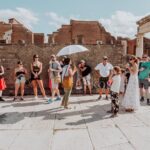

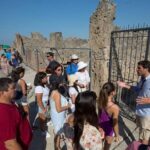
What’s included (and what isn’t)
The tour includes assistance before and during, a private tour, and a specialized archaeological guide. It also includes support tied to getting into the park (including a link to buy tickets entrance in advance).
What’s not included is the Pompeii park admission fee. The fee is listed as 19 euros per adult (and free for under 18). So your total trip cost is basically:
- the tour price plus
- the park entry tickets (which you must purchase separately)
This matters because one common frustration in Pompeii is confusion at the ticket stage. More on that later.
Meeting point at Hortus Pompei: start simple, then move fast
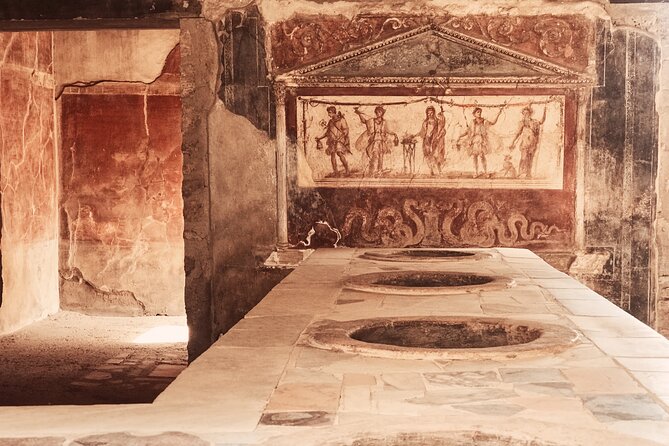
You start at Hortus Pompei, Restaurant & Garden Bar, near the Piazza Porta Marina Superiore area. The tour ends back at the meeting point, which is a big deal in Pompeii. You don’t need to figure out your return, and you don’t lose time on a late scramble.
The route is designed to move you through the site without backtracking too much. It begins at Porta Marina Superiore and finishes at Porta Marina Inferiore, which gives the whole visit a natural flow.
If you’re aiming for good photos or cooler walking, show up a few minutes early. Pompeii doesn’t forgive dawdling when you’re about to climb and weave.
The Pompeii route, stop by stop (and what you should look for)
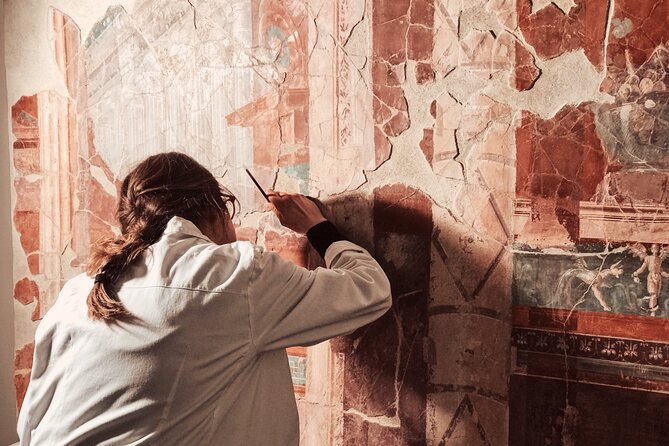
This tour is built as a highlights loop. Each stop is short—think quick orientation plus the most important details—so you get breadth in just three hours.
Stop 1: Pompeii Archaeological Park (Porta Marina Superiore → Porta Marina Inferiore)
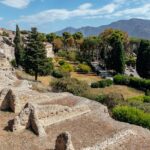
You enter the archaeological park and get your bearings right away. Even if you’ve read about Pompeii, your brain needs a “map in your head.” This stop is where the guide usually sets the framework: how the city was organized, where you’ll see daily life, and why the eruption changed everything so completely.
Practical tip: listen for what the guide says about the layout and the direction you’ll walk. It reduces the “Where am I?” feeling later.

Stop 2: Odeon / Teatro Piccolo (small theater)
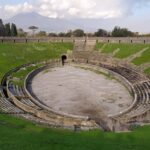
Next is the Odeon, also called the Teatro Piccolo—a compact theater space. Smaller theaters are great because you can see how entertainment fit into the city’s social life without the scale taking over.
Look for the relationship between seating and stage area. It helps you understand how Romans gathered, talked, watched, and judged.
Stop 3: Teatro Grande (large theater)
Then you shift to the Teatro Grande, the bigger stage. This is one of those spots where the guide’s storytelling can turn stone into action. You’ll likely get context on the role of theater in Roman culture and how public spaces worked as community hubs.
Time on this stop is longer than the Odeon. Use that extra time to step around a bit—positions can change your understanding of the theater shape.
Stop 4: The main street of Pompeii
You’ll pass the main street. Streets are where you start seeing Pompeii as a living city: movement, commerce, and neighbors crossing paths.
If you’re prone to tunnel vision at ruins, this is the stop to slow down. The street view is what helps your imagination place people in motion.
Stop 5: Granai del Foro (archaeological deposit)
This is the Granai del Foro, described as an archaeological deposit. Even if you’re not getting the “big wow” views you want, these stops matter because they explain how Pompeii was managed and studied.
It’s also a reminder that archaeology is not just about what survived—it’s about what gets stored, recorded, and interpreted.
Stop 6: Stabian Baths (Terme Stabiane)
The Stabian Baths are your “spa day” in ancient form. Baths were social spaces, not just places to wash. In this stop, you’ll usually get the bigger idea: how people spent time, relaxed, and interacted.
Time is around 15 minutes. You’ll want to focus on the layout and the purpose of different areas rather than trying to memorize every corner.
Stop 7: Forum (Foro di Pompei)
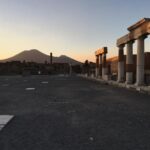
Now you get to the Forum, the city’s political and commercial heart. This is where the city’s power shows. Your guide can help you connect what you see—courts, public buildings, and civic space—with how Pompeians lived and argued and conducted business.
If you’ve ever visited a modern civic center, this is Pompeii’s version of that energy—minus the traffic.
Stop 8: Pompei La Basilica (court of justice)
The Basilica is tied to the court of justice. A basilica is a useful clue for understanding Roman civic architecture. This is where law, meetings, and public life usually had a home.
Try to imagine crowds using these spaces. The guide’s explanations can make it click fast.
Stop 9: Temple of Jupiter (Jupiter)
You’ll also stop at a Temple (listed as Jupiter). Temples anchor the city’s religious identity, but they’re also part of the political and social system.
Focus on how temples sit within the city plan. They aren’t isolated. They’re integrated.
Stop 10: Quadriporticus of the theatres (gladiators’ barrack)
This stop is described as the gladiators’ barrack in the quadriporticus area. It’s one of the most dramatic contrasts in Pompeii: huge public entertainment, supported by the daily reality of fighters training and living close to the action.
This is a great stop for story time. The guide’s vibe usually helps—some guides bring humor and energy while staying factual.
Stop 11: Lupanar (brothel area)
Then comes the Lupanar, a brothel space. It can be uncomfortable, but it’s also part of the full picture of life in Pompeii—sex work existed, and it was organized.
The key here is to stay respectful and treat it as history. The value is understanding how society functioned, not judging from a distance.
Stop 12: Temple of Venus
Another Temple stop, listed as Temple of Venus. This gives you another religious anchor point, balancing the earlier Jupiter stop.
The guide’s interpretation can help connect what you see to Roman beliefs and how people used sacred spaces in daily life.
Stop 13: Casa del Poeta Tragico (Cave Canem mosaic)
You’ll see the Casa del Poeta Tragico and the Cave Canem mosaic. This is the “house entrance moment” that makes Pompeii feel personal. A mosaic like this isn’t just decoration; it’s a direct message to visitors.
In a short time, you’ll get enough to understand why home art mattered: identity, status, humor, and hospitality.
Stop 14: Macellum (meat and fish market)
Next is the Macellum, the meat and fish market. Markets turn your mental model of Pompeii from “public buildings” into “people eating, trading, and living.”
Even in a quick stop, you can think about what a marketplace signals: schedules, supply chains, and community habits.
Stop 15: Edificio di Eumachia (wool market)
The wool market building (Edificio di Eumachia) shows another side of commerce. This is where you can connect Pompeii to crafts and production—clothing doesn’t appear from nowhere.
This stop is brief. Focus on how civic and economic life overlapped in the same city space.
Stop 16: Casa del Menandro (houses: frescoes and mosaics)
The Casa del Menandro is a major “home interior” highlight, known for frescoes and mosaics. If you want visual impact in a short visit, this is where it often lands.
When you see art inside homes, you start understanding Pompeii as a place with taste and personal storytelling, not just public monuments.
Stop 17: Termopolio di Vetuzio Placido (take-away shop & fast food)
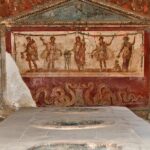
You’ll visit a termopolium, described as a take-away shop and fast food place. This is one of my favorite Pompeii concepts, because it signals everyday habits that feel modern: quick meals, snacks, and people grabbing food on the go.
You’ll likely get details on how these shops worked—another reminder that daily life is the real connection.
Stop 18: Fullonica di Stephanus (laundry)
The Fullonica is a laundry business. Romans needed clothes cleaned and colored. So this stop turns “city of legends” into “city of chores.”
Even if you only remember one thing from this stop, remember the idea: work happened here, not offstage.
Stop 19: Final temple stop
You end with another Temple stop (listed simply as TEMPLE). It’s a fitting wrap because Pompeii’s spaces keep returning to sacred architecture and civic structure.
Skip-the-line and tickets: the one part to get right
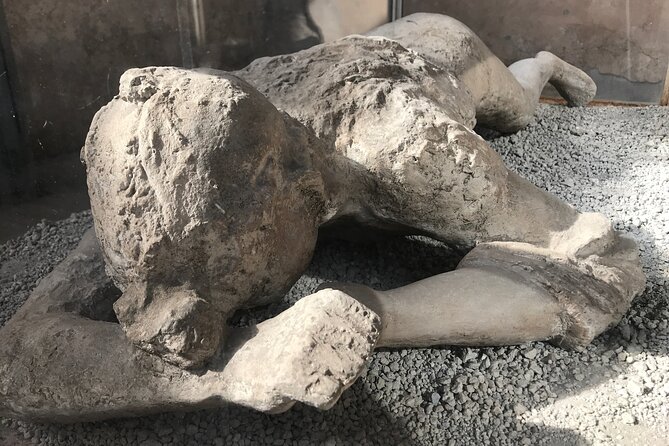
Here’s the practical truth: this tour’s skip-the-line advantage is not automatic. It’s described as available on request in advanced, plus there’s a link to buy your entrance tickets in advance.
Park entry itself is not included, and the current structure is listed as:
- free for under 18
- 19 euros per adult
Because of the ticket confusion that can happen in Pompeii, I recommend you do two things:
- Request the skip-the-line option during booking (not the day of).
- Buy your park entry tickets ahead of time using the provided link.
If you don’t, you could end up spending time at the ticket area trying to figure out what’s covered and what’s not. It’s a solvable problem. Just handle it early.
The guides are the secret sauce: Amadeo, Luisa, Eliana, Roberto
This is a private tour with a specialized archaeological guide. The difference is in the way the ruins get explained: architecture, daily routines, and the eruption context.
You’ll see guide names like:
- Amadeo (or Amadeu/Amedeo in different spellings)
- Luisa
- Eliana
- Mariagrazia
- Roberto
- Maria
- Louisa (also appearing in the guide list)
Common strengths across guides are easy to spot in real-world operation:
- They keep explanations moving so you don’t get bogged down.
- They answer lots of questions without making you feel like you’re slowing the group down.
- They help you adapt pacing, including for mobility constraints (with routes adjusted to what’s workable).
One more thing I love: some guides bring a sense of humor while still keeping the historical facts grounded. It makes long exposure to stone sites feel less like a lecture and more like a conversation with the city.
Walking reality check: steps, uneven ground, and slippery spots
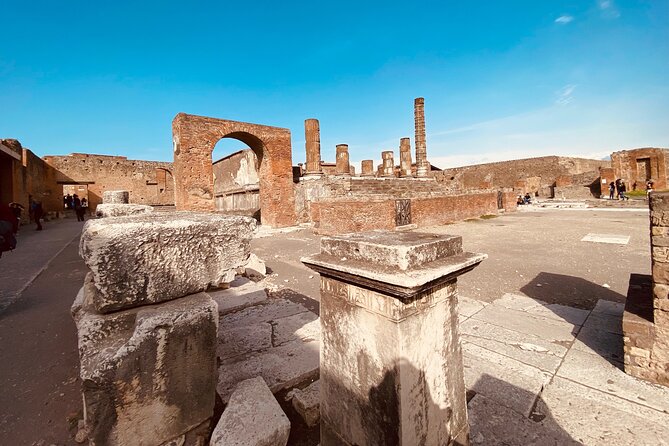
Pompeii is outdoors and ancient. That means:
- lots of walking
- steps
- uneven surfaces
- possible slippery areas
One of the clear messages from real guide experiences is that you should wear supportive shoes and plan for short, frequent pauses. If you have mobility issues, the guides can be accommodating and help you keep up at a pace that works, but you still need to treat Pompeii like Pompeii: not flat, not stroller-friendly, not a museum floor.
Bring a water plan. The tour is only three hours, but that doesn’t remove the need for basic hydration.
Value: is $302.32 per group worth it?
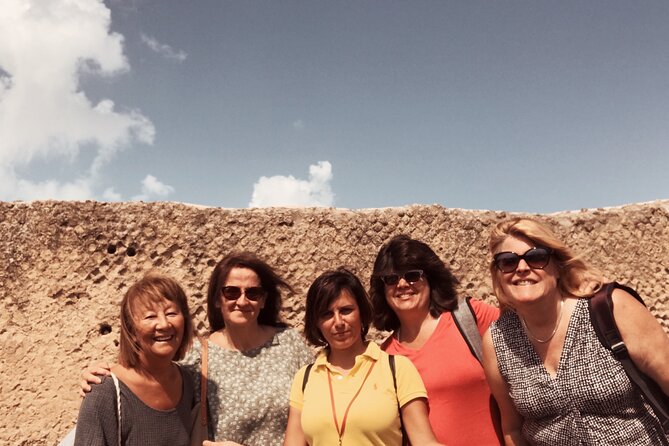
Let’s do the honest math and the decision logic.
You’re paying for:
- a private archaeologist-led route
- assistance before and during
- a structured visit to major highlights
- help with skip-the-line access (by request)
- English-speaking guidance
You’re not paying for:
- Pompeii admission tickets (19 euros per adult, under 18 free)
- meals
- transportation
If you’re traveling with 2+ people and you were going to rent multiple hours of taxi time, museum tickets, and lost time wandering, a guided private tour can actually feel efficient. Even for a solo traveler, it can be worth it if you want to stop guessing and start understanding.
The biggest value kicker: you’re not just seeing “the attractions.” You’re learning how they connect—baths as social spaces, the forum as civic power, markets as daily survival, homes as status and personal expression.
Who this Pompeii private tour suits best
This fits you best if:
- you want a structured route in just 3 hours
- you care about understanding daily life, not just photographing famous spots
- you prefer a private setting where you can ask questions
- you’re the kind of traveler who likes architecture and how cities are planned
It’s also a strong match if you’re visiting Pompeii for the first time and want orientation fast. If you’re the type who loves wandering aimlessly with no plan, you might feel boxed in by a set itinerary. But you can always spend a minute longer at your favorite stop if the guide allows it.
Should you book this Pompeii archaeologist tour?
I’d book it if your goal is: see the major Pompeii highlights and understand what you’re looking at without wasting time. The private format is the deciding factor here, because Pompeii rewards attention and punishes confusion.
Skip booking if:
- you’re trying to keep every cost ultra-low and you’re confident you can navigate ticketing and the route on your own
- you dislike walking and steps and want a more relaxed plan (this one still involves active terrain)
- you don’t want to handle ticket timing and the skip-the-line request ahead of time
My practical advice: if you book, plan your entrance tickets early, request skip-the-line, and show up ready to walk. Then let your guide do the heavy lifting—Pompeii becomes a real city when someone helps you read it.
FAQ
How long is the Pompeii Private Tour with an Archaeologist?
It’s approximately 3 hours.
Where does the tour start and end?
You meet at Hortus Pompei near Piazza Porta Marina Superiore and the tour ends back at the meeting point.
Is this tour private?
Yes. It’s a private tour/activity, and only your group participates.
What language is the tour in?
The tour is offered in English.
Are entrance tickets to Pompeii included?
No. Pompeii entrance tickets are not included in the tour price. The entry fee is listed as free for under 18 and 19 euros per adult.
Does the tour include skip the line access?
Skip-the-line is available on request in advance. The tour also provides a link to buy entrance tickets in advance.
Is a mobile ticket used?
Yes, the tour includes a mobile ticket.
What else is included besides the guided walking?
Included items are assistance before and during the tour, main attractions of Pompeii, a specialized archaeological tour guide, and the private 3-hour tour.
What if weather is bad?
The experience requires good weather. If it’s canceled due to poor weather, you’ll be offered a different date or a full refund.
Cancellation terms are included?
You can cancel for a full refund up to 24 hours in advance of the experience’s start time.