REVIEW · ROME
German Verstecktes Rom im Zentrum
Book on Viator →Operated by Deutsche Römerin · Bookable on Viator
Rome has layers. This tour shows the good ones.
It’s a German city walk that mixes big-name icons with lesser-seen underground remains, plus the kind of stories that turn stone into a timeline. I love how the route links familiar stops like the Trevi Fountain area to lesser-known sites, and I love the small-group feel with headsets when the group gets bigger than four.
One thing to consider: two of the underground stops are marked as ticket-not-included in the itinerary, so budget a bit of flexibility if you want to go in everywhere planned.
In This Review
- Key takeaways before you go
- A 3-hour route that makes Rome feel like one living museum
- Meeting at Piazza Navona and why the start location matters
- Piazza Navona’s Stadion Domitian: the underground arena in plain sight
- Pantheon stop: quick time, memorable stories, free entry
- Chiesa di Sant’Ignazio di Loyola: the 3D ceiling you need to see calmly
- Trevi Fountain moment: coin toss, then the story underneath
- Vicus Caprarius: the city of water under the Trevi area
- Rinascente Roma Tritone: an unexpected ending near the Spanish Steps
- The guides: what the German team is known for (and what to look for)
- Price and value: what $115.12 buys you in the center of Rome
- Weather, pacing, and logistics that actually affect your day
- Should you book this Hidden Rome in the Center tour?
- FAQ
- Is the tour in German?
- How long is the tour?
- Where does the tour start and end?
- How big is the group?
- Does the tour run in bad weather?
- Are entrance tickets included?
- What if plans change and I need to cancel?
Key takeaways before you go
- Underground Rome in the middle of the center: Piazza Navona’s submerged history and the water-world under the Trevi area.
- A tight 3-hour loop: you hit major landmarks without spending your whole day in transit.
- German guiding, small group (max 16): better pacing and more chances to ask questions.
- Headsets when needed: helps in crowds and inside louder streets.
- Trevi Fountain plus the water system behind it: you won’t just toss a coin and move on.
- Ends at Rinascente Tritone: a practical finish near the Spanish Steps area.
A 3-hour route that makes Rome feel like one living museum
The big idea here is simple: you’re not just sightseeing from street level. You’re learning how Rome works—literally—by stepping into places most visitors never see. It’s set up as a three-hour loop that keeps moving, but not frantic.
What makes it special is the mix of famous and hidden. You’ll get classic landmarks like the Pantheon and the Trevi Fountain area, then you’ll pivot to underground remains that explain why the city keeps repeating itself. And the guide’s stories are built to give you that aha moment—how ancient life functioned, why certain customs looked the way they did, and how the city’s water and architecture shaped everyday routines.
The pacing is a good middle ground. You’re not rushed through a checklist, but you also aren’t stuck in one spot. Expect walking between stops and a few “stand and look” moments that are short enough to keep energy up.
You can also read our reviews of more tours and experiences in Rome.


Meeting at Piazza Navona and why the start location matters
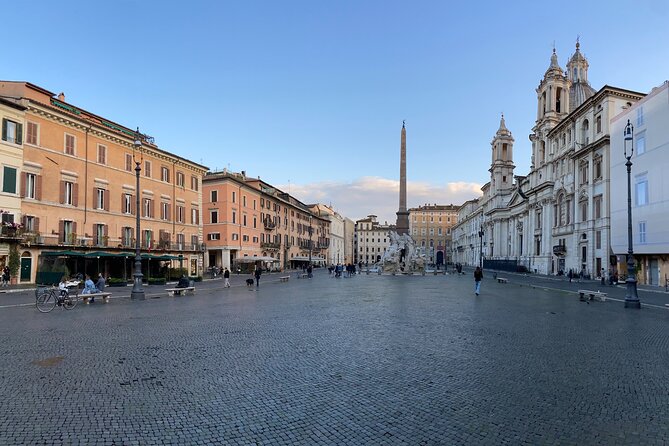
You start at the Fontana dei Quattro Fiumi in Piazza Navona, then the tour’s rhythm kicks in right away. Piazza Navona is already a show—so using it as a starting point makes sense. You’re oriented fast, and the guide uses the square to set context for what you’ll see next.
From the first segment, the tour is framed as more than photos. The guide gives an intro about Rome, the square itself, and what kind of underground story you’re about to enter. That matters because it trains your eyes: when you later see the Pantheon, the church ceilings, and the Trevi area, you’ll understand how each place fits into the bigger puzzle.
You’ll also find this route practical because it’s in a heavily walkable zone with public transport nearby. You’ll end at Rinascente Rome on Via del Tritone, close to the Spanish Steps. That’s a nice “release valve” after a guided tour—you can keep exploring on your own without hunting for transit.
Piazza Navona’s Stadion Domitian: the underground arena in plain sight
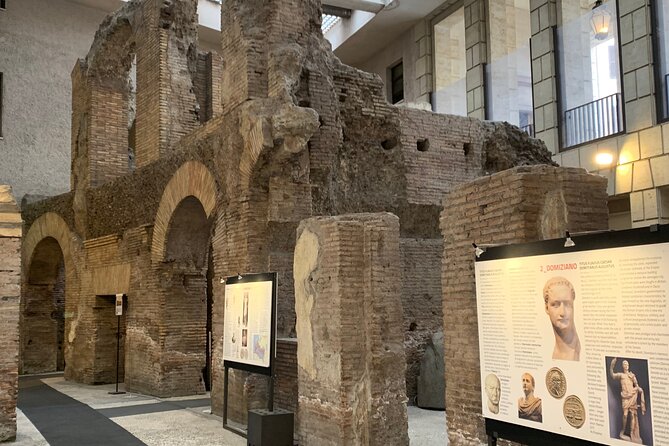
The first major wow moment is the underground visit linked to Piazza Navona, the Stadion Domitian. The itinerary gives it about 50 minutes, which tells you they’re not doing this as a quick glance. You’ll go below the current street level and see how this area once functioned as a venue.
What I like about starting here is contrast. Piazza Navona today looks like a baroque stage. Under it, you’re reminded that this neighborhood has hosted Roman public life for ages. The guide’s job in this stop is to make that contrast click—so you’re not just in the dark looking at rocks, you’re connecting layers of use over time.
Possible drawback: this underground stop is marked as not included for admission in the itinerary, even though the tour overall notes that tickets are included. In practical terms, I’d treat it like this: plan to pay for entry if needed, and keep your day flexible if you’re trying to avoid surprises. If you’re the type who hates last-minute costs, it’s worth checking what’s already covered before you arrive.
Pantheon stop: quick time, memorable stories, free entry
Next up is the Pantheon, with about 20 minutes on site. The itinerary lists admission as free, which is a good sign for value—Rome already charges plenty for many major sights, so squeezing in the Pantheon without an added ticket makes the math easier.
This is one of those stops where you’ll likely feel the “big sight” energy in the air. But the point of the tour isn’t to just marvel at the building and move on. You’ll hear curious stories about how it works today as a church, not just as an ancient monument.
Because the time is limited, pay attention to what the guide points out. The better approach is to treat this as a guided orientation rather than trying to inspect every detail on your own. If you’ve ever felt overwhelmed at the Pantheon, this structure helps: you’re told what to look for, and you’re given context that makes the building easier to read.
Chiesa di Sant’Ignazio di Loyola: the 3D ceiling you need to see calmly
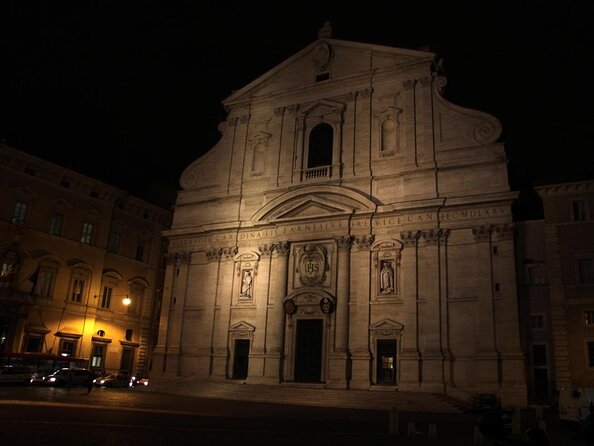
After passing the Senate building on the way toward the Pantheon area, the tour moves to Chiesa di Sant’Ignazio di Loyola. You’ll have about 20 minutes here, and admission is free.
The headline is the church’s famous 3D ceiling painting. Even if you’ve seen photos, it plays differently in person. The trick is that the ceiling illusion is visual, but it also rewards stillness. This stop feels designed to slow you down just enough to understand what’s going on.
In a practical sense, 20 minutes is the right chunk: long enough to notice the illusion and listen, short enough that you don’t get bored or stuck. If you tend to tune out in churches, you’ll probably do better here because the guide can explain the effect quickly, then you can watch it with fresh eyes.




Trevi Fountain moment: coin toss, then the story underneath
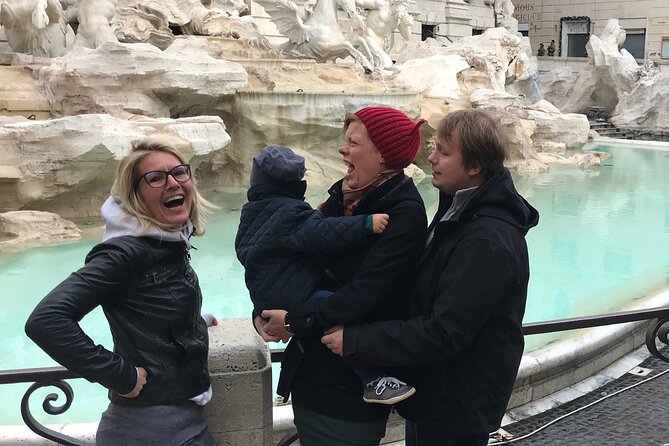
You’ll then stop for the Trevi Fountain. The plan includes the classic coin toss moment, which you’ll see done everywhere for a reason: people like a ritual. But the tour is careful not to stop at the ritual.
What’s more interesting is what comes next: the water story. The tour sets up the Trevi area not as a random fountain scene, but as the end point of a real system. That’s why this stop works. You’re not leaving with only a postcard habit; you’re leaving with a mechanism in mind.
If you go on a busy day, expect plenty of people around. The guide’s job is to keep your experience from turning into a shoulder-to-shoulder photo sprint.
Vicus Caprarius: the city of water under the Trevi area
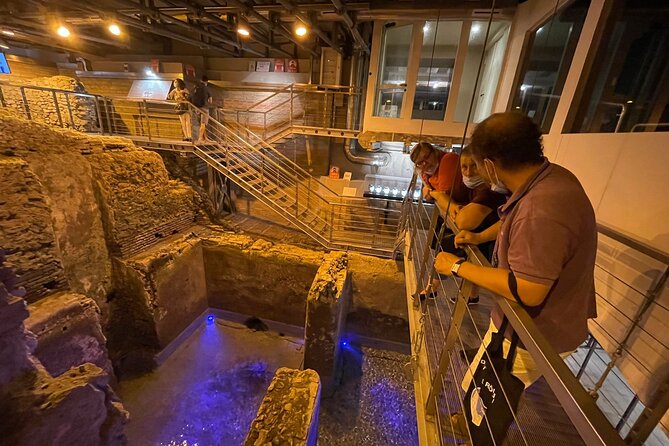
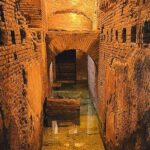
This is the underground highlight tied to the Trevi Fountain ecosystem: Vicus Caprarius – the City of Water. The itinerary budgets 30 minutes, which is enough to feel like you’re learning something real rather than passing through.
Here you find the “how.” The tour’s description is very clear that you’ll discover where the water to the Trevi Fountain comes from. That’s one of the best kinds of travel knowledge because it changes what you think you’re seeing. After you hear the route of water, the fountain isn’t just pretty. It becomes engineering.
Like the Stadion Domitian segment, this stop is marked as not included for admission in the itinerary. So again, I’d plan for possible extra costs depending on what you’re already being charged for in your specific booking.
Small tip for enjoying this part: keep your phone put away for the first few minutes. Let the guide talk, then look. In underground spaces, photos can distract you from the main point—how the water network and the city’s infrastructure fit together.
Rinascente Roma Tritone: an unexpected ending near the Spanish Steps
The tour finishes at Rinascente Rome, Via del Tritone 61, near the Spanish Steps. You’ll spend about 30 minutes here, and the itinerary lists it as included.
This sounds like a shopping stop, but it’s framed as a history-in-modern-life experience. The tour description hints at it clearly: you’ll discover what’s inside the famous department store’s lower levels. In other words, you’re not just walking out into a mall and calling it done. You’re using the ending to show how Rome layers commerce over older city rhythms.
Why this ending makes sense: after three hours of walking and underground detours, it’s nice to end someplace easy to navigate. You also get options. If you want dinner nearby, you can branch out from there without hauling your group back to a meeting point.
The guides: what the German team is known for (and what to look for)
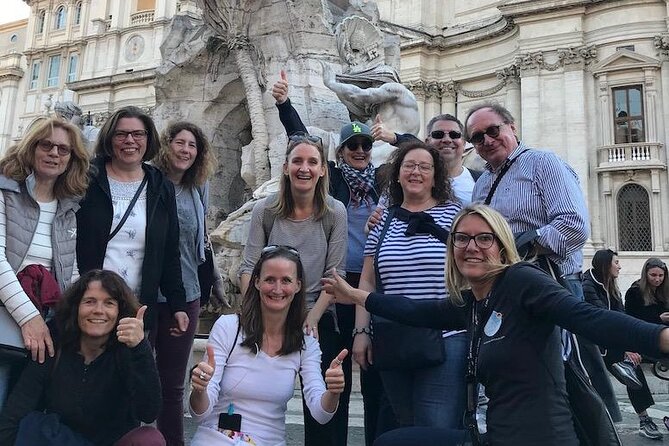
One of the most consistently praised things in the feedback for Deutsche Römerin Tours is the guiding style: energetic, detailed, and willing to answer questions. Names that show up often in the company’s feedback include Mira, Janina, Annett, Giancarlo, Donato, and Jutta.
You’ll feel that approach on this route because the content depends on storytelling. This isn’t a tour where you just wander from monument to monument. It’s built on explanations: why ancient sports were held in the nude, what the city’s water routes looked like, and what everyday Roman life was doing behind the scenes.
If you’re traveling with kids or teens, this kind of guide matters. The route includes legend-type explanations and discussion points, so you’re more likely to get engagement than you would with a purely lecture-style walk.
Price and value: what $115.12 buys you in the center of Rome
At about $115.12 per person for roughly three hours, this sits in the mid-to-higher range for a guided walking tour. Is it worth it? For many people, yes, because the value comes from three things you can’t easily replicate on your own.
First, you’re paying for access and context around the underground sites. Second, you’re paying for a German-speaking guide who connects famous landmarks with the less obvious layers underneath. Third, the small group cap of 16 and the potential use of headsets helps you actually hear and process the explanations.
Where you should be cautious is the underground entry overlap. The itinerary marks some underground admissions as not included, even while the tour mentions that admission tickets are included in the tour price. That suggests coverage can depend on the specific booking details for each stop. Bottom line: treat this as a tour where you might still need to budget a little extra if you want every planned underground segment.
If you hate paying extra at the door, it’s worth confirming what’s covered for the Stadion Domitian and Vicus Caprarius portions.
Weather, pacing, and logistics that actually affect your day
The tour runs even if it rains, so you’re less likely to lose your plans to the weather gamble. Underground segments also help because you’re already partway out of the outdoor sun-shadow problem when you reach the key stops.
The group size cap of 16 is important for comfort. This isn’t a huge bus-style crush. When groups stay small, you get better sightlines, quicker transitions, and the guide can slow down when someone asks a real question.
You’ll want to plan for walking between stops, including underground passages. Bring shoes that work on uneven ground. That’s the simplest comfort rule for this kind of Rome day.
Should you book this Hidden Rome in the Center tour?
Book it if you want Rome to feel like a story, not a photo list. This tour is a strong choice when you like explanations, you enjoy learning why things were built the way they were, and you specifically want underground access tied to major landmarks.
Skip it if you want maximum time at the Pantheon or Trevi for independent wandering, or if you strongly prefer tours where every single entry cost is clearly included with no chance of extra admission. The itinerary includes at least two underground stops flagged as ticket-not-included, so your budget style matters.
If your goal is to see the famous stuff while also learning how Rome’s water and architecture shaped daily life, this is one of the better ways to do it in a compact 3-hour window.
FAQ
Is the tour in German?
Yes. The tour is described as a German-language city tour through central Rome.
How long is the tour?
It’s listed as about 3 hours.
Where does the tour start and end?
It starts at Fontana dei Quattro Fiumi in Piazza Navona and ends at Rinascente Rome, Via del Tritone 61 (near the Spanish Steps).
How big is the group?
The maximum group size is 16 travelers. Headsets are needed if there are more than 4 participants.
Does the tour run in bad weather?
Yes, it takes place even if it rains.
Are entrance tickets included?
The itinerary shows Pantheon and Chiesa di Sant’Ignazio di Loyola as free, while Stadion Domitian and Vicus Caprarius are marked as not included. Rinascente is marked as included. The tour also states that entrance tickets are included in the tour price, so it’s worth verifying which stops are covered for your booking.
What if plans change and I need to cancel?
You can cancel for a full refund up to 24 hours before the experience start time. Cancellation within 24 hours is not refunded.