REVIEW · ROME
Rome: Arena of Colosseum, Roman Forum and Palatine Hill
Book on GetYourGuide →Operated by TOURISTATION · Bookable on GetYourGuide
Gladiators start at a 3D video.
This combo tour uses a 30-minute 3D multimedia reconstruction to set the scene for the Roman ruins, then guides you into the real thing. I especially like how the visit feels organized without turning into a rushed bus stop parade. The second thing I like is the payoff: you get to stand on the Colosseum arena floor where the action once happened. My one caution is timing and meeting-point pressure: you may wait for Colosseum entry after Forum/Palatine, and the pickup spot is busy enough to make you double-check you’re in the right place.
You’re also not stuck with only one site. After the ancient centerpiece, you can add an English city walk covering Piazza Navona, the Pantheon, and Trevi Fountain (plus the Spanish Steps), so you get more classic Rome in the same overall outing.
In This Review
- Key things worth knowing before you go
- Checking in at Touristation Aracoeli (Piazza d’Aracoeli 16)
- The 30-minute 3D video: a smart warm-up for ruined Rome
- Roman Forum at your own pace: where public life happened
- Palatine Hill: imperial views and the origin story on foot
- The Colosseum arena floor: engineering scale and gladiator tunnels
- Timing matters: why your Colosseum entry can feel delayed
- The included English highlights walk: Navona, Pantheon, Trevi (and Spanish Steps)
- Price and value: how $57 stacks up for Colosseum access
- What to bring (and what to leave behind)
- Who this Colosseum–Forum–Palatine experience suits best
- Should you book this Colosseum, Roman Forum and Palatine Hill tour?
- FAQ
- Where do I meet the tour?
- What’s included in the Colosseum visit?
- How long is the experience?
- Is the Roman Forum and Palatine Hill self-guided?
- Does this include an English city walking tour?
- What ID do I need?
- Is it refundable if I cancel?
Key things worth knowing before you go
- 3D multimedia video first: a visual warm-up that helps ruined stone make sense.
- Roman Forum + Palatine Hill are self-paced: you can slow down for views and photo stops.
- Arena floor access is included: you’re not limited to just looking from afar.
- What’s not included matters: first/second levels and the Underground are excluded.
- You’ll add a highlights walk: Navona, Pantheon, Trevi Fountain (and Spanish Steps) are part of the package.
Checking in at Touristation Aracoeli (Piazza d’Aracoeli 16)
Your day starts at TOURISTATION ARACOELI, Piazza d’Aracoeli 16, near Piazza Venezia. Look for a fountain and orange flags in front of the office entrance—those are your best cues when the area gets chaotic.
This is also where the ID rules start to matter. You need a valid original ID (passport or national ID card). Photos or photocopies won’t work, and names and age have to match the ticket type you selected, or access can get denied.
Tip: if you’re early, use the time to orient yourself around Piazza Venezia. The better you understand where you are, the less stressful the walk to the Forum feels later.
You can also read our reviews of more tours and experiences in Rome.


The 30-minute 3D video: a smart warm-up for ruined Rome
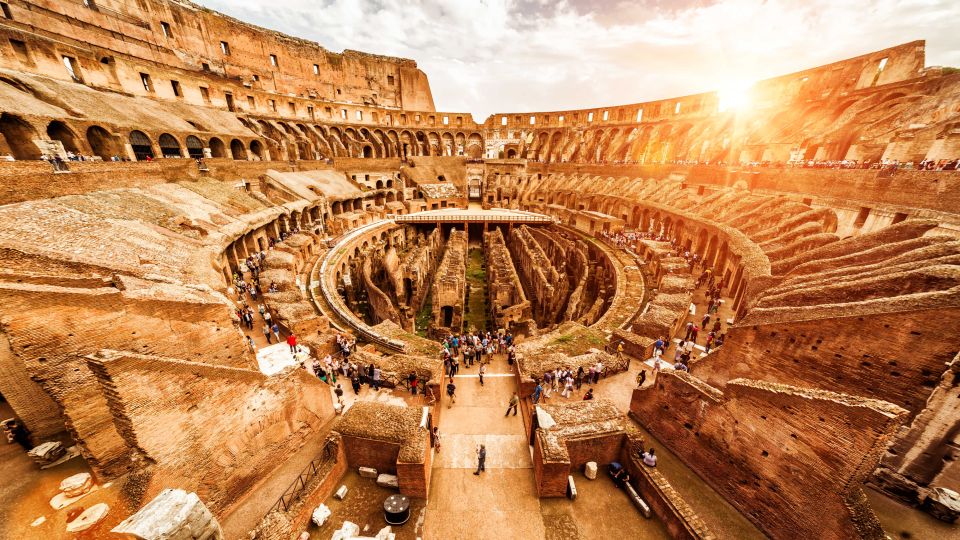
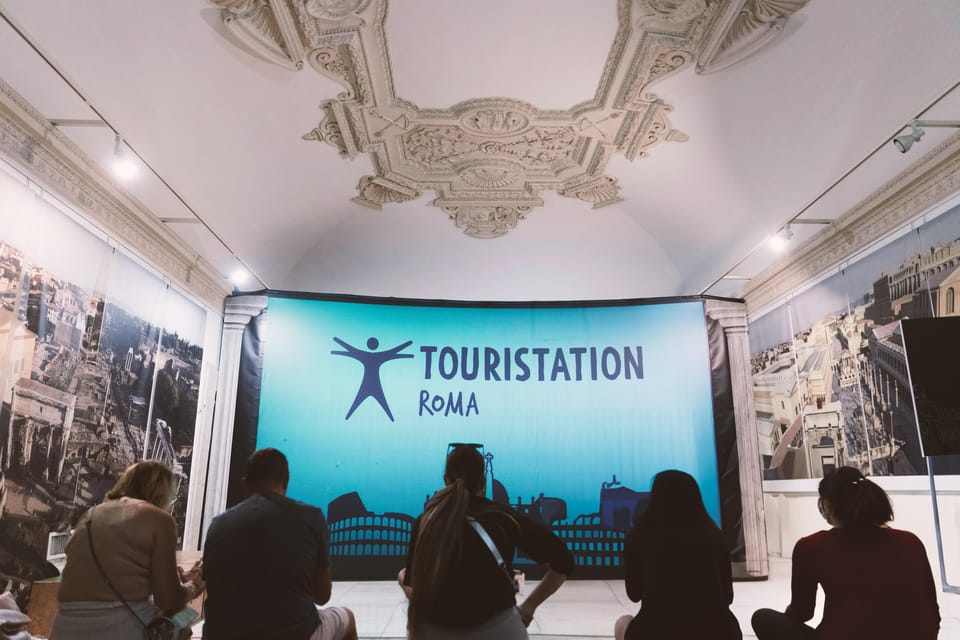
Before you enter the Roman sites, you watch a 30-minute 3D multimedia video. It’s designed to recreate Rome as it looked at the height of the Roman Empire, which is exactly what you want when you’re about to walk among foundations and scattered columns.
Here’s the practical benefit: the video gives you a mental map. Without that, the Forum can feel like a bunch of stone parts with no clear storyline. With it, the spaces you see start lining up with what the reconstruction showed—temples, civic areas, and the general flow of the complex.
A key reality check: the video is heavy on visuals. If you want lots of deep, lecture-style history, you’ll get more meaning once you’re actually walking and reading whatever signage you encounter on-site.
Roman Forum at your own pace: where public life happened
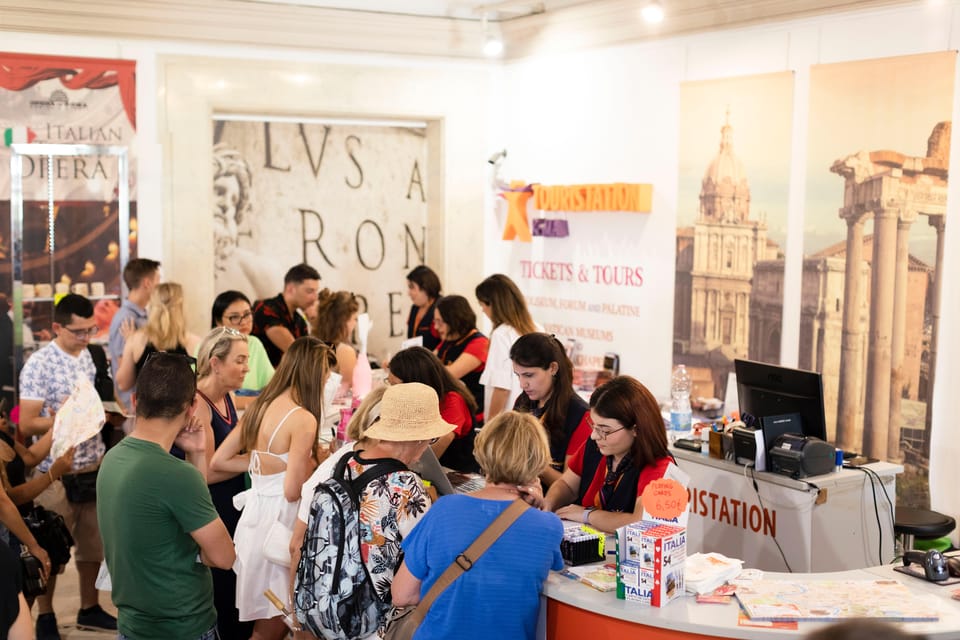
Once Touristation staff gets you through security and ticketing assistance, you head into the Roman Forum. This is where ancient Rome wasn’t just standing still—it was doing business, making laws, worshipping, and gathering for public events.
Because this part is at your own pace, you can shape the visit:
- If you like photos and slow sightseeing, you can take your time.
- If you prefer moving quickly, you can focus on the biggest sections you’re seeing from your viewpoint.
Real talk: the Forum is big and uneven. Comfortable shoes are non-negotiable. You’ll cover ground even if you don’t try to speed-run it.
Also, plan your energy. The Forum segment is timed in the sense that you’re expected to finish roughly around the point when the schedule moves you to the next area. The best strategy is to enjoy the Forum, but don’t disappear for an hour at the far edges.
Palatine Hill: imperial views and the origin story on foot
After the Forum, you continue to Palatine Hill, often described as the legendary birthplace of Rome. Even if you know the myth already, Palatine hits differently because it’s a hill—built for commanding views.
What you’ll like here is the perspective. The higher ground helps you understand why emperors and powerful families wanted to build palaces overlooking the city. You’re not just looking at ruins; you’re looking across a real urban panorama that explains the old power.
This is also a good place to slow down. Palatine gives you more “standing and looking” moments than some flatter sites do. If you’re the type who likes to pause and take in how a place connects to its surroundings, Palatine Hill is where you’ll feel it most.
The Colosseum arena floor: engineering scale and gladiator tunnels
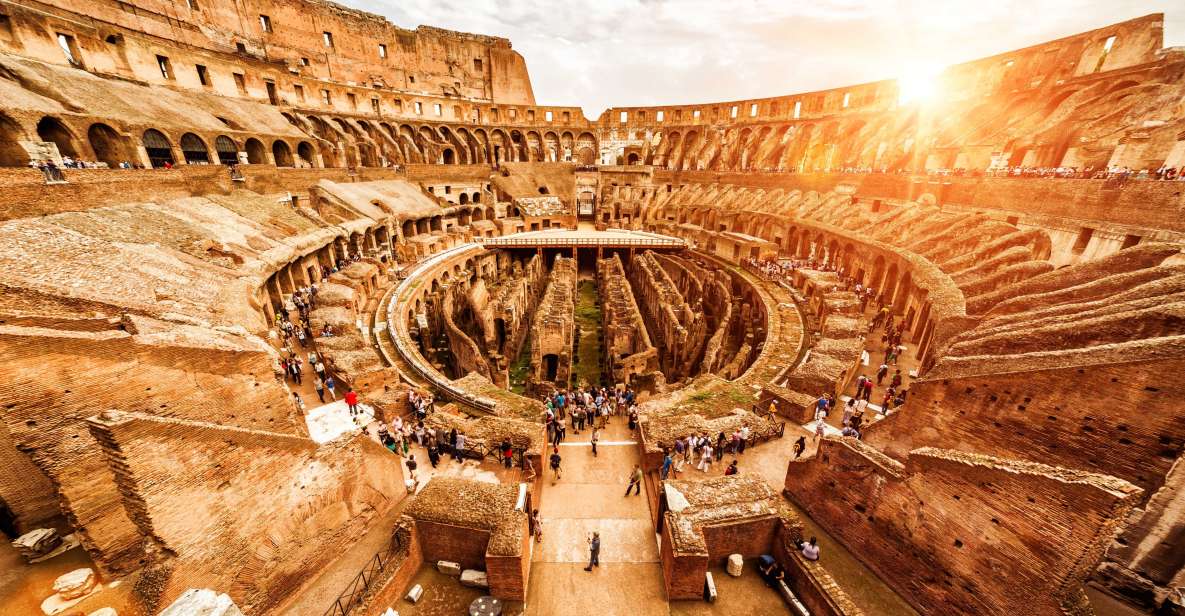
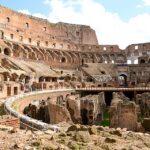
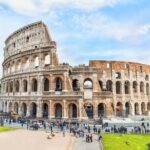
This is the moment you came for: the Colosseum, including access to the arena floor.
The Colosseum was built to hold up to about 80,000 spectators, which is almost too big to picture until you stand inside the space. Once you’re on the arena floor, you get a sense of how close the spectacle was. The crowd wasn’t watching from a distant balcony—it was part of the show.
One of the most interesting details here is the arena itself. The floor was covered with sand, and the Latin word for sand was tied to the origin of the word “arena.” That sand wasn’t just for effect. It was meant to absorb blood and give traction for combatants.
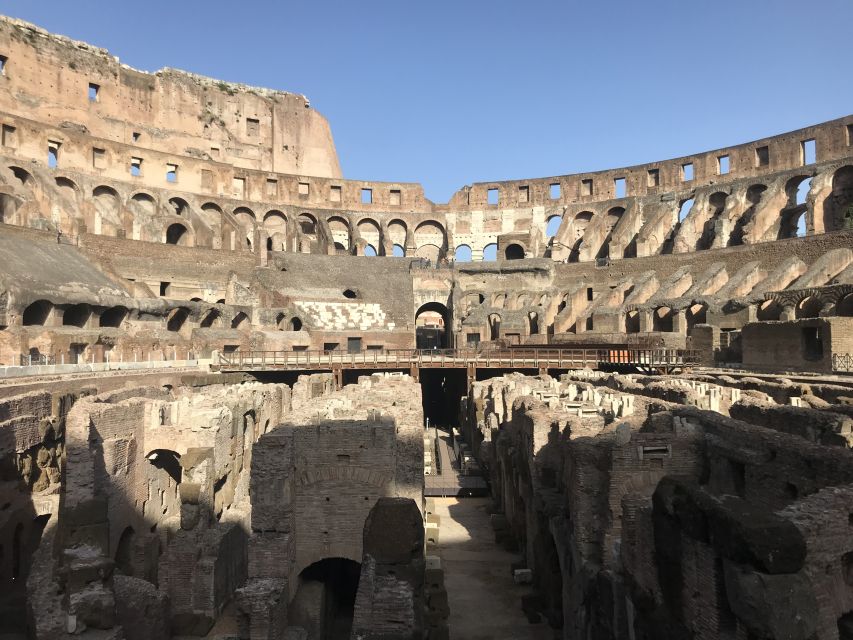
You’ll also hear about the backstage infrastructure—tunnels and chambers beneath the arena that once held gladiators and wild animals, and even elaborate sets for mock naval battles. In other words, the drama didn’t start on the sand. It started underground and in the pathways that fed into the stage.
Important: this package includes the arena floor access, but it does not include the first and second levels and it also excludes the Colosseum Underground. So if your dream version of the Colosseum is walking among the underground rooms, you’ll need a different ticket option than this one.


Timing matters: why your Colosseum entry can feel delayed
The selected time usually refers to check-in, and there’s a key flow detail: you typically tour the Roman Forum and Palatine Hill first (around two hours) before you go to the Colosseum.
That can mean a gap in the day between your check-in time and your actual arena timing. If you arrive expecting the Colosseum right away, you may feel impatient.
If you want a simple plan, do this:
- Treat check-in as the start of your Forum/Palatine window.
- Use that time to see the ruins, not to pace in circles waiting for the next stop.
- Build in a little buffer so the day doesn’t feel like it’s always on a stopwatch.
One more practical note: the pickup office is busy, so give yourself extra time to confirm you’re in the right spot before you start worrying about the schedule.
The included English highlights walk: Navona, Pantheon, Trevi (and Spanish Steps)
After the main ancient sites, the package adds an English city walking tour that covers classic Rome stops: Piazza Navona, the Pantheon, Trevi Fountain, and the Spanish Steps.
This part is valuable because it changes the vibe. The Forum and Palatine are about temples, politics, and hilltop viewpoints. Navona and the Pantheon pull you into the city’s later layers. Trevi Fountain is the big postcard moment, but it’s also where you can connect the dots to Roman street life—especially if you’ve spent the morning thinking only in ancient ruins.
Plan for walking. This is Rome, so even “short transfers” add up. If you’re the type who hates long legs at the end of a day, keep the pace comfortable and let the guide keep you moving between stops.
Price and value: how $57 stacks up for Colosseum access
The price is listed at $57 per person for a 3-hour experience. That number only makes sense when you compare what’s included.
You’re not just paying for a single ticket. Your package includes:
- Assistance at the Touristation office
- A 3D multimedia video
- Help getting you into the Roman Forum
- Colosseum arena floor access plus Forum/Palatine entry
- An English highlights walk covering multiple major sites
There’s also a helpful pricing clue: entry to the Colosseum/Forum/Palatine is €24 for adults, and children 0–17 are free. The remaining amount is what you’re paying for the extra services bundled into the package—handling, coordination, and the additional walking-tour component.
So the value question becomes simple: if you want a low-stress way to combine multiple big sites, plus an English highlights walk, this price can feel fair. If you’re the type who loves planning everything yourself and you only care about one slice of the Colosseum (like the highest views or the Underground), you might find cheaper options elsewhere—but this one saves time and mental load.
What to bring (and what to leave behind)
Bring:
- Your passport or ID card (original)
- Comfortable shoes
- Comfortable clothes
Leave behind:
- Pets
- Weapons or sharp objects
- Luggage or large bags
- Alcohol and drugs
- Glass objects
This kind of “no big bags” rule matters in Rome because it shapes how you pack for the day. If you’re traveling light already, you’re fine. If you show up with a large bag, you may run into hassle and delays before you ever reach the ruins.
Who this Colosseum–Forum–Palatine experience suits best
This tour is a strong fit if you:
- Want three major ancient Rome areas in one coordinated outing
- Prefer self-paced exploring inside the Forum and Palatine Hill rather than constant group herding
- Like the idea of a short 3D warm-up before walking into complicated ruins
- Want your day to include more than just ancient sites, thanks to the English city highlights walk
It’s less ideal if you:
- Specifically want the Colosseum Underground or access to the first and second levels
- Hate waiting for a scheduled Colosseum entry after the Forum/Palatine portion
Should you book this Colosseum, Roman Forum and Palatine Hill tour?
If your goal is the classic Rome hit list—Forum + Palatine Hill + Colosseum arena floor, then a guided highlights walk—this booking makes a lot of sense. You get the practical support to keep logistics from eating your morning, and you still get freedom on the ruins.
Book it if you want:
- Smooth help at the start
- A visual intro that makes the ruins easier to read
- Arena-floor access without committing to the Underground
Skip or compare options if:
- Underground access is your top priority
- You only care about one Colosseum viewpoint level and don’t want the Forum/Palatine time
FAQ
Where do I meet the tour?
Meet at TOURISTATION ARACOELI, Piazza d’Aracoeli 16. There’s a fountain and orange flags in front of the office entrance.
What’s included in the Colosseum visit?
You get access to the Colosseum arena floor, plus Roman Forum and Palatine Hill access. The first and second levels and the Underground are not included.
How long is the experience?
The total duration is listed as 3 hours. The Colosseum portion happens after you complete the Forum and Palatine Hill visit, which usually takes about two hours.
Is the Roman Forum and Palatine Hill self-guided?
Yes. After entry assistance, you explore the Roman Forum ruins and Palatine Hill at your own pace.
Does this include an English city walking tour?
Yes. The English walking tour includes Piazza Navona, the Pantheon, Trevi Fountain, and the Spanish Steps.
What ID do I need?
You must bring a valid original ID (passport or national ID card). Photos or photocopies are not accepted, and ticket details must match the ID and age.
Is it refundable if I cancel?
No. The activity is non-refundable.