REVIEW · ROME
Rome: Guided City Center Evening Sightseeing Walking Tour
Book on GetYourGuide →Operated by Rome Your Way · Bookable on GetYourGuide
Rome at dusk turns big sights into intimate ones. This 3-hour evening walking tour threads from Piazza del Popolo to the Pantheon and through the grand Baroque stops, ending in Campo de’ Fiori. I love the Pincio Terrace moment when the city lights start to glow.
I also like how the tour builds to the big names: Spanish Steps with Bernini’s Barcaccia Fountain, then the Trevi Fountain coin-toss tradition and Piazza Navona’s Four Rivers Fountain. One drawback: it’s fast and you stay on your feet for the full 3 hours, plus there’s a bit of uphill climbing early on, so comfortable shoes matter.
In This Review
- Key highlights you’ll feel in your feet and your photos
- Why this Rome evening walk works better than a random self-guided route
- Piazza del Popolo: the launch pad that makes the whole evening easier
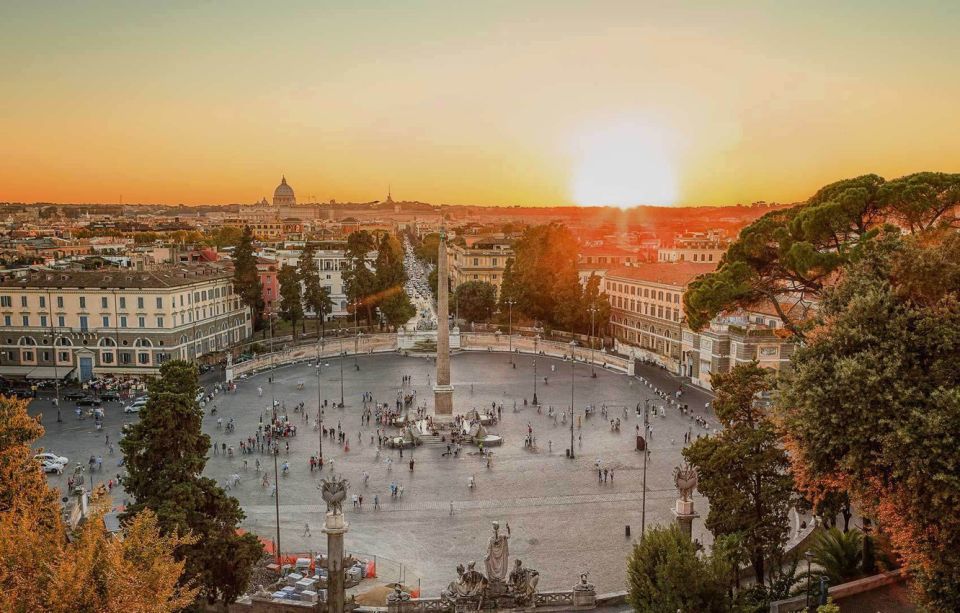
- Pincio Terrace at sunset: the view that makes you understand the city
- Spanish Steps and Bernini’s Barcaccia Fountain: fashion, drama, and Baroque flair
- Trevi Fountain coin-toss: why the legend is fun, and why the scale surprises
- Pantheon exterior stop: seeing the why behind the stones
- Piazza Navona and the Four Rivers Fountain: where Rome’s art feels theatrical
- Campo de’ Fiori: the ending that makes your next hour of the trip easy
- Pace and comfort: what “3 hours on foot” really means
- Price value: is $46 fair for this many central landmarks?
- The guide experience: what you’re paying for besides the map
- Should you book this Rome Your Way evening walking tour?
- FAQ
- How long is the guided Rome evening walking tour?
- Where do I meet the guide?
- Is hotel pickup included?
- Which sights are included on the route?
- Is the tour offered in English?
- Are headsets provided?
- Is the tour wheelchair accessible?
- FAQ
- How much does the tour cost and are kids included?
- Is there free cancellation?
- Is there a reserve now pay later option?
Key highlights you’ll feel in your feet and your photos
- Pincio Terrace sunset views over Rome, right when the light turns soft
- Spanish Steps + Bernini’s Barcaccia Fountain in one smooth stretch
- Trevi Fountain coin-toss myth and the kind of Baroque scale you don’t guess from afar
- Pantheon exterior context from Roman temple origins to later church use
- Piazza Navona’s Four Rivers Fountain plus nearby architectural gems
- Campo de’ Fiori at night as a natural place to keep walking after the tour ends
Why this Rome evening walk works better than a random self-guided route
Rome is easy to overdo. You arrive, you see a few famous façades, you take pictures, and you still feel like you missed the meaning. This tour is built to fix that feeling in one evening.
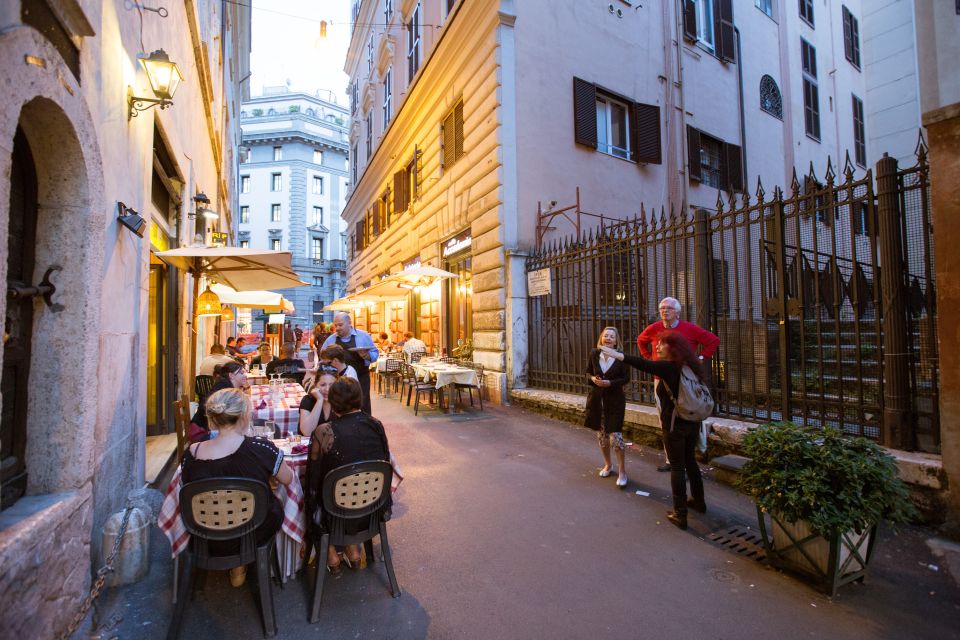
You get a tight loop through the center of Rome while the day cools off. That timing matters. Streets feel more human. You can hear your guide better. And you get the best “wow” moment built in: sunset views from Pincio Terrace before the big fountains and piazzas take over.
The other big win is how the route flows. It’s not just a checklist. It’s a “how Rome became Rome” kind of walk, moving from major squares to major monuments and showing how the city’s layers—ancient, Renaissance, Baroque, and later Christian Rome—sit right on top of each other.
You can also read our reviews of more tours and experiences in Rome.
Piazza del Popolo: the launch pad that makes the whole evening easier
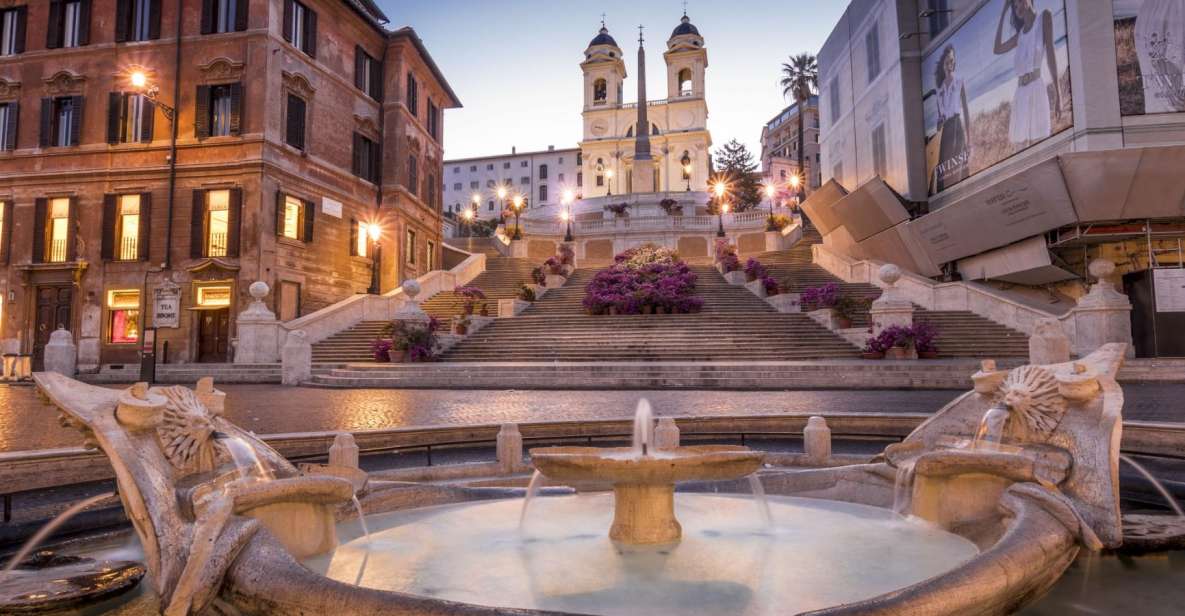
You meet at Piazza del Popolo, in front of the Santa Maria del Popolo Church (the church is next to the Leonardo da Vinci Museum). Look for a guide holding the Rome Your Way sign.
This is a smart starting point. Piazza del Popolo is broad, open, and easy to regroup in, even if you’re still adjusting to Rome traffic noise and the general buzz. You start surrounded by churches, fountains, and monuments that quickly tell you you’re in a “center of power” part of the city—not just a pretty neighborhood.
Practical tip: give yourself a few extra minutes before the meeting time. The church and its neighbors are close enough that it can be confusing if you rush in.
Pincio Terrace at sunset: the view that makes you understand the city
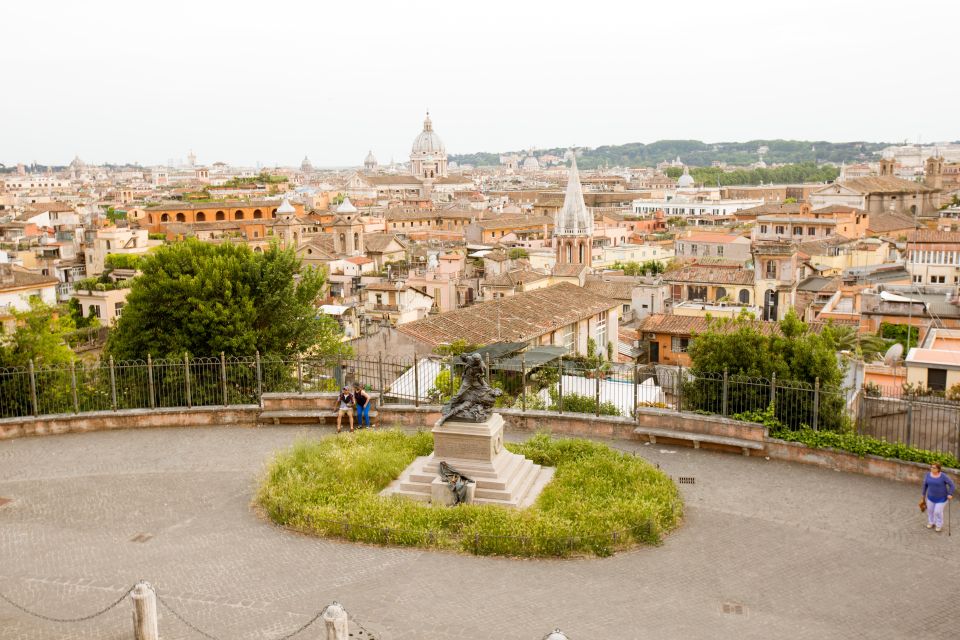
Next comes the uphill climb to Pincio Terrace—and yes, you’ll feel it. Expect a bit of stamina work early in the tour, and plan your pace accordingly.
Then the reward hits: a sunset panorama over Rome’s rooftops. This isn’t just a nice photo stop. It’s a perspective reset. From up here, you can see why Romans built the way they did, with axes, domes, and monuments designed to be seen at angles and distances.
If you’re the type who likes to map the city in your mind, this stop helps. Once you’ve got the “big picture,” the later sights—Spanish Steps, Trevi, Pantheon area, Piazza Navona—start to feel like parts of one story rather than separate stops.
Spanish Steps and Bernini’s Barcaccia Fountain: fashion, drama, and Baroque flair
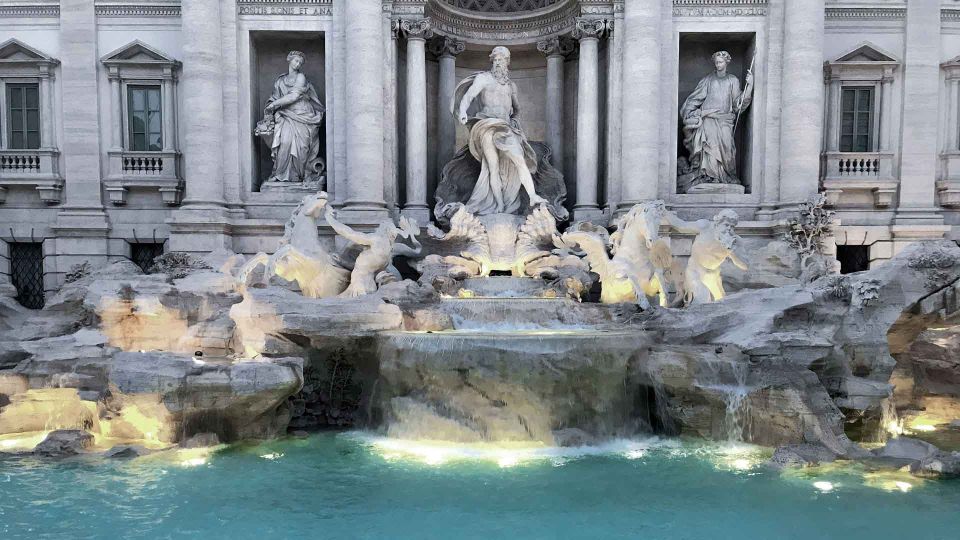
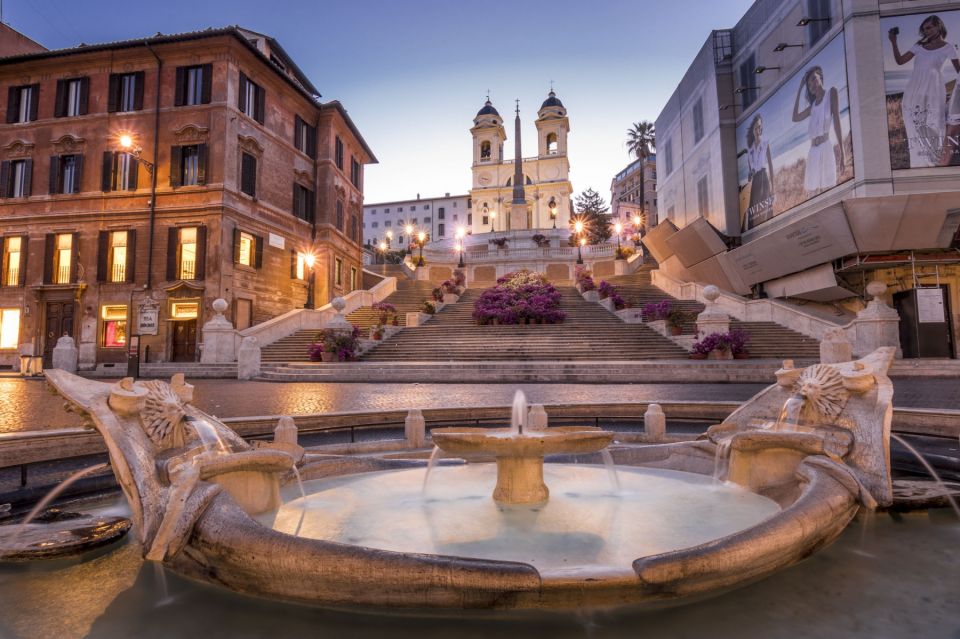
At Piazza di Spagna, you’ll see the Spanish Steps and Bernini’s Barcaccia Fountain (the one most people recognize by its playful, boat-like shape).
This is a perfect “evening light” pairing. The Steps give you that layered Rome look—buildings stacked, stairways pulling your eye upward. The fountain adds character and movement, which is exactly what you want when the day shifts from hot to comfortable.
What makes this stop click is the way the guide ties together art, religion, and city life. In past groups led by guides such as Ghil, Carolina, and Andrada, the common thread was turning famous landmarks into understandable stories, not just reciting dates.
Trevi Fountain coin-toss: why the legend is fun, and why the scale surprises
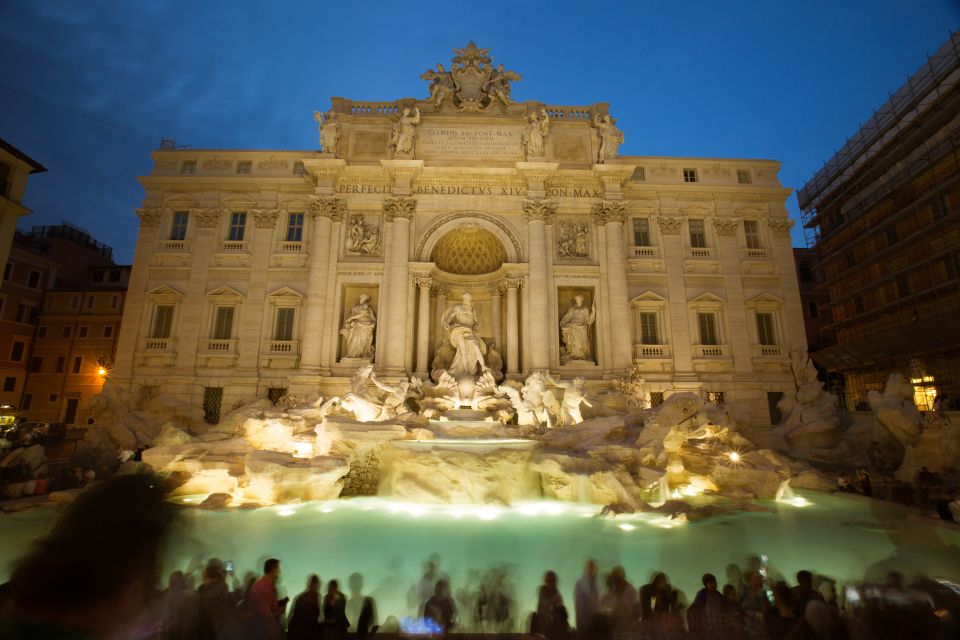
Then it’s off to the Trevi Fountain, described as the largest Baroque fountain in Rome. This is one of those sights where you think you know it from photos—until you see it in person at night.
The tour includes the classic tradition: you toss a coin over your left shoulder into the fountain. The promise attached to that simple gesture is that you’ll return to Rome one day.
Even if you’re not the superstitious type, this is still worth doing because it gives you a ritual moment at the middle of the walk. It also slows the group down long enough to take in details: the sculpture groups, the dramatic flourishes, and the sheer “big stage” feel of the whole composition.
Tip for photos: keep your eyes up as well as down. Trevi is famous, but the best shots often include surrounding façades and the way people flow through the square after dark.

Pantheon exterior stop: seeing the why behind the stones
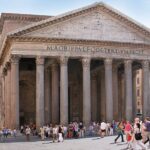
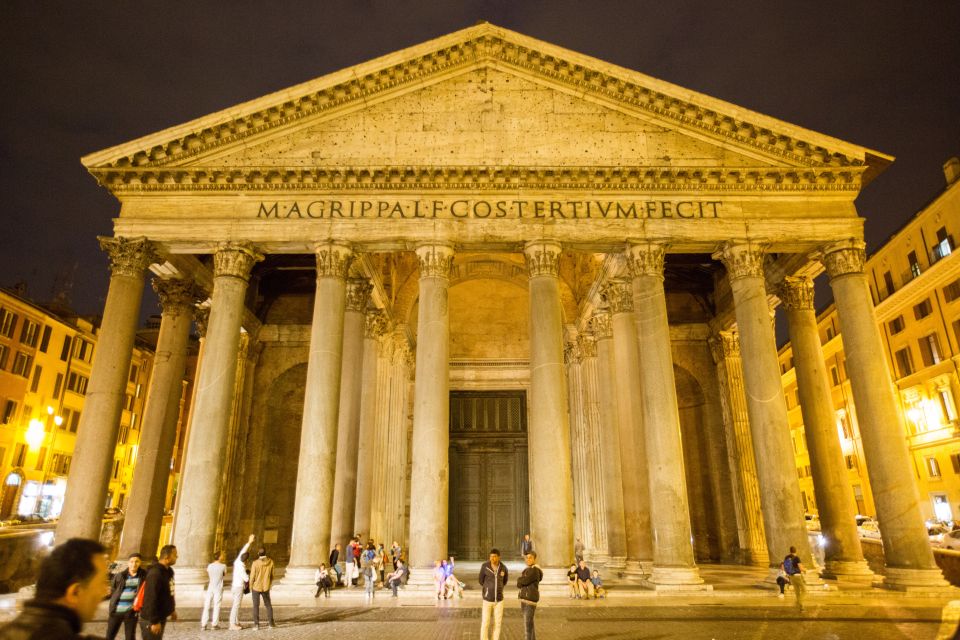
From there you move to Piazza della Rotonda to admire the exterior of the Pantheon.
Here are the facts that make this more than a quick photo:
- It was built in 27 B.C.
- It was dedicated to all the Roman gods
- In the 7th century, it was converted into a church dedicated to Mary and the martyrs
- It’s also the resting place of major Renaissance artists, including Raffaello
That arc—Roman temple to Christian church—matters because it explains a lot about Rome. You’re not only looking at an ancient building preserved by time. You’re looking at a building reused by changing beliefs. Same stones, new meaning.
You’ll likely notice how Roman architecture keeps working visually: scale, symmetry, and the confident use of space. Even from the outside, it’s one of the clearest “Rome logic” lessons on the route.
Piazza Navona and the Four Rivers Fountain: where Rome’s art feels theatrical
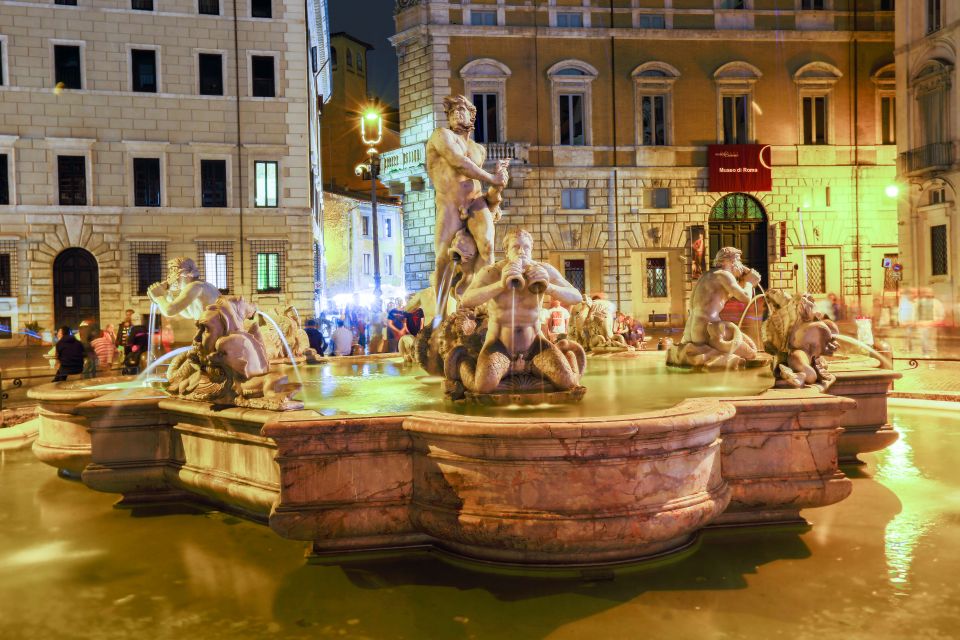
The tour ends up at Piazza Navona, home to Bernini’s Four Rivers Fountain. This is one of the best squares in central Rome for evening energy, because it’s designed like a stage.
What helps here is that the stop isn’t only about the main fountain. You also see other important creations around the square, including:
- the Church of Sant’Agnese in Agone by Borromini
- Palazzo Pamphili
- the Neptune Fountain at the northern end
- the Moor Fountain at the southern end
If you love architecture, this is where the city clicks into place. The Baroque isn’t just decoration here—it’s a way of shaping your movement through the space, pulling your attention from one sculptural idea to the next.
Also, this stop tends to get the best “linger time” of the tour, because Piazza Navona invites it. Just remember you still have a walk left after.
Campo de’ Fiori: the ending that makes your next hour of the trip easy
The tour finishes at Campo de’ Fiori, a square with a strong sense of history and a very practical modern use.
This place used to be known for races and executions. Today it’s a lively market area in the morning and a nightlife center after the sun goes down. In the center of the square, you’ll see the statue of Giordano Bruno.
The reason this ending works well: you’re not dropped off at a random street corner. You’re left in a spot where you can keep going on your own—grab food, walk off dinner, or just browse and people-watch for a bit.
If you’re trying to plan your first night in Rome, this is a good move. You end the tour where local energy already exists, so your evening doesn’t stall out.
Pace and comfort: what “3 hours on foot” really means
This is a 3-hour walking tour, and the common theme in firsthand feedback is that it stays active. You should expect to be on your feet for the full duration, with no long break built in.
One more reality check: the route includes a climb up toward the viewpoint at Pincio Terrace. It’s not a marathon, but it’s enough that you’ll want steady shoes and a good walking pace.
Here’s how to prepare:
- Wear comfortable, supportive shoes
- Dress for evening weather shifts (cooler air can still turn damp near fountains)
- Bring a light layer if you run cold
- Plan to move quickly between stops—this is “see the highlights with meaning,” not “slow wander at museum pace”
If you need lots of seating breaks or you’re managing mobility issues, you might find the pace tough. The tour is not suitable for wheelchair users.
Price value: is $46 fair for this many central landmarks?
At about $46 per person for a 3-hour guided evening walk, the value comes down to one question: can you realistically see all these sights in one coherent evening on your own?
This tour stacks major hits in a tight loop:
- Piazza del Popolo
- Pincio Terrace sunset views
- Spanish Steps + Barcaccia Fountain
- Trevi Fountain
- Pantheon exterior area
- Piazza Navona + Four Rivers Fountain
- Campo de’ Fiori
Then there’s the support that’s easy to forget until you’re in it: you get a professional guide and headsets when needed, which helps when crowds swell near popular monuments.
If you’re visiting Rome for the first time and want to get your bearings fast, this kind of guided “high-frequency” sightseeing usually pays off. If you already know exactly what you want to see and you prefer total freedom, it may feel like a lot of structure for your style. Either way, you’ll walk away with a better sense of where everything sits.
The guide experience: what you’re paying for besides the map
The route is great on paper. The guide is what turns it into a memory.
In the feedback, guides including Ghil, Carolina, Ava, Andrada, Marzia, Rosa, and Elida come up repeatedly, praised for connecting art, religion, and city design into stories you can actually follow while walking.
That matters on an evening tour, because you don’t have time to stop and research every façade on your own. A strong guide gives you the “why” in a way that sticks, so you’re not just collecting images—you’re collecting meaning.
If you’re the type who enjoys facts, this tour gives you historical context at the major stops (like the Pantheon’s dates and its later Christian conversion). It’s also friendly for questions. Many people specifically mention that the guide answered off-track curiosities when they popped up mid-walk.
Should you book this Rome Your Way evening walking tour?
I’d book it if you want:
- a well-paced, first-night intro to central Rome
- sunset views plus the headline monuments in one go
- a guide who turns famous sights into understandable stories
- a drop-off point that naturally supports your next meal or evening walk
I’d skip it if:
- you need frequent rest stops or lots of step-free options (it’s not suitable for wheelchair users)
- you hate fast walking and prefer long, slow sightseeing breaks
- you already have a tight self-planned route and don’t want the structure
If you’re deciding between a daytime plan and an evening one, this is a strong case for night. You get cooler air, iconic viewpoints, and fountains that feel extra dramatic after dark.
FAQ
How long is the guided Rome evening walking tour?
The tour lasts 3 hours.
Where do I meet the guide?
Meet at Piazza del Popolo square in front of the Santa Maria del Popolo Church, next to the Leonardo da Vinci Museum. Look for a guide holding the Rome Your Way sign.
Is hotel pickup included?
No, hotel pickup and drop-off are not included.
Which sights are included on the route?
You’ll see Pincio Terrace, the Spanish Steps and Bernini’s Barcaccia Fountain, Trevi Fountain, the Pantheon exterior, Piazza Navona with Bernini’s Four Rivers Fountain, and you’ll end at Campo de’ Fiori.
Is the tour offered in English?
Yes, the live tour guide speaks English.
Are headsets provided?
Headsets are provided when needed.
Is the tour wheelchair accessible?
No, it is not suitable for wheelchair users.
FAQ
How much does the tour cost and are kids included?
The price is $46 per person. Children 5 years old and younger go for free.
Is there free cancellation?
Yes. You can cancel up to 24 hours in advance for a full refund.
Is there a reserve now pay later option?
Yes, you can reserve now and pay later to keep your travel plans flexible.