REVIEW · ROME
Tour Squares of Rome and Vatican
Book on Viator →Operated by RomaTourGratis · Bookable on Viator
Rome moves fast when you follow the right route. This Squares of Rome and Vatican experience strings together Roman, Baroque, and Vatican landmarks into a single, easy-to-follow circuit with a mobile ticket.
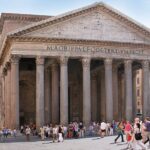
I love the way it includes a real entry stop at the Pantheon, so you’re not just looking from the outside. And I really like the fountain-focused route, because you get multiple named works in one go: Trevi, Triton, the Four Rivers, Neptune, and the Moor at Piazza Navona.
One thing to consider: a previous customer reported a mix-up after buying through a third-party site, where their paid ticket didn’t match what others in the group were told. It’s not something you can predict, but I’d bring your booking confirmation and be prepared to show it if there’s any confusion.
In This Review
- Key highlights at a glance
- A smart “squares first” way to get your bearings in Rome
- Imperial Rome: Pantheon entry and the ancient backbone of the city
- Castel Sant’Angelo: why this stop matters even if you skip the views
- Papal Rome and the Baroque era: Michelangelo and Bernini in your line of sight
- Trevi, Triton, Four Rivers, Neptune, and the Moor: seeing five fountains without losing time
- St Peter’s Square: the “finish line” that changes the whole mood
- Sundays and the Angelus: what to expect when the pace slows down
- Price and logistics: what $17.44 buys you (and what it doesn’t)
- Group size and pace: why 30 people can feel either perfect or tight
- Accessibility and practical comfort (service animals, transit, and the real-world walk)
- A value check: who should book this and who should skip it
- Should you book the Squares of Rome and Vatican tour?
- FAQ
- Where does the tour start?
- Where does the tour end?
- How long is the experience?
- What do I need to bring for the ticket?
- How large is the group?
- Is this tour available on Sundays?
- Is the Pantheon stop included?
- Is free cancellation available?
- Are service animals allowed?
Key highlights at a glance
- Pantheon entry included on the route (listed as a free-admission segment)
- Michelangelo and Bernini linked to the Baroque-era walk toward the Vatican
- A focused fountain lineup: Trevi, Triton, Four Rivers, Neptune, and the Moor
- Ends at St Peter’s Square, with Vatican area time leading into the finish
- Sundays include the Angelus papal blessing at the end of the experience
A smart “squares first” way to get your bearings in Rome
This tour works because it starts with a classic Rome orientation point: Fontana del Tritone at Piazza Barberini. From there, you’re guided through the city’s big visual landmarks in an order that makes sense if you’re trying to understand how Rome layers eras on top of each other.
Even with short blocks of time at different stops (the tour is listed as 2 to 45 minutes overall, depending on the segment), the route doesn’t feel random. You’re moving through places that shaped how Rome looked at different moments in history—then you roll that momentum right into the Vatican area.
It’s also a nice option if your Rome day is already packed. Instead of trying to build your own route among scattered sights, you follow someone else’s pacing and sequencing, and you can spend your energy actually looking.
You can also read our reviews of more tours and experiences in Rome.

Imperial Rome: Pantheon entry and the ancient backbone of the city
The most important anchor on the Rome side is the Pantheon. The listing signals a free-admission ticket segment tied to this stop, and that matters for value. If you’ve ever tried to plan Rome admissions on your own mid-trip, you know how much time gets lost figuring out what to pre-book, where lines are, and what’s worth your effort.
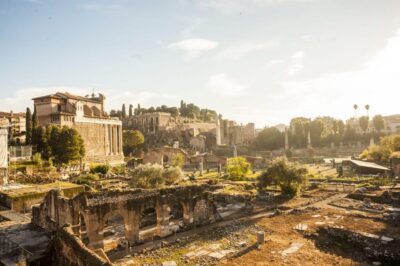
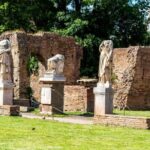
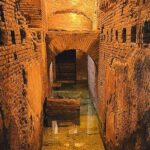
You’ll also pass through the feel of Imperial Rome rather than treating it like a single photo stop. The experience mentions the Ruins of the Domitian Flavio Stadium and the Castel Sant’Angelo as part of the Imperial-to-medieval transition, which is exactly the kind of context that helps monuments make sense.
Here’s what to keep in mind: when you visit ancient Rome, the location is only half the story. The other half is seeing how later people re-used space, repurposed ideas, and built new identities on top of old structures. This route nudges you in that direction by pairing the Pantheon with adjacent reminders of how the empire organized public life.
Castel Sant’Angelo: why this stop matters even if you skip the views
Castel Sant’Angelo shows up in the middle of the route for a reason: it’s a physical hinge between eras. Even if your main goal is photography and quick orientation, seeing it in sequence with Imperial references helps you understand why Romans and later rulers cared so much about controlling key corridors through the city.
A practical note: the walk timing is short across the whole experience, so you should treat Castel Sant’Angelo as a “picture and context” moment, not a long sit-down. If you love lingering at one site, you’ll likely want to schedule extra time on your own another day.
But as a guided connector—something that takes you from ancient Rome to the Papal era—Castel Sant’Angelo does its job well.
Papal Rome and the Baroque era: Michelangelo and Bernini in your line of sight
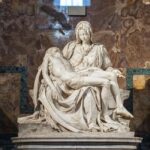
The tour description explicitly calls out the Roma Renacentista-Barroca era and names two giants: Michelangelo Buonarroti and Gian Lorenzo Bernini. Even if you’re not deep into art history, having those names attached to what you’re seeing changes how you look.
The Baroque era is about drama: strong shapes, theatrical movement, and public art meant to be seen at street level. When the route starts guiding you toward fountains and grand civic visuals, it’s basically teaching you how Baroque Rome wanted to impress you—without needing a museum pass for every moment.
You’ll move through major fountain stops that are linked in the tour to this golden Papal period, including multiple works associated with the Baroque “showpiece” tradition. The takeaway is simple: you’ll finish the fountains feeling like you’ve covered a single theme, not a pile of unrelated sights.
Trevi, Triton, Four Rivers, Neptune, and the Moor: seeing five fountains without losing time
This is where the tour earns its keep: the fountain cluster is very concrete. You’re guided through a lineup that’s famous for a reason, and it’s spaced so you can keep your bearings instead of wandering.
You’ll hit these key fountain stops:
- Trevi Fountain (the most famous one in the world, as the tour frames it)
- Fontana del Tritone (near where your tour starts)
- Four Rivers Fountain
- Neptune Fountain
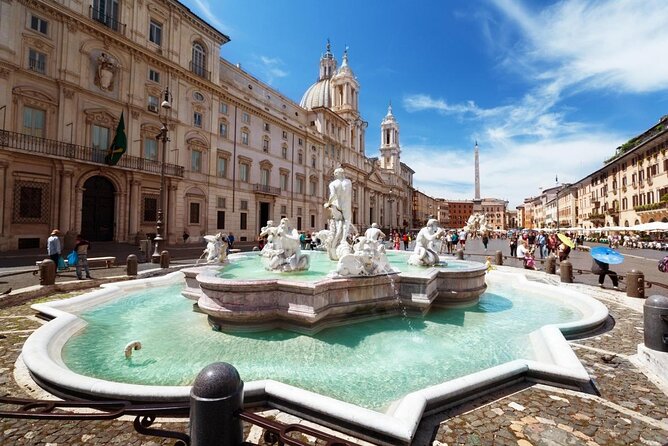
- The Moor Fountain at Piazza Navona
What I like about seeing them as a group is that your brain starts comparing styles. Trevi feels like a big myth on a city stage. The Four Rivers does something different: it’s about symbolism and balance. Piazza Navona, with the Moor, gives you a calmer, more plaza-like rhythm where the fountain feels like part of social space.
One warning, though: famous fountains mean crowds. Since this experience is built as a guided circuit, you’ll be moving from one point to the next rather than staking out the best spot for a slow, detailed look. If you want to read every carved detail up close, plan to return later.

St Peter’s Square: the “finish line” that changes the whole mood
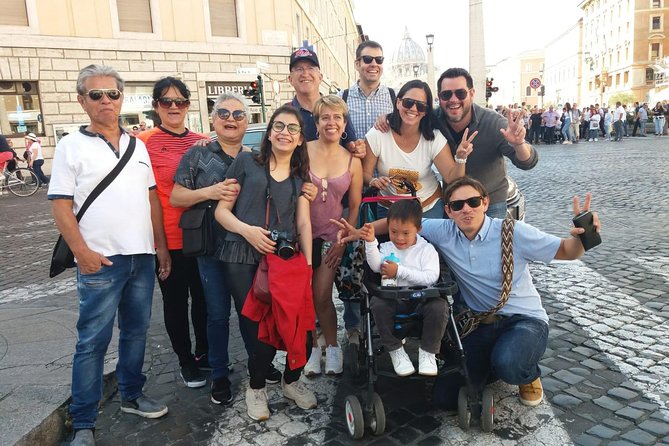
The walk ends at Saint Peter’s Square. That’s not just a location—it’s a mood shift. You go from street-level civic art (fountains, piazzas) into a space designed for massive gatherings, ceremonial viewing, and sweeping sightlines.
The tour description also notes that you’re leaving the Vatican Museums area as part of the finish. I wouldn’t treat that line as a promise of long museum time, since the overall tour duration is listed as 2 to 45 minutes depending on the segment. But it does mean you’re likely heading into the Vatican zone with a guided sense of what matters most outside the museums too.
If you’ve ever felt intimidated by the Vatican’s scale, ending at St Peter’s Square helps because the space is its own landmark. Even if you can’t see everything, you can orient quickly: where the major church frontage sits, how the square opens, and how your day’s route connects.
Sundays and the Angelus: what to expect when the pace slows down
On Sundays, the tour includes the papal blessing in the Angelus. This can be a special add-on if your trip lines up, but it also changes the practical reality of timing.
Think of it like this: you’re not just arriving at St Peter’s Square; you may be arriving around a moment with more security and tighter movement. If you’re traveling with a plan after your tour, give yourself a buffer. If you’re there just to soak it in, Sundays can be deeply memorable because the square becomes part ceremony, part crowd energy.
If you’re the type who hates surprises in scheduling, check whether your Sunday plans can flex. The Angelus element is only mentioned for Sundays, so it’s a key factor in deciding whether to book on that day.
Price and logistics: what $17.44 buys you (and what it doesn’t)
The price is listed at $17.44 per person, which is notably low for a guided route that covers major Roman icons and finishes at the Vatican’s headline square. The practical value here isn’t “one expensive ticket included”; it’s more about the guided sequencing.
You’re getting:
- a mobile ticket
- a route that stitches together big-name sights in one flow
- a group size capped at 30 travelers
- a starting point and ending point that reduce decision fatigue
What you should not assume: that this is a long, detailed deep-dive into every site. The overall duration is listed broadly (2 to 45 minutes), and that usually means you’ll be seeing things faster than if you were on a slower, single-site tour.
So I’d treat it as an orientation-and-highlight experience. If you want to linger inside the Pantheon longer, spend extra time at any one fountain, or do a serious Vatican Museums day, you’ll still want separate time blocks.
A small planning note: the listing says the average booking window is 53 days in advance. If you can, booking earlier is smart, especially if you’re targeting a Sunday for the Angelus.
Group size and pace: why 30 people can feel either perfect or tight
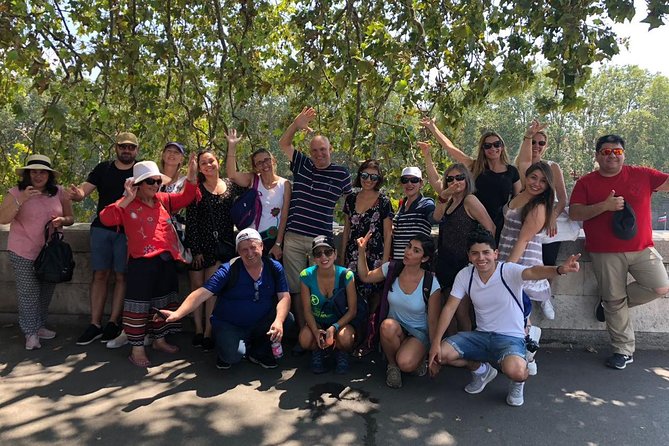
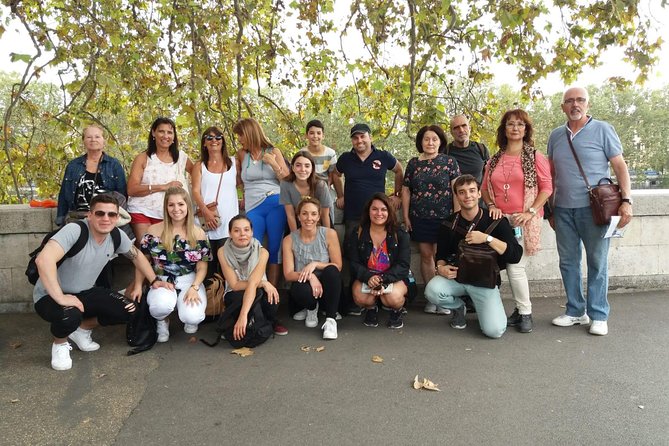
Maximum group size is listed as 30 travelers, which is big enough to keep the energy up but small enough that you’re not stuck in a moving crowd of hundreds.
Because the tour includes multiple stops and some likely waiting, the pace matters. If you’re quick to move on, you’ll enjoy the momentum. If you prefer slow looking, you might feel like you’re always on the way to the next photo.
The best strategy is to decide what you want from each stop:
- Take your main photo quickly, then watch what your guide points out.
- If something catches your eye, make a mental note for a return visit later.
This lets you get a lot today without getting annoyed about time.
Accessibility and practical comfort (service animals, transit, and the real-world walk)
The listing says service animals are allowed and that the activity is near public transportation. That’s helpful because you’re starting at Piazza Barberini and ending at St Peter’s Square—both are areas where it’s easier to re-route your day after the tour.
The walking is implied by the nature of the route, so wear shoes you trust. The biggest comfort factor isn’t just distance; it’s how quickly you’ll need to move between stops during busy periods around fountains and in the Vatican area.
If you’re traveling with anyone who needs frequent breaks, I’d plan extra buffer time before and after the experience, since the tour segments are short and the route is built for movement.
A value check: who should book this and who should skip it
This tour suits you best if:
- you want a guided highlight route without doing route planning math all day
- you like seeing multiple famous monuments connected by a theme
- you’re budget-minded and want big names like the Pantheon and St Peter’s Square in one go
It may be less ideal if:
- you want long time inside major sites
- you want to sit and read every detail on your own without a schedule
- you prefer single-site touring where you can slow down and go deep
Also, here’s the one caution I’d treat seriously. One posted experience described a situation where a participant paid for what they expected was a paid ticket, but the group they joined was told it was free, and the guide didn’t resolve the mismatch. That doesn’t mean it’ll happen to you, but it’s a good reminder: double-check what your ticket includes, and keep your booking confirmation accessible.
Should you book the Squares of Rome and Vatican tour?
If you want a fast, guided overview that connects Roman monuments to the Vatican finish, I think this is a strong value for $17.44. You’ll likely love the structure: Pantheon entry, a serious fountain lineup, and a clean end at St Peter’s Square, with the option of the Angelus on Sundays.
I’d book it if your priority is getting your bearings and collecting the must-see images without juggling logistics. I’d also book it if you’re the type who enjoys context more than long stays.
Skip it if you’re hunting for a slow, detailed museum-style day or you already plan to spend hours at each major site separately. In that case, consider using this as inspiration, then build your own longer day with extra time where you feel the pull.
FAQ
Where does the tour start?
The meeting point is Fontana del Tritone, Piazza Barberini, 00187 Rome.
Where does the tour end?
The tour finishes at Saint Peter’s Square, Piazza San Pietro, 00120 Vatican City.
How long is the experience?
The duration is listed as 2 to 45 minutes (approx.), depending on the segment and pacing.
What do I need to bring for the ticket?
You’ll use a mobile ticket.
How large is the group?
The tour/activity lists a maximum of 30 travelers.
Is this tour available on Sundays?
Yes. On Sundays it ends with the papal blessing in the Angelus.
Is the Pantheon stop included?
The route includes an entry at the Roman Pantheon, and the provided stop information lists admission ticket free for that segment.
Is free cancellation available?
Yes. You can cancel for a full refund up to 24 hours in advance of the experience start time.
Are service animals allowed?
Yes. Service animals are allowed.