REVIEW · ROME
The Treasures of Rome
Book on Viator →Operated by Greenline Tours · Bookable on Viator
Rome’s best hits come fast, but you will walk. This 3-hour morning tour strings together iconic stops in the centro storico and wraps with Vatican City views. I like how efficient the route is, and I also like that key sights are paired with clear context, including the Pantheon’s famous tombs.
Two things I think are especially good for your trip: you get a guided look that helps you understand what you’re seeing, and the free-admission stops keep the cost down while still hitting the big names. One thing to consider is the pace: Rome cobblestones add up, and you can’t expect a mostly-ride tour.
In This Review
- Quick hits before you go
- Meeting in Central Rome: the start point and how the morning flows
- Piazza Barberini and the Bernini fountains detour that anchors your orientation
- Trevi Fountain: how to enjoy Fontana di Trevi without losing time
- The Pantheon: Rome’s best-preserved ancient building and Raphael’s tomb
- Piazza Navona: baroque fountains on top of a Roman stadium site
- St Peter’s Square: Bernini’s colonnades and the obelisk centerline
- St Peter’s Basilica interior: dress code and the Sunday reality check
- Pace and walking: the real make-or-break detail
- Value check: what $49.26 buys you and why the timing matters
- Who should book this tour, and who should skip it
- Should you book The Treasures of Rome?
- FAQ
- How long is the Treasures of Rome tour?
- Where does the tour start and end?
- What’s included in the price?
- Is admission to the main sights included?
- What should I wear for the churches?
- Can I visit the inside of St Peter’s Basilica on Sundays?
- What’s the cancellation policy?
Quick hits before you go
- Small group (max 20) for a more manageable morning pace
- Air-conditioned vehicle helps on the transfer toward Vatican City
- Trevi Fountain, Pantheon, and Piazza Navona are timed for photos plus orientation
- Pantheon stops for Raphael’s tomb and other famous burials
- St Peter’s Square drop-off means you can keep exploring on your own
- Dress code matters for worship spaces: covered knees and shoulders
Meeting in Central Rome: the start point and how the morning flows
The tour meets at Via Giovanni Amendola, 32 (00185 Roma RM) and starts at 9:00 am. This is a practical time choice because the streets are calmer before the day fully ramps up, and it gives you room later to explore the city yourself. You’ll also get a mobile ticket, which simplifies check-in (no paper scavenger hunt).
The vibe is set early: you’re guided from a central pickup point into Rome’s historic core, mostly on foot for the main sights and by vehicle for the transfer toward Vatican City. The group size is capped at 20 travelers, so you’re not being shoved along like luggage through a train station.
One detail that affects your experience: you can expect some transfers and then short-to-medium walks. The description and the feedback you’ll hear both point to this as a tour where you should plan to use your legs, even though there’s vehicle time. If you’re coming in with a careful plan for the rest of your day, this morning format is a good fit because you finish at Piazza San Pietro.
You can also read our reviews of more tours and experiences in Rome.

Piazza Barberini and the Bernini fountains detour that anchors your orientation
Before the big-ticket names, the route tees up your morning with a stop at Piazza Barberini. In the center is the Triton Fountain, created by Gian Lorenzo Bernini in 1643, commissioned by Pope Urban VIII Barberini. Look for the details: it’s made of travertine and features coats of arms carved between the dolphins supporting the triton.
On a corner near Via Veneto, you’ll also see the Fountain of the Bees, tied to the Barberini family symbol. This is a smart “warm-up” stop. It’s not just about pretty water; it helps you read the city’s baroque language. By the time you reach the next squares, you’ll be looking at fountains with more of a why behind the wow.
Also, this area sits between the Quirinale hill and the Horti Sallustiani, which is the kind of geographic note that matters in Rome. Tiny distances can feel different because of the layout and elevation. A short guided orientation here can make later landmarks easier to navigate on your own.
Trevi Fountain: how to enjoy Fontana di Trevi without losing time
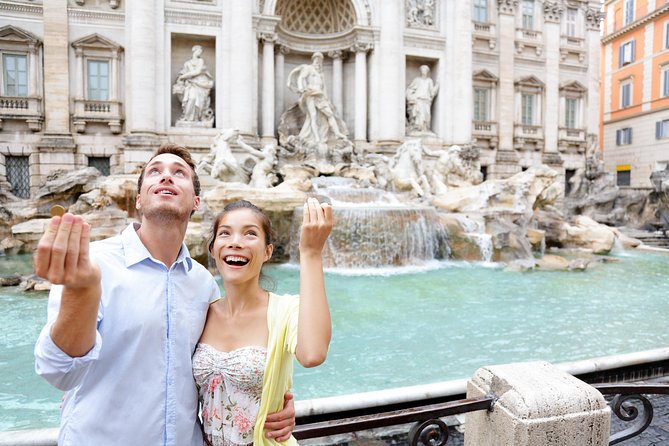
Next is Trevi Fountain (Fontana di Trevi) with about 20 minutes on-site. Admission is free, which is great because this is exactly the sort of place where you don’t want the day to turn into a line-and-ticket exercise.
Trevi’s special because it’s both grand and slightly hidden in the historic center. That contrast is part of what makes it so famous. You’ll likely see it in typical photo angles immediately, but I like taking those minutes to step back and see the whole composition—water, stonework, and the central figures—so the fountain doesn’t just become a backdrop.
A practical tip: if you want the classic coin moment, do it quickly and respectfully, then move along. The best use of your short window is to grab a few photos, take in the details, and then not get stuck in a single spot while other parts of the city are waiting.
The Pantheon: Rome’s best-preserved ancient building and Raphael’s tomb
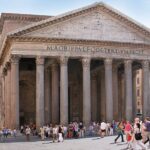
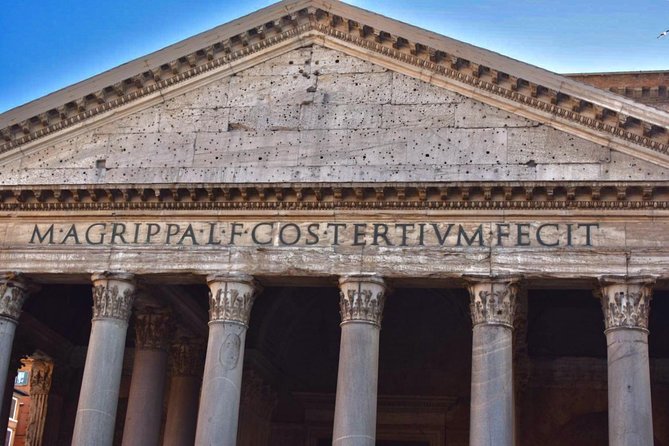
The Pantheon is the anchor stop for many people. You get about 30 minutes, and entry is free. This is the former Roman temple (built on an earlier foundation commissioned under Augustus) that later became a church. Even if you think you know it from pictures, seeing the scale and the dome in person is usually the moment your brain catches up to the hype.
Here’s what I’d focus on during your time: the Pantheon isn’t just architecture porn. It’s also a layered memorial space. The tour points out the tomb of Renaissance artist Raphael, plus the burial of King Umberto I among others. Seeing these connections is the value of a guided stop, because it turns the Pantheon from a must-see photo to a place with a story you can actually hold onto.
The meaning of the Pantheon’s name—temple of all gods—also helps you understand why the building mattered in antiquity. Then, once you shift into its identity as a church dedicated to St. Mary and the Martyrs, the mood changes. You’re not only looking at Roman engineering; you’re in a space where centuries of worship have left their own imprint.
Timing note: 30 minutes is enough to see the key points if your group stays moving. If you drift into a slow shuffle, the clock becomes the enemy. Treat this stop like a focused visit, not a wandering museum session.
Piazza Navona: baroque fountains on top of a Roman stadium site
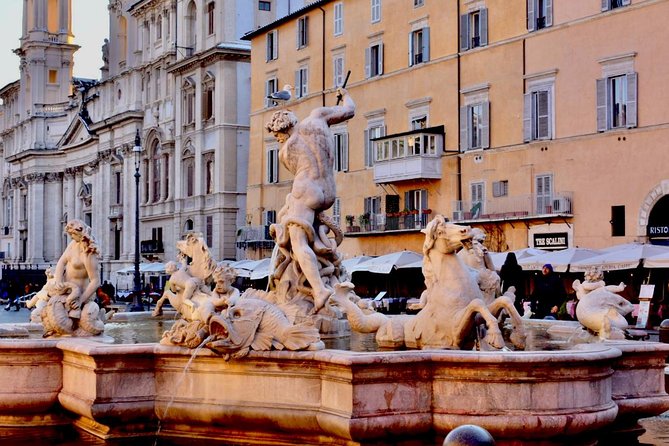
From the Pantheon, it’s a walk over to Piazza Navona, where you’ll have around 20 minutes. Admission here is free, but the square’s the attraction—especially the Baroque fountains designed by Bernini.
Navona sits on the footprint of the ancient Stadium of Domitian, where Romans went for public games. That means the square isn’t random. You’re standing on a footprint that shaped how people gathered for centuries—first for athletics, then for civic life, and later for baroque spectacle.
In a short stop, you can still do two useful things:
- Notice how the oval shape of the piazza matches the ancient stadium layout.
- Watch the fountains from more than one angle. It changes your perception of depth and scale.
If you’re the type who likes to stop and people-watch, Navona gives you plenty of that without needing to sacrifice your schedule.

St Peter’s Square: Bernini’s colonnades and the obelisk centerline
The tour then hops by vehicle toward Vatican City and ends at St. Peter’s Square, with about 30 minutes there. It’s a great finishing point because the layout does most of the work for you: the square pulls your eyes toward the basilica.
In the center is an ancient Egyptian obelisk, erected in 1586. The dramatic framing around it is credited to Gian Lorenzo Bernini, including the massive Doric colonnades designed in the mid-to-late 1600s. Standing here, you’ll feel why this was engineered for crowds: it creates a visual “stage” even when you’re standing in the outer rings.
Your best move is to choose a position and look up for a moment. Don’t rush straight into the nearest photo point. If you take 60 seconds to orient yourself, the rest of your time in the Vatican area will feel less chaotic.
St Peter’s Basilica interior: dress code and the Sunday reality check
The tour includes an inside visit of St. Peter’s Basilica, but there’s an important catch: it will not be possible on Sundays, on religious festivals, and during religious ceremonies. On those days, expect the itinerary to shift.
Dress code is strictly enforced for places of worship and selected museums: no shorts or sleeveless tops. Your knees and shoulders must be covered for both men and women, and the rules are enforced in practice, not just on paper. If you’re traveling in summer heat, plan your clothing accordingly or you might lose time at the entrance sorting out what you can wear.
A good way to protect your experience is to treat the basilica interior as a bonus, not a guarantee. If you arrive at St Peter’s Square on a day when interior access is limited, you can still enjoy the square and then pivot your own plans for later.
Pace and walking: the real make-or-break detail
This is where you should be honest with yourself. The tour involves considerable walking on uneven, cobbled surfaces due to coach regulations. The good news is that you can sometimes remain on the coach to reduce walking, but doing so means you will miss many of the sights.
So the right strategy depends on your priorities:
- If you want the full highlights feel, commit to the walking portions and wear shoes that can handle uneven stone.
- If mobility is an issue or heat is a concern, be prepared to skip some of the stops and focus on what you personally can handle.
On hot days, the difference between “short walk” and “a long walk” is huge. Rome in the morning can still feel warm by the time you reach the middle of the route. Bring water, and pace yourself during the longer standing moments at Trevi and Navona.
Value check: what $49.26 buys you and why the timing matters
At $49.26 per person for roughly 3 hours, the value comes from the combination: a local guide, an air-conditioned vehicle for part of the route, and several major sights where entry is free. You’re not paying extra for attraction tickets on this itinerary.
The other value is time. If you try to stitch together these stops on your own, you lose time in transit and you also lose the “what am I looking at” layer that makes monuments meaningful. A short guided morning is a smart way to get your bearings fast—especially if you’re on your first day in Rome or you want a simple introduction before deeper solo exploring.
Two practical items to note: drinks aren’t included, and pick-up/drop-off isn’t provided. Lunch is listed as included only if you select an option, so treat food as optional unless you specifically choose a package that includes it.
There’s also a ceiling to the experience. It ends at St Peter’s Square, not at a museum door, and it doesn’t turn into a long Vatican day. That’s not a flaw; it’s the trade you make for seeing more of Rome’s central highlights in one compact morning.
Who should book this tour, and who should skip it
This tour makes sense if you:
- Want a fast overview of key classical and baroque Rome landmarks in one morning.
- Enjoy learning while you walk, especially around the Pantheon and major squares.
- Like the idea of ending at St Peter’s Square so you can continue at your own speed.
You may want a different format if:
- You prefer very minimal walking or mostly sit-and-view sightseeing.
- You’re counting on guaranteed inside access to St Peter’s Basilica on a Sunday or during festival periods.
- You need long stays at each site. The time windows are short by design.
Should you book The Treasures of Rome?
I’d book this if your goal is a smooth, highlights-first morning that connects central Rome to Vatican City without turning your trip into a logistics project. The Pantheon stop is the strongest reason to choose it, especially for the tomb references and the guided way of reading the space. The rest of the route supports that main hit by giving you big squares that are easy to revisit later on your own.
I’d think twice if walking on cobblestones is difficult for you, or if you’re hoping for a long, slow Vatican experience. In that case, you might get more satisfaction with a slower, Vatican-focused tour.
If you’re flexible, dressed for worship spaces, and ready to move, this is a good-value way to see Rome’s headline sights in a single morning.
FAQ
How long is the Treasures of Rome tour?
It’s listed as about 3 hours.
Where does the tour start and end?
The tour starts at Via Giovanni Amendola, 32, 00185 Roma RM, Italy and ends in St Peter’s Square (Piazza San Pietro, 00120).
What’s included in the price?
Included items are a local guide and an air-conditioned vehicle. Lunch is included only if you select the option, and drinks are not included.
Is admission to the main sights included?
The stops listed (Trevi Fountain, Pantheon, Piazza Navona, and St Peter’s Square) are shown as free for admission.
What should I wear for the churches?
A dress code is required: no shorts or sleeveless tops. Your knees and shoulders must be covered, and the rule is strictly enforced.
Can I visit the inside of St Peter’s Basilica on Sundays?
The inside visit is included, but it is not possible on Sundays, on religious festivals, and during religious ceremonies. On those days, the itinerary may change.
What’s the cancellation policy?
You can cancel for a full refund up to 24 hours before the start time. If you cancel less than 24 hours before, the amount paid is not refunded.