REVIEW · ROME
Rome: Pantheon Priority Entry Ticket & Audio Guide App
Book on GetYourGuide →Operated by Vox City International · Bookable on GetYourGuide
A line outside the Pantheon is a waste. This Pantheon priority entry ticket gets you inside faster, and the included audio guide app helps you spot what matters without rushing. Just note the strict dress code (no shorts or sleeveless tops), so plan your outfit before you arrive.
What I like most is the time-saving feel: you’re not stuck waiting in the sun, and once you enter, you can go at your own rhythm. The second big win is the audio format itself: a dedicated 35-minute route with 12 points of interest, plus a digital map so you can orient yourself inside the basilica.
One consideration: if your phone battery is low or the audio clips don’t load smoothly, the experience can feel less effortless. Bring a charged smartphone, use headphones you already have, and download the app via the QR code on your voucher before you go.
In This Review
- Key things you’ll notice before you book
- Priority entry at Piazza della Rotonda: how the fast lane really helps
- Downloading the audio app: your phone becomes the guide
- Inside the Pantheon: dome, Oculus, and the view that makes people quiet
- Artworks, pavement details, and myths you can actually picture
- Turning your Pantheon stop into a self-guided Rome walk
- Where the small-group energy matters (and where it doesn’t)
- Price and value: is $6 for Pantheon priority entry worth it?
- Who should book this Pantheon Priority Entry with app audio?
- Should you book? My practical call
- FAQ
- What’s the duration of the Pantheon priority entry and audio experience?
- Where do I go to start the experience?
- How do I enter the Pantheon with this ticket?
- What’s included with the ticket?
- Do I need headphones?
- What languages are available for the audio guide?
- What should I bring?
- What clothing is not allowed?
- Is there free cancellation?
Key things you’ll notice before you book
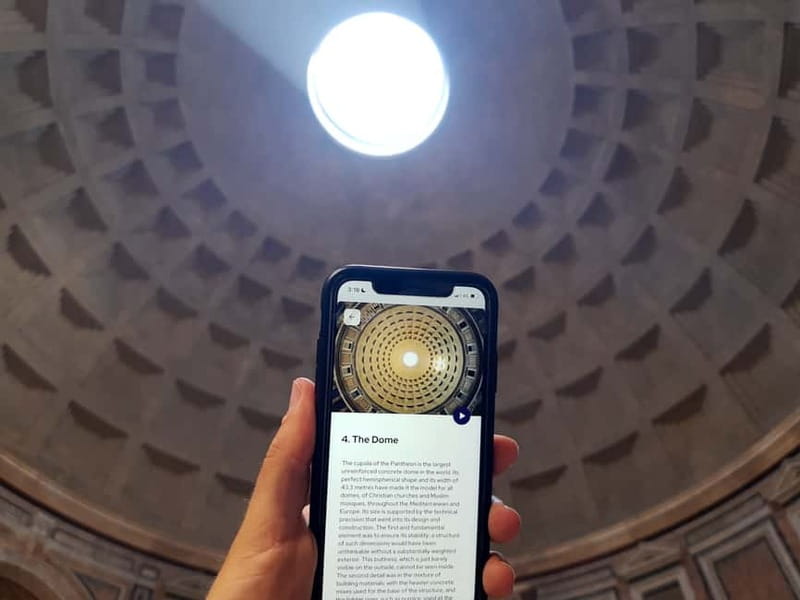
- Priority entry through a separate entrance helps you avoid the worst queue time at one of Rome’s top sites
- 35 minutes of audio inside the Pantheon with 12 labeled points and a digital map
- Self-guided app tour of up to 30 landmarks after your visit, including stops around Piazza Navona, Trevi, and Piazza di Spagna
- Small group size (up to 10) keeps the check-in experience less chaotic
- Audio in 10 languages, so you can match the narration to your comfort level
- Dress code rules (no shorts or sleeveless tops) are real and worth planning for
Priority entry at Piazza della Rotonda: how the fast lane really helps
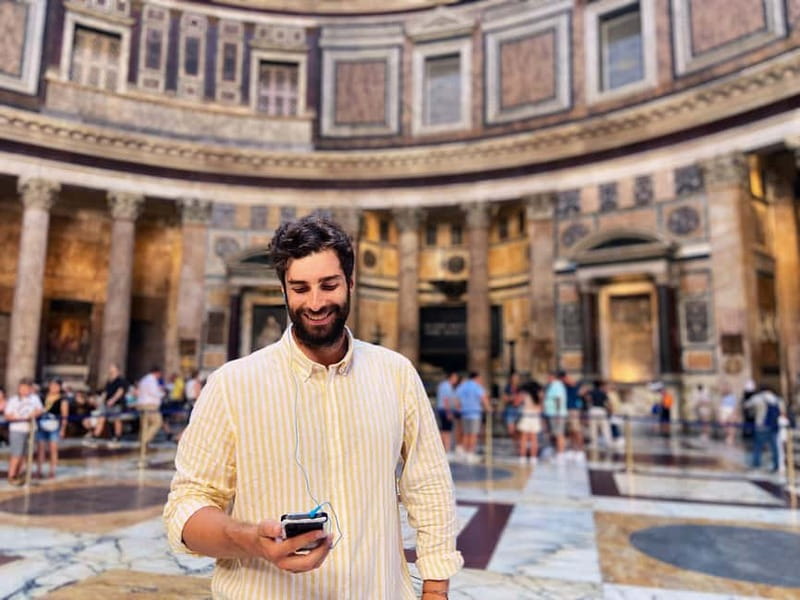
The Pantheon is famous for a reason, but it’s also famous for lines. This experience is built for the moment you don’t want to burn time outside the doors. Your ticket is designed as skip-the-line priority entry, using your e-ticket shown on your phone to staff at the entrance.
The start point is simple: head straight to Piazza della Rotonda, 00186 Roma. From there, you present your e-ticket on your mobile device. In practice, that means less waiting, more inside time, and a visit that feels like something you can actually fit into a busy Rome day.
What’s especially practical here is that the experience isn’t just about entry. Once you’re inside, you’re not stuck with a loud group tour or a guide telling you to move on every few minutes. You’re given an audio experience you control. That matters at the Pantheon, because you’ll likely want time to look up at the dome and then slow down for details around the interior.
One small heads-up: a couple of people noted that the fast-track entrance can be easy to miss if you’re not paying attention. When you arrive, take a second to scan for the separate entrance signs before you join any crowd.
You can also read our reviews of more tours and experiences in Rome.



Downloading the audio app: your phone becomes the guide

This is a smartphone-based experience, so the audio is only as good as your device prep. You’ll want to do two things before you arrive:
First, download the audio guide using the QR code on your voucher. Second, make sure your phone has enough battery to last through the visit. You also need headphones (not included), since the audio clips are meant for personal listening.
The audio itself is structured as a 35-minute route built around key visual moments inside the Pantheon. You’ll get 12 audio points of interest, and you’re guided with a digital map to help you locate each stop as you move. That turns the Pantheon from a big impressive room into something you can follow.
Language support is strong for a ticket like this: the app offers audio in 10 languages, including English, French, German, Italian, Spanish, Portuguese, Polish, Korean, Japanese, and Chinese. If you’re traveling as a mixed-language group, that’s a big deal because everyone can use the same app without coordinating schedules.
If you’re the type who likes to read while you walk, this will still work, but you’ll get more out of it if you treat the audio as your spotlight. Each clip is timed to help you look at the right space, like the dome and the famous opening (the Oculus) rather than just hearing history without a visual anchor.
Inside the Pantheon: dome, Oculus, and the view that makes people quiet
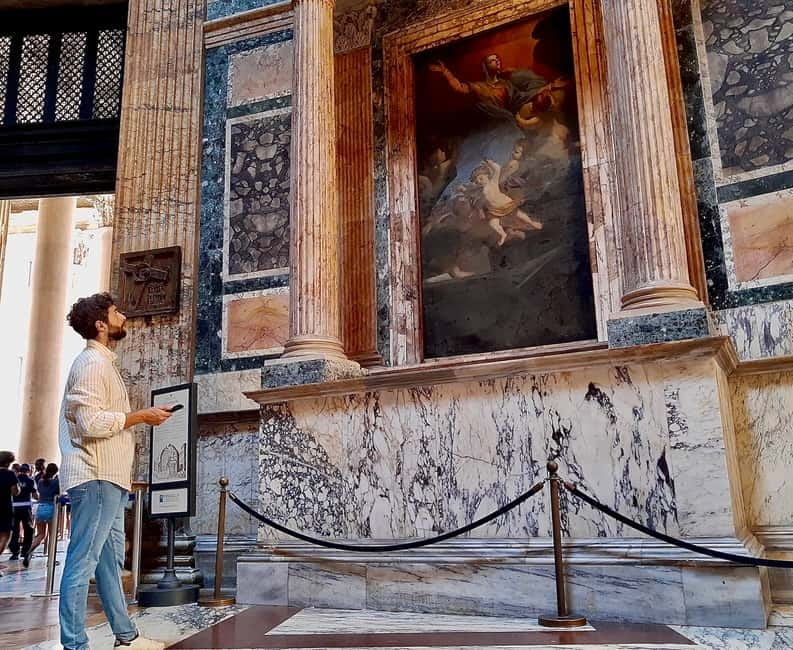
The Pantheon’s interior is one of those places where you instinctively slow down. The dome does that. The opening at the top does it too. With this app, you’re not just looking; you’re guided toward what to notice.
Expect the audio to focus heavily on the dome and its famous Oculus, including an archaeoastronomical story. Even if you’re not a “science-of-ancient-architecture” person, the audio format helps because it gives you a reason to keep your eyes up and then explains why the light matters.
You’ll also hear guidance about:
- the interior and how to read the space visually
- the pavement and how the floors relate to the building’s design
- the legends and myths tied to the Pantheon
- the history behind the Oculus
- the notable tombs and other major features inside
This is also where your 35-minute audio timing helps. You don’t feel trapped in a long tour, but you still get enough structure to avoid wandering aimlessly. At the Pantheon, that’s the sweet spot: enough context for meaning, enough freedom for your own pacing.
Artworks, pavement details, and myths you can actually picture

A lot of attraction audio guides fall into one of two buckets: either they’re too short to feel useful, or they’re too long and you stop paying attention. This one seems designed for people who want clarity without getting dragged through facts.
The audio points are meant to match what you can see inside—so when you hear about specific artworks and treasures, the goal is to help you identify what’s in front of you. You’re not left asking, Wait, where did they say that was?
The pavement is worth your attention here. The Pantheon interior is dramatic, but the floor details often become the moment people realize the building is more than a postcard. The app nudges you toward that mindset: look down, then back up. It’s a simple rhythm, but it makes the visit feel more intentional.
And then there are the stories—the legends and myths, plus the narrative around the dome and Oculus. This matters because history in Rome can feel like a blur of names and dates unless someone gives you a way to connect it to the physical space. The audio does that by tying the stories to visible locations.
One more practical note: the audio is delivered through the app, and a few people have reported the audio not loading fully if the connection or device performance isn’t great. If you know your signal inside can be spotty, it’s smart to start with the audio already working before you enter, while you still have a decent connection.
Turning your Pantheon stop into a self-guided Rome walk

The Pantheon visit is only half the value. The included app also supports a self-guided walking tour of Rome’s top landmarks—up to 30—so you can roll right into your next stop without switching apps or hunting for another guide.
The experience specifically mentions a walking storyline after the Pantheon. You’ll pass the area around the Pantheon and head toward major sights such as Fontana di Trevi and end around Piazza di Spagna. It also references Piazza Navona as part of the route planning.
Here’s why that’s useful: Rome days can go sideways when you don’t have a plan for when to move. With this, your phone gives you a structure for what to do next—while still leaving you in charge of how long you linger at fountains, squares, and viewpoints.
Think of the app as two layers:
- an inside layer for the Pantheon itself (with 12 points and a map)
- an outside layer for picking up momentum and seeing more of central Rome in one day
And because it’s self-guided, you can adjust based on your energy level. If you want Trevi right after the dome, you can. If you want to detour to a side street for a coffee or just people-watch, you can—without feeling like you’re falling behind a group.






Where the small-group energy matters (and where it doesn’t)

This experience is listed as a small group limited to 10 participants. For an app-based entry like this, you might wonder what a “group” changes. The main difference is typically in the check-in environment—less crowded, fewer logistics to manage, and a smoother transition to the separate entrance.
Even though the visit is largely self-guided once you’re in, the presence of staff matters. Several reviews mention helpful on-site people at the ticket center or check-in point. Named examples include Mari (check-in support), Natalia (helpful when dates or details needed correcting), and Francesca (praised as an excellent tourist guide). Reviews also mention guide-style storytelling from individuals like Tom and Matt, with strong praise for the knowledge shared.
You don’t need a live guide to enjoy the Pantheon, but staff support can be the difference between a calm start and a confusing one—especially if you’re troubleshooting the QR code, downloading the app, or figuring out the entrance path.
Price and value: is $6 for Pantheon priority entry worth it?

At $6 per person, the price is the kind of deal that makes you double-check you read it right. And while it’s not a full guided tour, it still hits the key things that cost time in Rome: line length and lack of context.
Here’s the value math:
- Priority entry is what you’re paying for if you want to avoid the biggest queue at the Pantheon.
- The audio guide is included and adds meaning so your visit doesn’t feel like you just walked through a large room.
- Afterward, the app extends the usefulness with a self-guided route of up to 30 landmarks, which helps you get more from the same ticket and the same day.
If you’re comparing against buying only a regular ticket and then spending your energy in queues, the fast-track approach often wins—especially at peak hours. One review even made the point directly: if you see the regular line, the priority option starts to feel like time bought back.
The main reason it might not be worth it is if you hate app-based experiences. If you strongly prefer a live human guide at every step, you may find the audio approach less satisfying. But if you’re flexible, this is a very cost-effective way to see the Pantheon without losing an hour (or more) to waiting.
Who should book this Pantheon Priority Entry with app audio?

This fits best if you:
- want skip-the-line access to the Pantheon
- prefer moving at your own pace instead of being rushed through a script
- like using your phone as a guide, especially with map support
- want an audio experience in 10 languages
- plan to keep walking central Rome right after the Pantheon (toward Trevi and Piazza di Spagna)
It might be a weaker fit if you:
- can’t or won’t use a smartphone (this includes headphones and battery requirements)
- are traveling in clothing that doesn’t meet the dress code (no shorts, short skirts, hats, or sleeveless shirts)
- need a fully live, Q-and-A style guided tour rather than narrated audio
Dress code is a real factor here. Rome can be relaxed in the street, then strict at sacred sites. Plan for a cover-up approach if you’re traveling in hot weather.
Should you book? My practical call

I’d book this if you want the Pantheon to feel efficient and meaningful. Fast-track entry plus a structured audio route is a strong combo, and the added self-guided walk keeps your day moving in a way that’s hard to replicate with a regular ticket alone.
The only “don’t-book-unless” concern is the tech side. Bring your own headphones, keep your phone charged, and download the app ahead of time. If you do that, you’ll get a calm entry, a clear path to key sights inside, and a bonus walking plan for Rome’s classic squares and fountains.
If you want, tell me what day/time you’re considering and what languages you need, and I can suggest a smart pacing plan for the 1-hour window so you don’t feel rushed.
FAQ
What’s the duration of the Pantheon priority entry and audio experience?
The activity is listed as 1 hour. Audio inside is described as a 35-minute guided segment on your smartphone, plus time for exploring.
Where do I go to start the experience?
You can make your way directly to the Pantheon at Piazza della Rotonda, 00186 Roma.
How do I enter the Pantheon with this ticket?
You show your e-tickets on your mobile device to staff at the entry.
What’s included with the ticket?
Included are a skip-the-line ticket to the Pantheon, a digital audio guide via app for the Pantheon in 10 languages, and a self-guided tour through the app of Rome’s top landmarks (up to 30).
Do I need headphones?
Yes. Mobile device and headphones are not included, so you’ll need to bring your own headphones.
What languages are available for the audio guide?
The audio guide offers Chinese, English, French, German, Italian, Polish, Portuguese, Spanish, Korean, and Japanese.
What should I bring?
Bring headphones, a charged smartphone, and make sure you have the downloaded app.
What clothing is not allowed?
Shorts, hats, short skirts, and sleeveless shirts are not allowed.
Is there free cancellation?
Yes. Free cancellation is available up to 24 hours in advance for a full refund.