REVIEW · ROME
Rome by Golf Cart Private Tour: Beyond the Landmarks
Book on Viator →Operated by Rolling Rome · Bookable on Viator
Rome has a lot going on at once, so start smart. A private golf cart tour lets you see major sights and quieter corners in the same outing, with story time from guides like Julio and Francesca.
I especially love the way this tour mixes famous Rome with small, high-impact stops that most people miss when they walk solo. And I like the comfort factor: covered carts, rain protection, and short photo stops mean you keep energy for more Rome later.
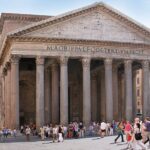
One thing to consider: this is sightseeing from the outside. If you want to go inside places like the Colosseum, Roman Forum, Vatican Museums, or the Pantheon, you’ll need separate tickets.
In This Review
- Key Things You’ll Notice Right Away
- Rolling Through Rome’s Center (Without the Stair Workout)
- Private Means Personal: How the Itinerary Works
- Colosseum Stop: Big Exterior Views, No Ticket Pressure
- Circus Maximus and the Ancient Traces You Can Still Feel
- Knights of Malta Keyhole: The Mini-Miracle Photo Break
- Jesuit Church Stop for the Dome Surprise (Sant’Ignazio di Loyola)
- Spanish Steps and the Stairs-That-Are-a-Scene
- Aventine Views at Giardino degli Aranci
- Piazza Navona: Geometry, Fountains, and That Oval Shape
- Villa Borghese and the Pincian Hill Pass-By
- Constantine’s Arch and Other Triumphs in Stone
- Fontana Stops: Big Drama in Compact Time
- Mouth of Truth: A Short Stop With a Big Legend
- Trastevere Alleys: Food Streets and Night-Life Energy
- Churches With Famous Art: San Pietro in Vincoli
- Janiculum and Garibaldi: Views and a Possible Canon Moment
- Piazza Venezia and the Feeling of Ancient Overlap
- Trajan Column: 2000 Years of Stone Narrative
- Teatro di Marcello and Caelian Hill: Rome’s Less-Rushed Structures
- Ghetto Walk and the Four Rivers Fountain Finale
- How Long Should You Book: 2 Hours vs a Full-Day Route
- Price and Value: Is $180.67 Per Person Worth It?
- Best Fit: Who This Rome Golf Cart Tour Works For
- Should You Book This Tour?
- FAQ
- Is this a private tour?
- Does the tour include pickup from my hotel?
- Where does the tour start and end?
- How long is the tour?
- Are entrance tickets included for places like the Colosseum?
- What kind of vehicle is used?
- Is lunch included?
- Does the tour run in bad weather?
- Are there places we can visit besides the main monuments?
- What is the cancellation policy?
Key Things You’ll Notice Right Away
- Hotel pickup in central Rome so you don’t waste your first hours hunting for a meeting point
- A realistic route plan based on what you care about most, with stops chosen to fit the time
- Street-legal, covered carts with seat belts and side protection, plus rain covers
- No inside access at ticketed sites, so you get views and photos without the timed-entry stress
- Strong guide energy: names that pop up often include Gabriel, Eugene, Oscar, Beatrice, and Angelo
Rolling Through Rome’s Center (Without the Stair Workout)
This is a private Rome golf cart tour built for efficiency. You meet the team at Piazza del Gesù 47 (or your hotel in central Rome, if you request pickup), then you board a comfortable, covered cart that’s street-legal and designed for sightseeing.
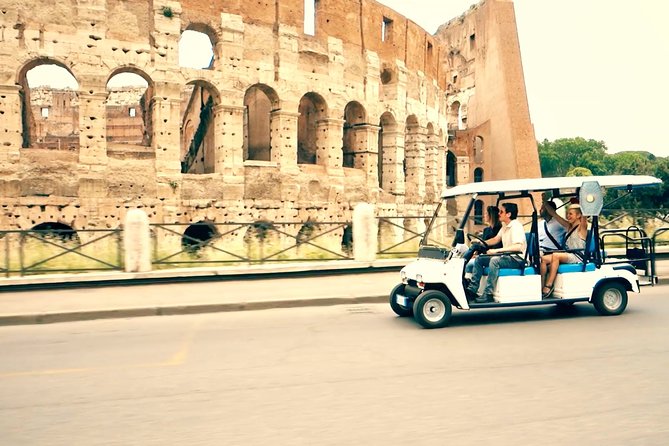
The cart setup matters. It’s typically a six-seat vehicle with four seats facing forward (including the driver’s position) and two seats facing backward. Side protection and seat belts are included, and the carts run rain or shine with rain covers on board. For people who don’t want to do long stretches on foot, it’s a big upgrade: you still see plenty, but you’re not grinding through constant cobblestones.
And because this is private, the pace stays personal. If you want more time at a viewpoint, your guide can steer the schedule that way. If your group is more museum-minded, you can swap stops accordingly.
You can also read our reviews of more tours and experiences in Rome.
Private Means Personal: How the Itinerary Works
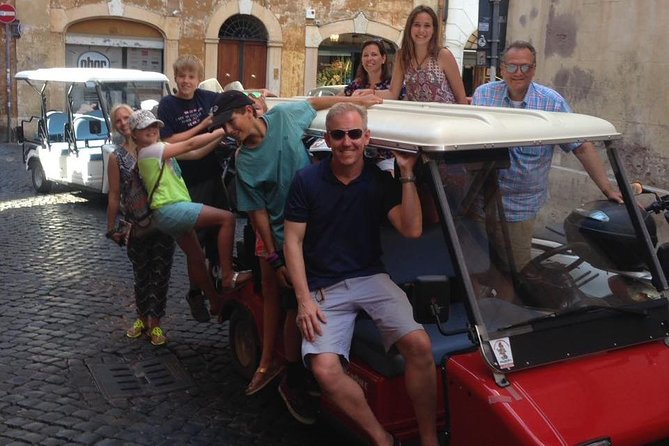
Your guide doesn’t follow a rigid script. You get a menu of possible stops, then at the start you talk through your priorities and your guide builds a route that fits the length you booked.
That flexible planning is a real value in Rome. The city is tight, traffic can slow you down, and some areas are more pleasant at certain times of day. The best tours don’t just list sights; they decide what to prioritize so your day doesn’t feel rushed or randomly shuffled.
Here’s what you should expect:
- You’ll see as many sites as time allows.
- You’ll get exterior views and photo time at many major stops.
- You can request a more “big sights” route or a “churches, fountains, and neighborhoods” route.
- The tour ends back where it started (often your pickup point, or within the historic center).
Colosseum Stop: Big Exterior Views, No Ticket Pressure
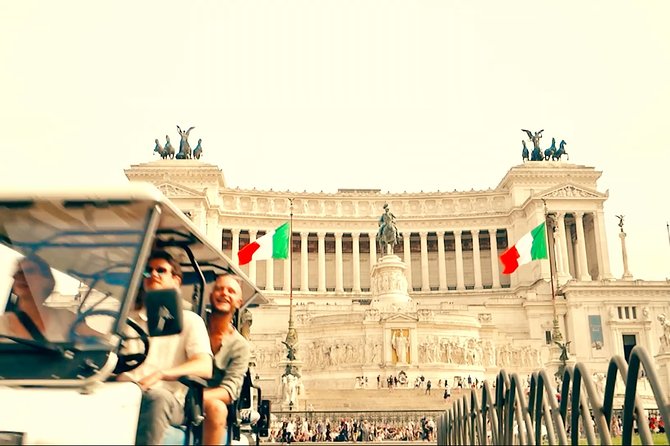
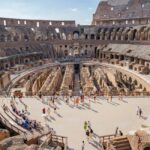
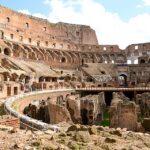
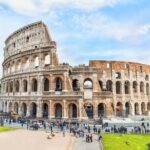
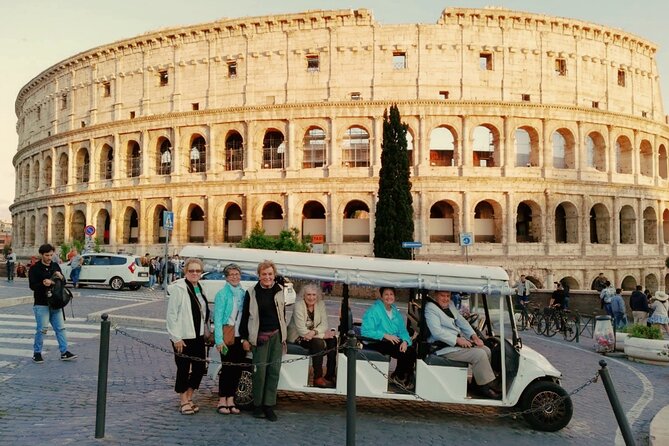
The Colosseum is on the menu and it’s a classic first-stop choice. Expect about 15 minutes for this stop, with the Colosseum viewed from the outside.
That “outside only” detail is important. The tour does not include entry tickets to ticketed attractions, so you won’t go into the arena or climb into interior sections. What you do get is time for photos, a sense of scale, and a quick story-driven orientation so you understand what you’re looking at before you tackle it again on a separate visit.
If you’re doing a first-day plan, this works well because it helps you connect the Colosseum to other nearby ancient structures you’ll see later.
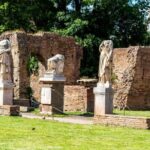
Circus Maximus and the Ancient Traces You Can Still Feel
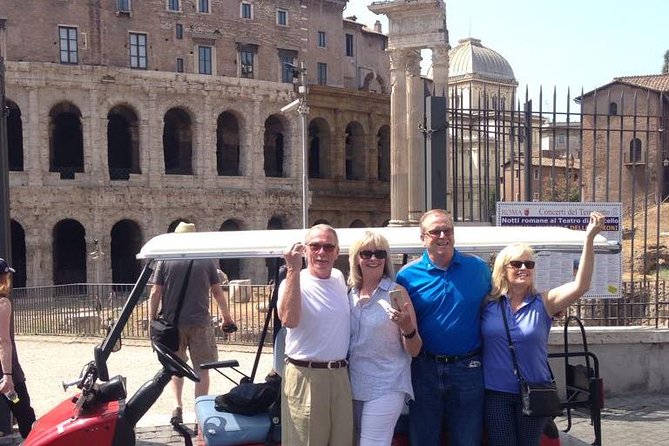
The Circus Maximus is a short stop (about 10 minutes). It’s free, and the charm here is the contrast: today it’s a long green ribbon, but in Roman times it was built for chariots and massive crowds.
This kind of stop is exactly where a cart tour shines. You can get the historical context quickly, stand where the scale makes sense, and move on without spending an hour crossing between major sites.
If you like “less famous but very Roman” stops, this one is a good anchor.
Knights of Malta Keyhole: The Mini-Miracle Photo Break
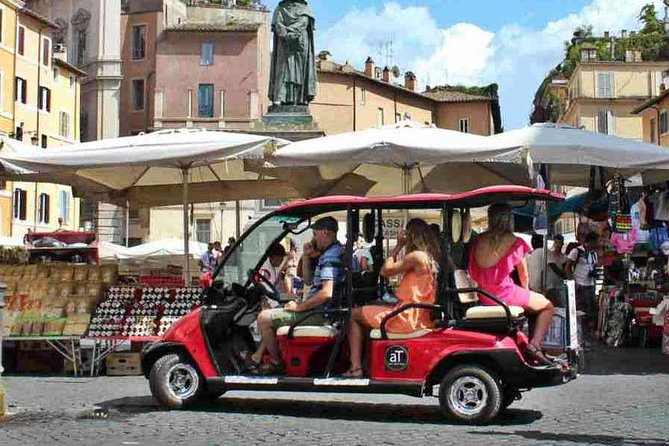
One of the most playful stops on the list is the Knights of Malta Keyhole, with about 10 minutes scheduled and admission listed as free.
You’ll get a quick lesson on what you’re seeing and why this little peephole is a thing in Rome. It’s a perfect reset stop: short, fun, and memorable in photos. It also breaks up the heavier-feeling ancient sites with something lighter.

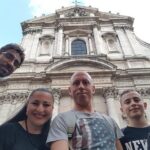
Jesuit Church Stop for the Dome Surprise (Sant’Ignazio di Loyola)
If your group enjoys architecture, this is a stop worth aiming for: Chiesa di Sant’Ignazio di Loyola (about 10 minutes, free entry listed).
The draw here is the dome moment. Even if you’re not a church maximalist, the storytelling approach helps you look at the building like a puzzle instead of just a place to pass through.
And since you’re in a cart, you get to fit church stops into an itinerary that would be hard to manage on foot.
Spanish Steps and the Stairs-That-Are-a-Scene
The Spanish Steps (around 10 minutes, free) sit in that sweet spot of “famous” but still worth seeing in person. You’ll get a sense of how the terraces and irregular shape turned this area into a social stage.
This is also a smart photo stop. Rome is full of great corners, but the Spanish Steps are one of the places where a wide shot instantly tells people you were there.
If you’re visiting in busy seasons, the cart rhythm helps because you’re not stuck pacing around waiting for the right angle for an hour.
Aventine Views at Giardino degli Aranci
The Giardino degli Aranci on the Aventine Hill is a short stop (about 10 minutes, free), but it’s one of those Rome moments that earns its time.
You get rooftop views over the city, and you’re positioned at a slightly calmer altitude than some of the more central streets. It’s a great “breather” stop after clusters of crowds and traffic.
Piazza Navona: Geometry, Fountains, and That Oval Shape
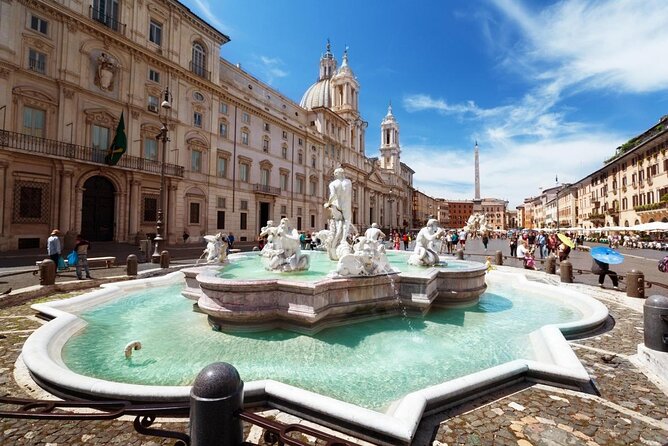
Piazza Navona (about 10 minutes, free) is a crowd magnet for a reason. It’s dominated by the famous fountain of the four rivers, and the square’s shape ties back to its older past.
The cart tour gives you the right rhythm: a quick orientation, a moment to take it in, and then movement before you lose the day to slow wandering.
Villa Borghese and the Pincian Hill Pass-By
At about 15 minutes with free admission listed, Villa Borghese is more about what you experience from the outside—park scenery, statues and fountains passing by, and views toward Piazza del Popolo and St Peter’s depending on sightlines.
This stop is a good match for travelers who want a green break without committing to a full park visit.
Constantine’s Arch and Other Triumphs in Stone
Rome’s triumphal arches don’t just look good; they tell you who controlled the story. One stop in the set is a “Victory arches” stop for Constantine the Great, where the point is the continuing presence of Roman architecture and how later eras used it.
You’ll likely get a photo break and a clear explanation of why this arch is tied to big shifts in Roman power and religion.
Fontana Stops: Big Drama in Compact Time
This tour leans into fountains, and that’s a smart strategy. Fountains create instant visual payoff, and they’re easy to pair with nearby streets and viewpoints.
Two listed fountain stops:
- Fontana dell’Acqua Paola (about 5 minutes, free) on Janiculum Hill, built to mark the end of the Acqua Paola aqueduct.
- Fontana della Terrina (about 10 minutes, free), described as a romantic fountain and square with a story behind it.
- Fontana dei Quattro Fiumi (about 10 minutes, free), tied to Bernini and the Bernini vs Borromini rivalry story.
Because the cart keeps transit friction low, you can stack multiple fountain encounters in one outing without feeling like you’re sprinting between far-apart locations.
Mouth of Truth: A Short Stop With a Big Legend
The Mouth of Truth is listed as a 5-minute stop with admission tickets not included. You’ll get the legend and then the short chance to try the photo moment.
This is one of those stops where the story is half the fun. The other half is the quick, hands-on tradition you’ll see people doing nearby.
If you’re bringing kids, this is often an easy win because it’s quick, playful, and instantly recognizable.
Trastevere Alleys: Food Streets and Night-Life Energy
This part isn’t framed as a single monument stop. Instead, you’ll get a chance to explore tiny and colorful alleys once linked to a fisherman neighborhood, where today you’ll find bars, cocktail bars, restaurants, and nightlife.
Even in short time windows, this can be valuable because it helps you see Rome as a living city, not only an open-air museum. If your ideal day includes a “where to eat” feel, this section is a good fit.
And since it’s a private tour, your guide can adjust how long you linger depending on your group’s vibe.
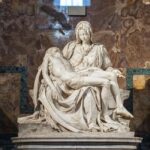
Churches With Famous Art: San Pietro in Vincoli
Basilica of San Pietro in Vincoli (about 10 minutes, free entry listed) is included for one standout reason: it houses Michelangelo’s Moses holding the ten commandments.
You don’t need to be a die-hard art fan to appreciate this stop. It’s a perfect “Rome in one object” moment: sculpture you recognize, inside a church you can point to, connected to the larger story of Italy’s art and power.
Janiculum and Garibaldi: Views and a Possible Canon Moment
Giuseppe Garibaldi Monument is planned for about 5 minutes and sits on the Janiculum Hill. There’s also a time-based detail: if you arrive by 12pm, you could see the famous canon shooting the city.
That condition is worth noting when you plan your day length. If you’re booking a morning start and the group loves spectacle, this becomes a reason to pick that timing.
Even without the canon, Janiculum Hill views and Rome’s layout are easy to enjoy from a cart stop.
Piazza Venezia and the Feeling of Ancient Overlap
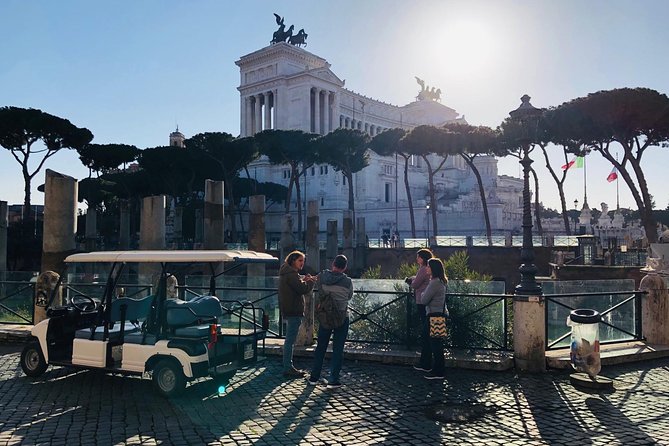
Piazza Venezia / Ancient City is on the list as a 10-minute free stop. It’s a busy square full of layers, where multiple eras stack up visually.
This is a useful stop if you want to understand how Roman history doesn’t just sit in one fenced-off zone. Instead, it spills into everyday streets and squares.
Trajan Column: 2000 Years of Stone Narrative
The Trajan Column is listed as about 10 minutes, free. The point isn’t just that it’s old; it’s that it’s a story carved in marble, describing the Dacian war and the glory of Emperor Trajan.
For many visitors, this is the moment where Rome shifts from “photos” to “meaning.” You start seeing how Romans used art and monuments to teach and persuade.
Teatro di Marcello and Caelian Hill: Rome’s Less-Rushed Structures
Two stops worth attention if you like architecture and Roman remnants:
- Teatro di Marcello (about 10 minutes, free): described as older than the Colosseum, with construction tied to Caesar and today privately owned.
- Caelian Hill (about 20 minutes, free): includes the church of Santissimi Giovanni e Paolo, remnants of the temple of Hadrian, and views toward Villa Celimontana.
These stops are excellent when you want a break from the most over-photographed scenes. They’re also good for groups who want variety without adding extra walking.
Ghetto Walk and the Four Rivers Fountain Finale
The Ghetto stop is about 10 minutes and is free. It’s framed with the note that the Roman Jewish community is the oldest continued Jewish community in the world, and that a Roman ghetto was created as a closed neighborhood.
This is one of the stops where a short, thoughtful pause can matter. It works well because you’re not forced into a long visit during a multi-stop day.
Then, depending on your route length, you may end near or stop at Fontana dei Quattro Fiumi, letting you close with a strong visual punctuation.
How Long Should You Book: 2 Hours vs a Full-Day Route
Your booking length changes the feel of the entire day.
- Shorter options (around 2 to 3 hours) work best when you want a top-sights orientation plus a couple of personality stops. This is also a solid first-day choice because you’ll leave with a map in your head.
- Full-day options (up to 7 hours) are for travelers who want more than one neighborhood mood. In the full-day package, there’s a lunch break included.
If you’re visiting on a tight schedule, a shorter cart tour gives you the best return on time. If you’re the type who wants to keep discovering Rome even after you’ve seen the big names, go full day.
Price and Value: Is $180.67 Per Person Worth It?
At $180.67 per person, this isn’t a bargain-basement tour. But it can be good value because you’re paying for three things that add up quickly in Rome:
- Private transport by cart through the center
- A guide who builds a route around your interests instead of marching you through a fixed list
- Comfort that protects your time and energy, especially if you’d otherwise spend longer waiting, walking between distant stops, or fighting traffic on foot
Also, this tour avoids the biggest time-wasters of ticketed landmarks by keeping it mostly exterior. You get orientation and photo moments without committing to long entry lines during the tour itself.
For couples, families, and small groups who want to maximize one day and keep it easy on the feet, the value often makes sense. If you already have a detailed plan and you love walking a lot, you might not need the cart.
Best Fit: Who This Rome Golf Cart Tour Works For
This is a strong choice if you:
- want a first-day overview so you can plan deeper visits afterward
- prefer less walking while still seeing major Rome
- enjoy guides who connect monuments to stories, not just dates
- want a day built around your interests, not a fixed script
- like mixing big hits (Colosseum area, Piazza Navona) with smaller “why it matters” stops (keyhole, domes, fountains, columns)
It’s less ideal if you know you want to spend long interior hours inside multiple ticketed attractions during the same outing. This tour is built for exterior sightseeing, so you’d pair it with separate ticket visits.
Should You Book This Tour?
If your goal is to get oriented fast and enjoy Rome from the comfort of a covered cart, I’d book it. The private setup and flexible route planning help you shape the day instead of swallowing a generic checklist. Just go in knowing you’re getting views and photo time, not included museum or interior entry.
If you want one practical strategy: book this early in your trip. It helps you pick which ticketed places you truly want to return to and gives you a better sense of what you’re looking at when you do go inside.
FAQ
Is this a private tour?
Yes. It’s private, meaning only your group participates.
Does the tour include pickup from my hotel?
Pickup is offered from central Rome hotels when provided up to 24 hours in advance. If pickup isn’t selected, the tour departs from the Rolling Rome office at Piazza del Gesù 47.
Where does the tour start and end?
The start meeting point is Piazza del Gesù, 47, 00186 Roma RM, Italy. The tour can end at your hotel or within the historic center, or at the Rolling Rome office.
How long is the tour?
Duration is listed as 2 to 7 hours (approx.), depending on the option you book.
Are entrance tickets included for places like the Colosseum?
No. The tour includes sightseeing and exterior views, but entry to ticketed sites is not included.
What kind of vehicle is used?
It uses a street-legal, covered golf cart with seat belts and side protection. The cart is typically a six-seat layout with four seats facing forward and two seats facing backward.
Is lunch included?
Lunch is included only on the full-day tour option.
Does the tour run in bad weather?
The tour runs rain or shine. Golf carts have rain covers, and weather issues may affect scheduling if poor conditions occur.
Are there places we can visit besides the main monuments?
Yes. Your guide discusses your interests and builds a route using a list of possible sites, which can include churches, viewpoints, fountains, and neighborhood streets.
What is the cancellation policy?
Free cancellation is available if you cancel at least 24 hours in advance for a full refund. If you cancel within 24 hours of the start time, the amount paid is not refunded.