REVIEW · POMPEII
Pompeii 2h Small-Group Tour with Expert Archaeologist
Book on Viator →Operated by Mondo Guide Srl · Bookable on Viator
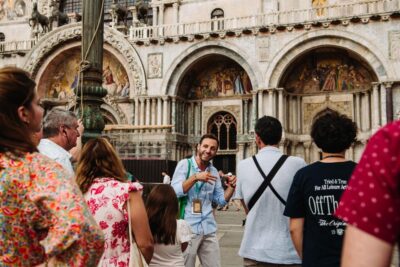
Pompeii, compressed into two sharp hours. What makes this tour work is the expert-led route that hits the big sights fast, plus the guide-style storytelling that turns ruins into real daily life. I especially like how you get a guided look at places you’d easily miss on your own, and how the pace can work for families too. One thing to keep in mind: with a 2-hour format, you’re moving from stop to stop, so it is not the kind of visit where you linger.
You start at a simple meet-up spot near the action—Ristorante Suisse in Piazza Esedra—and you finish back there. The tour runs in English, and the mobile ticket is meant to make entry smoother once you’re at the site.
Another plus is the built-in focus on major areas, not random wandering. Pompeii entrance is always free on the first Sunday of each month, and under 18s can also get free entry with a valid ID, but this tour still includes admission for the stops on the itinerary.
In This Review
- Key things to know before you go
- Pompeii in 2 Hours: What You Really Get
- Meet at Piazza Esedra and Get Into the Site Fast
- Stop-by-Stop Through Pompeii’s Most Recognizable Sights
- Archaeological Park of Pompeii (Admission included, about 10 minutes)
- Odeon and Teatro Piccolo (about 10 minutes)
- Teatro Grande (about 15 minutes)
- House of Menander (about 15 minutes)
- Stabian Baths, Terme Stabiane (about 15 minutes)
- Lupanar (about 10 minutes)
- Via dell’Abbondanza (time included in route)
- House of the Faun (about 10 minutes)
- Foro de Pompeya (about 15 minutes)
- Basilica (about 15 minutes)
- Why the Guide Matters More Than You Think
- Price and Ticket Value: What $32.67 Buys You
- Who This Tour Fits Best (And Who Should Pass)
- Quick Planning Tips That Make the Tour Easier
- Should You Book This Pompeii 2-Hour Small-Group Tour?
- FAQ
- How long is the Pompeii 2-hour small-group tour?
- Is the tour in English?
- Where do we meet for this Pompeii tour?
- What does the itinerary cover?
- Is admission included?
- Are there any free-entry rules for Pompeii?
- What group size should I expect?
- What if plans change and I need to cancel?
Key things to know before you go
- A highlight route with admission included for each stop on the agenda, so you spend less time figuring out logistics
- Theaters + Roman street life in one tight loop, including the Teatro Grande and Via dell’Abbondanza
- Big-house details like the House of Menander and the House of the Faun, where architecture and decoration matter
- Baths and the Lupanar give you a fuller picture of Pompeii beyond temples and streets
- Family-friendly pacing (and guides who adapt to heat and energy levels)
- Group size control, but not tiny: max 30 travelers, with a minimum of 6
Pompeii in 2 Hours: What You Really Get
This is a smart choice when you want the Pompeii basics with structure. You’re not just walking through a ruined city—you’re getting a guided sequence that makes connections between neighborhoods, buildings, and everyday routines. In a site this large, that kind of order matters.
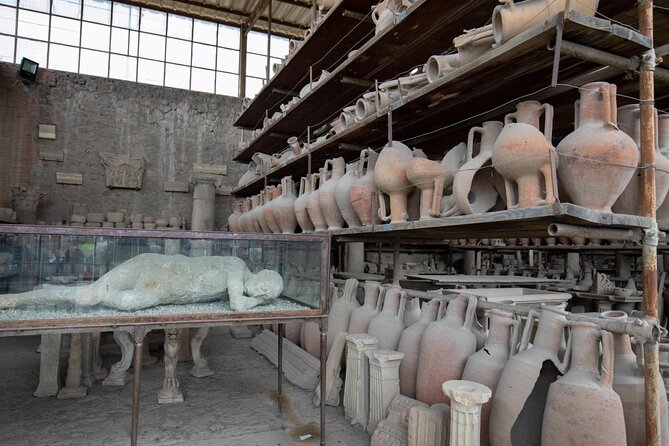
In about two hours, the itinerary concentrates on Pompeii’s most recognizable public spaces (theaters, Forum, Basilica), plus household and entertainment stops (two major residences and the famous brothel). That mix is what makes this tour feel efficient instead of rushed. You finish with a mental map you can use when you roam on your own afterward.
The time budget is also honest. You’ll get quick orientation at each stop, not a slow, minute-by-minute inspection. If you like to photograph every corner or read every label, you may want to plan extra time later.
You can also read our reviews of more tours and experiences in Pompeii.



Meet at Piazza Esedra and Get Into the Site Fast
The meeting point is Ristorante Suisse, Piazza Esedra, 10/13, 80045 Pompei. The tour ends back at the same meeting spot, which is handy if you’re coordinating with trains or other plans in Naples or Sorrento.
The location is described as near public transportation, and Pompeii is crowded enough that starting with a clear plan is a comfort. Add the mobile ticket, and you avoid the last-minute scramble that can happen when you’re trying to match timelines with tours, buses, and the heat.
Physically, plan for moderate walking. Pompeii’s ground can be uneven, and you’ll be covering enough distance that comfortable shoes are a must.
Stop-by-Stop Through Pompeii’s Most Recognizable Sights
The route is a tight chain of stops, each with its own purpose. The minutes are brief, but the ordering is what helps you make sense of the city.
Archaeological Park of Pompeii (Admission included, about 10 minutes)
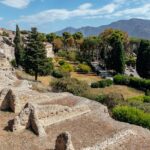
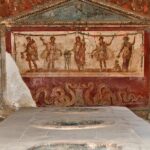
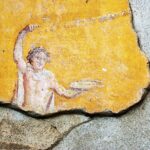
You start inside the Archaeological Park of Pompeii. The big idea is context: an ancient Roman city preserved by the eruption of Mount Vesuvius in 79 AD. From there, the guide focuses on the frescoes and the kinds of decoration that help you picture what this place looked like before the eruption.
A short opening stop like this is useful because it sets the rules of the game. Once you understand what you’re looking for—wall paintings, building layouts, and street orientation—you’ll pick up more in the theaters and houses that follow.
Odeon and Teatro Piccolo (about 10 minutes)
Next comes the Odeon and Teatro Piccolo, the smaller theater spaces. Even if you’ve seen photos of grand ruins before, small venues like this help show how Pompeii’s culture wasn’t only about monuments. It was also about regular performance life—voices, gatherings, and entertainment.
If you’re the type who likes details, this stop helps you notice scale. The size of a theater changes the feel of the whole area around it.




Teatro Grande (about 15 minutes)
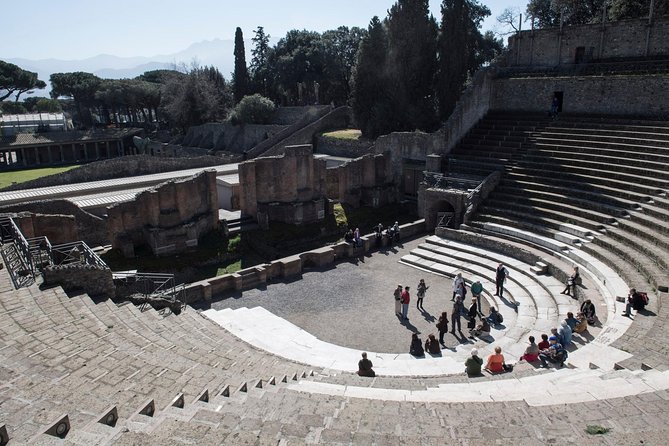
This is the big one: Teatro Grande, the most important theater in Pompeii. You’ll be guided through what makes it important and how theater space worked in Roman life.
This is also a good moment to think like a city dweller. Where do you enter? How do you move through crowds? What would sound and visibility feel like? A guide’s explanations can make the structure click quickly, which is exactly what you want in a two-hour format.
House of Menander (about 15 minutes)
Now you shift from public life to wealthy private life. The House of Menander is described as one of the richest homes in Pompeii, notable for architecture, decoration, and contents. Even in a short visit, this stop is about showing you how status shows up in design.
This is where frescoes and layout become more than decoration. You start to see how people displayed taste, wealth, and connections through their homes.
Stabian Baths, Terme Stabiane (about 15 minutes)
Then comes everyday life—literally bathing and social routines—at the Stabian Baths (Terme Stabiane). These baths occupy a vast area and are described as the oldest thermal complex in the city, located between Brothel lane, Holconius crossroads, and Via Stabiana.
Baths are a great anchor stop because they explain how “public” could still feel personal. You’re not just learning about water. You’re learning about meeting points, routines, and how neighborhoods functioned around communal spaces.
Lupanar (about 10 minutes)
The Lupanar is the most famous brothel in Pompeii. This stop can be surprisingly informative if your guide keeps it grounded in how the city worked, not just the headline reputation.
It also adds balance to the itinerary. After theaters and baths, a stop like this reminds you that ancient cities had a full range of services and social realities.
Via dell’Abbondanza (time included in route)
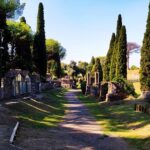
Next you hit Via dell’Abbondanza, the famous main street. This is where you connect the dots between major buildings. Streets are the glue of the city, and walking through or referencing this road helps you understand where the stops sit in relation to one another.
If your brain needs a “map moment,” this is it.
House of the Faun (about 10 minutes)
Then you move back into elite domestic life at the House of the Faun. It’s described as one of the largest and most impressive private residences in Pompeii.
In just a few minutes, the value here is comparing this home to the House of Menander. Both are wealthy, but they communicate wealth differently through size, layout, and the kinds of decoration you’d expect from elite households.
Foro de Pompeya (about 15 minutes)
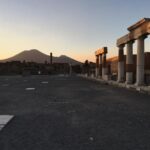
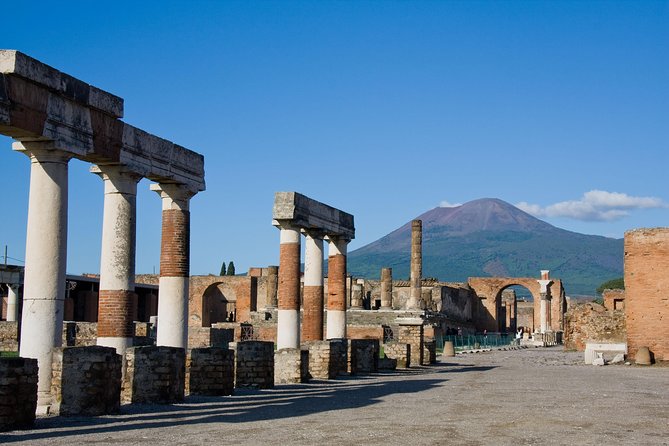
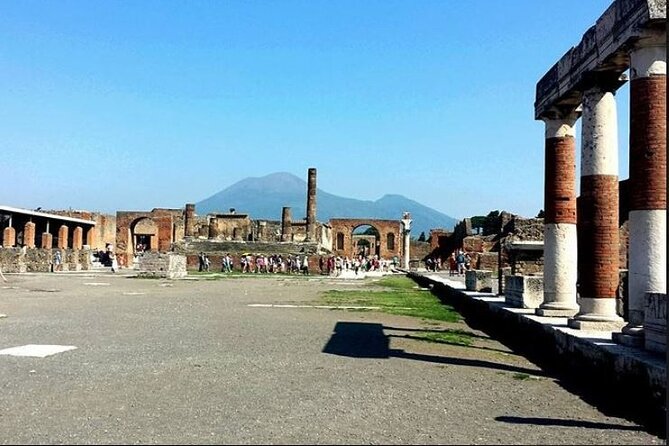
The Forum is Pompeii’s main square, and it’s the obvious centerpiece for understanding how the city organized public life. The key is that the guide can help you see why this square mattered—who gathered here and what kinds of activities would have filled the space.
This stop is great for first-time visitors because it gives you a sense of place. After this, you can roam more confidently.
Basilica (about 15 minutes)
Finally, the Basilica. In Roman cities, these open portico structures sheltered merchants and other activities. In other words, this is where commerce and everyday business happened.
When you finish here, you’re ending with a practical “how the city ran” perspective—exactly the kind of ending that makes the whole tour feel coherent.
Why the Guide Matters More Than You Think
Pompeii can feel like a photo album unless someone gives you the keys. The best guides don’t just recite facts. They point out what to notice, then explain why it matters.
Some guides stand out in how they handle pacing and tone. For example, Luca’s storytelling style is repeatedly described as passionate and engaging, with a moderate pace that can work for older visitors too. Roberta’s approach is praised for passion and crowd-smart navigation. Manuela is highlighted for being entertaining and educational for families, including kids around ages 7 to 10.
And when the weather turns hot, a good guide can make a big difference. I like that this tour has short enough stops that your guide can adjust—looking for shaded places when possible and keeping the group moving without turning the whole visit into a marathon.
One honest consideration: the format is built around brief viewing windows. That means you’ll get clarity, but not endless time. If you want long, slow studying of inscriptions and architectural minutiae, you’ll likely need a longer second visit.
Price and Ticket Value: What $32.67 Buys You
At $32.67 per person, the price is essentially buying three things: a guided route, an expert archaeologist experience, and admission included for the itinerary stops.
Even if you’re capable of buying tickets and walking on your own, the value here is time. Pompeii can swallow hours fast, especially when crowds slow you down and you lose your sense of direction. A two-hour guided plan helps you get the big hits without spending the first hour just orienting.
Also, don’t forget the local free-entry rules can change what you pay in other scenarios:
- Pompeii entrance is free on the first Sunday of each month
- Admission is free for under 18 with a valid ID shown on the day of the tour
This tour still includes admission for the stops listed, so the biggest benefit of those free rules is when you’re planning additional entry time beyond the guided portion.
Who This Tour Fits Best (And Who Should Pass)
This is a great fit for:
- First-time Pompeii visitors who want the highlights and a mental map
- People who are short on time but hate feeling lost in a big site
- Families looking for a route that keeps kids from melting into boredom
- Travelers who want expert context at iconic places like the Teatro Grande, Forum, and Basilica
It may be less ideal if:
- You want to take your time and wander slowly block by block
- You prefer deep technical explanations for every house and room
- You’re sensitive to short stops and constant movement
One more practical note: group size can be up to 30. It’s still “small-group” compared to big buses, but Pompeii crowds are Pompeii crowds. If you hate noise, you might want to plan ahead about how you handle packed spaces.
Quick Planning Tips That Make the Tour Easier
- Wear comfortable shoes with grip. Uneven stone is part of the experience.
- Bring water, and plan for heat. Pompeii can feel brutal in the daytime.
- If you have hearing concerns, ask about the tour’s sound setup when you arrive. Some groups use listening equipment, and it’s worth checking comfort early.
- Use your first day wisely: do this tour for orientation, then roam afterward with clearer targets.
Should You Book This Pompeii 2-Hour Small-Group Tour?
If your goal is to see the most important parts of Pompeii with a guide-led route, I think this is an excellent way to start. The itinerary is built around major public spaces and major residences, and the tight timing helps you actually finish and feel satisfied rather than overwhelmed.
I’d book it especially if you want a family-friendly experience or you’re traveling with older relatives and you need a moderate pace. It’s also a strong option for travelers who want a guided path so you can enjoy wandering later without guessing.
But if you’re the kind of traveler who wants to spend half a day inside one house or read everything in detail, consider pairing this with additional independent time. In a city like Pompeii, the best plan is often a guide for direction, then personal time for depth.
FAQ
How long is the Pompeii 2-hour small-group tour?
The tour is about 2 hours.
Is the tour in English?
Yes, the tour is offered in English.
Where do we meet for this Pompeii tour?
The meeting point is Ristorante Suisse, Piazza Esedra, 10/13, 80045 Pompei NA, Italy.
What does the itinerary cover?
It includes Pompeii highlights such as the Archaeological Park of Pompeii, Odeon and Teatro Piccolo, Teatro Grande, the House of Menander, Stabian Baths, the Lupanar, Via dell’Abbondanza, the House of the Faun, Foro de Pompeya, and the Basilica.
Is admission included?
Yes. Admission tickets are included for each stop listed in the itinerary.
Are there any free-entry rules for Pompeii?
Yes. Pompeii entrance is free on the first Sunday of each month. Admission is also always free for people under 18, but they must show a valid ID or passport on the day of the tour.
What group size should I expect?
There is a minimum number of travelers (6) and a maximum of 30 travelers.
What if plans change and I need to cancel?
You can cancel for a full refund up to 24 hours in advance of the experience start time. Free cancellation is available.