REVIEW · POMPEII
Pompeii Private Tour with an Archaeologist Guide
Book on Viator →Operated by Askos Tours · Bookable on Viator
Pompeii makes more sense with the right guide. This private Pompeii tour with an archaeologist guide gives you focused time to ask questions while you hit top stops like the Stabian Baths and Forum. I especially like the way the route mixes major landmarks with everyday-life details (houses, a brothel, and a street full of activity). One drawback to plan for: the park admission situation can be confusing, so you’ll want to confirm what you’re paying on the day, and the tour is only about 2 hours, so you won’t see everything in full depth.
I also like the small, human feel of the experience. You’re not stuck listening to a headset script while people funnel past you. In reviews, guides like Rossana, Jolanda, Paolo, and Vito are praised for keeping a steady pace, working around crowds, and making the ruins feel like real homes and workplaces instead of just stone blocks.
Still, this is a lot of ground in a short window. Expect quick orientation stops rather than lingering at one house for an hour. If you want to slow-walk frescoes and floor mosaics, plan extra time to explore afterward.
In This Review
- Key takeaways before you book
- Private Pompeii with an Archaeologist: what this tour gets right
- Price and ticket logistics: the one thing to double-check
- Where you meet and how to start smoothly at Porta Marina
- The 2-hour route: what each stop is really for
- Stop 1: Archaeological Park of Pompeii at Porta Marina
- Stop 2: Casa dei Vettii (House of the Vettii)
- Stop 3: Lupanar (the brothel)
- Stop 4: House and Thermopolium of Vetutius Placidus (termopolium)
- Stop 5: Teatro Grande (Grand Theatre)
- Stop 6: House of Faun
- Stop 7: Stabian Baths (Terme Stabiane)
- Stop 8: Via dell’Abbondanza (street walk)
- Stop 9: Forum Baths
- Stop 10: Macellum
- Stop 11: House of Menander
- Stop 12: Granaries of the Forum
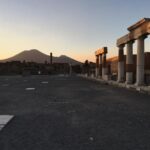
- Stop 13: Foro di Pompeya (the Forum)
- Crowd control and pace: the real value of private attention
- What to expect from the archaeologist-style guide
- Who this Pompeii tour suits best
- My booking checklist before you go
- Should you book this Pompeii archaeologist private tour?
- FAQ
- How long is the Pompeii Private Tour with an Archaeologist Guide?
- Is this tour private or shared?
- What language is the tour offered in?
- Is the Pompeii entrance ticket included in the tour price?
- Where do we meet the guide?
- What should I wear for the ruins?
Key takeaways before you book
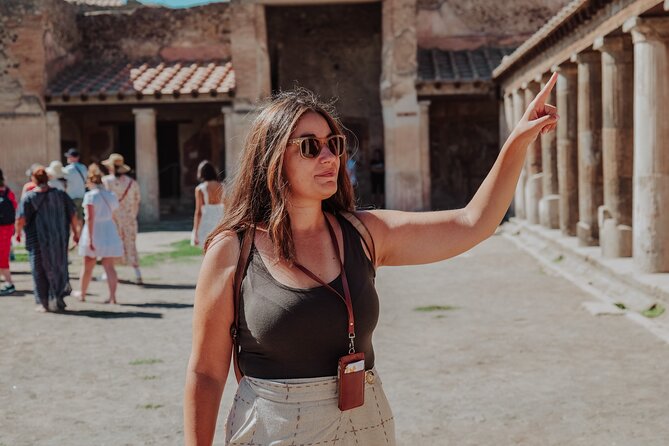
- Archaeologist-led storytelling: You’re not just getting captions; you’re getting context for how people lived and why certain spaces matter.
- A private route through the highlights: Stabian Baths, Forum area, and major public spaces come in one efficient loop.
- Q&A time that actually works: Guides are set up to pause for questions, not rush you to the next group.
- Crowd-smart movement: Multiple reviews mention navigation around busier areas.
- You’ll see a lot, fast: The upside is coverage; the tradeoff is you must be comfortable moving on quickly.
- Confirm admission expectations: Some guests reported paying the park entrance fee in addition to the tour price.
Private Pompeii with an Archaeologist: what this tour gets right
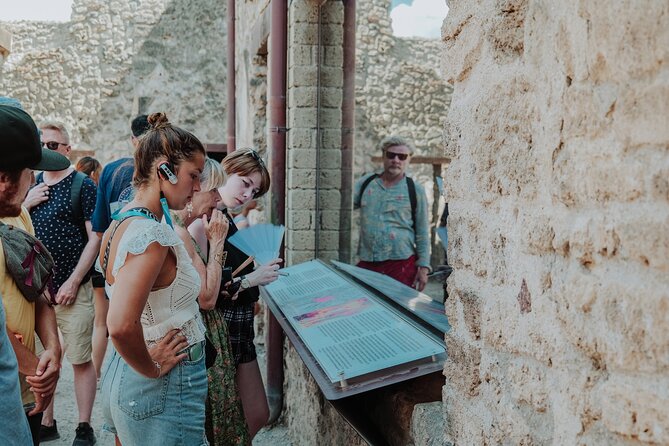
Pompeii is huge, and it can feel like information overload fast. What I like about this private format is that you get a guide who can steer you toward the most meaningful things in the time you have. You’re not trying to guess what matters most, and you’re not spending your limited vacation hours staring at a map instead of the ruins.
The tour is also designed for real questions. One of the best perks of private touring is that you can ask for clarification on the spot. In reviews, guides such as Rossana and Mena are singled out for answering questions clearly and sticking with a pace that works even when families have kids or teens along.
Price-wise, $178.45 per person for a 2-hour private tour is not cheap. But it can still be good value if you fall into one of these groups: you have limited time, you want a crowd-avoidance strategy, you’d rather pay for guidance than pay for confusion, or you simply want Pompeii explained in a way that sticks.
You can also read our reviews of more tours and experiences in Pompeii.



Price and ticket logistics: the one thing to double-check
The tour price is listed as $178.45 per person, and it runs about 2 hours. Guidance by an archaeologist and a private experience are included.
Here’s the part you should not treat casually: the itinerary notes admission at the archaeological site is included. Yet at least one review says they had to pay the park entrance ticket separately, around 20 euro per person more. That’s a big enough swing that I’d do one quick step before you go: confirm, in writing, whether your ticket is truly included for the day of your visit. If it is, great. If it isn’t, you’ll have the cash ready and you’ll avoid a stressful pause at the entrance.
One more cost note: transportation isn’t included. Since this tour begins and ends at the same point in Pompei (Via Villa dei Misteri, 1), make sure your plan for getting there and back is solid so you’re not late. A late start is the fastest way to lose the value of a short tour.
Where you meet and how to start smoothly at Porta Marina
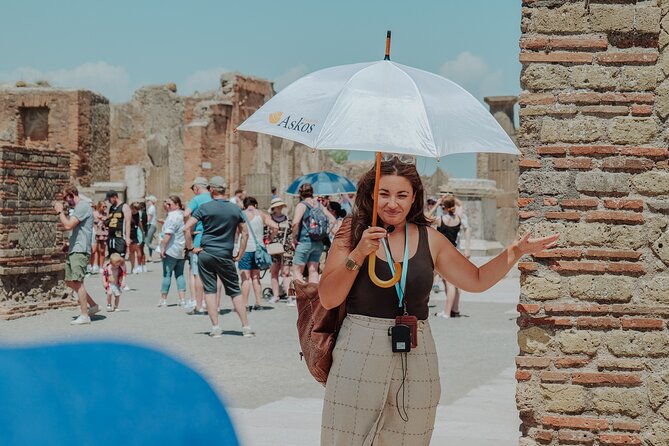
The tour starts at the main entrance of the archaeological site at Porta Marina Superiore. The guide will be holding a sign with the company name Askos Tours at the entrance.
Your meeting location is also listed as Via Villa dei Misteri, 1, 80045 Pompei NA, Italy, and the tour ends at the same address. That matters because Pompeii logistics can be confusing if you’re using a navigation app without confirming the exact meetup point.
Practical tip: wear closed shoes. Reviews and tour guidance point out it can be tough to move on the ruins with flip-flops. Even a “quick 10-minute stop” becomes a real walking segment when the ground is uneven.
The 2-hour route: what each stop is really for
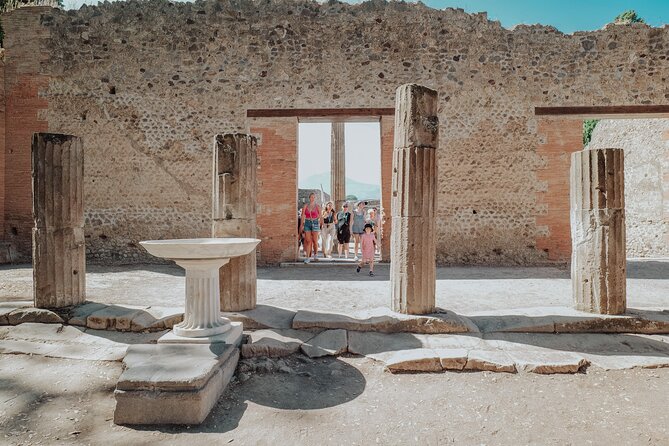
This tour is built as an efficient highlight loop. You’ll move from public spaces to houses and back again, so you get a sense of how Pompeii worked as a city, not just a collection of famous rooms. Most stops are around 5–10 minutes, which means you’ll want to treat each stop like a guided “orientation snapshot” and then decide where you want to linger later.
Stop 1: Archaeological Park of Pompeii at Porta Marina
This is your kickoff. You’ll meet the archaeologist guide at the main entrance, and your entry is tied to this first stop. The value here is getting oriented right away—what you’re seeing, how the site is laid out, and what to notice as you walk.
If you’re the type who likes an explanation before you look, this start is helpful. If you just want to jump into visuals, the guide can still help you avoid missing key zones.



Stop 2: Casa dei Vettii (House of the Vettii)
The Casa dei Vettii is your early glimpse into domestic life. A house tour in Pompeii is never only about one room. It’s about understanding space—what people gathered in, how the layout worked, and what survived well enough to teach you something.
In reviews, the most memorable part of these house stops is how the guide makes the place feel inhabited rather than dead. Expect the archaeologist to point out details that help you “read” the house.
Tradeoff: because the stop is brief, you’ll see the big-ticket features rather than everything. If you’re hoping for a slow, room-by-room museum pace, you’ll probably want extra time on your own after the tour.
Stop 3: Lupanar (the brothel)
This stop often ends up being one of the most talked-about sections for obvious reasons. The Lupanar is a specific site tied to social and economic life, and the guide’s job is to explain what it represented and how it functioned in that setting.
If you like the human side of the story—work, services, and everyday behavior—this can hit hard in a good way. Just remember: this is still a fast stop, so you’re getting the meaning and context, not a full extended walkthrough.
Stop 4: House and Thermopolium of Vetutius Placidus (termopolium)
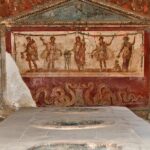
A thermopolium (termopolium) is a key window into routine meals and street-level business. This pairing of house + thermopolium helps you connect private life with public trade, which is exactly what makes Pompeii more than scenery.
One thing I like about this kind of stop selection is balance. You get public spaces, homes, and working spaces rather than only the most famous buildings.
Stop 5: Teatro Grande (Grand Theatre)
Theatres are where you start thinking about crowds, performances, and civic life. Even with a short visit, a good guide can help you understand how the theatre fits into the larger city plan.
If you’re the kind of person who wonders how people gathered for events, this theatre stop adds a missing layer. If you’re less into performance spaces, you may still appreciate it as a landmark that helps you navigate the rest of the ruins.
Stop 6: House of Faun
The House of Faun is another major house stop, and it’s usually where visual attention spikes. Houses in Pompeii often come with details—floor patterns and wall decoration—that reward a slower pace, but this tour keeps it moving.
I see this as a “taste test.” You’ll likely leave knowing which aspects you want to revisit later if you have time.
Stop 7: Stabian Baths (Terme Stabiane)
This is one of the headline stops for a reason. The Stabian Baths let you step into a large, communal building type, which changes the mood from “house and street” to “public systems.”
Reviews highlight the Stabian Baths and Forum area as part of what makes the tour worthwhile, and I agree with the logic. It’s easier to understand a city’s habits when you visit how people gathered for routine activities in big shared spaces.
Stop 8: Via dell’Abbondanza (street walk)
A street walk is the secret weapon of short tours. Via dell’Abbondanza helps you connect the dots between buildings. You’re not just seeing isolated rooms; you’re watching the city breathe as a street network.
In a private setup, the guide can pause and point out what matters along the way, instead of you trying to figure it out while dodging other visitors.
Stop 9: Forum Baths
Forum Baths keep you in public-life territory. This stop adds a second layer to your understanding of shared spaces: not just the idea of a forum, but how nearby facilities supported daily rhythm.
Even in limited time, this is a smart addition because it reinforces patterns. Pompeii isn’t only “big monuments.” It’s systems that repeat across neighborhoods.
Stop 10: Macellum
The Macellum is the market area. Markets help you picture daily life in a way that feels surprisingly modern. You can almost imagine what the space would have meant as the city’s social and food hub.
This stop is also useful if you’re a “show me how people lived” traveler. A market space gives you that angle fast.
Stop 11: House of Menander
Back to domestic life, the House of Menander is another chance to compare what you’ve seen earlier. A strong guide will connect this home to what you learned at the Casa dei Vettii, so the houses start telling a bigger story together.
Again, because you’re only here briefly, focus on understanding the why: why certain rooms were positioned and what survives that lets you interpret daily life.
Stop 12: Granaries of the Forum
Granaries are functional buildings, so they can feel less glamorous than theatres or frescoed houses. That’s exactly why this stop matters. It tells you the city wasn’t just about buildings you pose in front of. It had to store and supply itself.
If your group likes business-side history—how the city ran—this stop will play well.
Stop 13: Foro di Pompeya (the Forum)
You end in the forum area, a natural payoff. By the time you reach this space, you’ve already seen homes, markets, street activity, and public bath life. That makes the forum feel less abstract.
For many people, the forum stop is where it all clicks: you can connect how people moved through the city and how the city organized public life.
Crowd control and pace: the real value of private attention
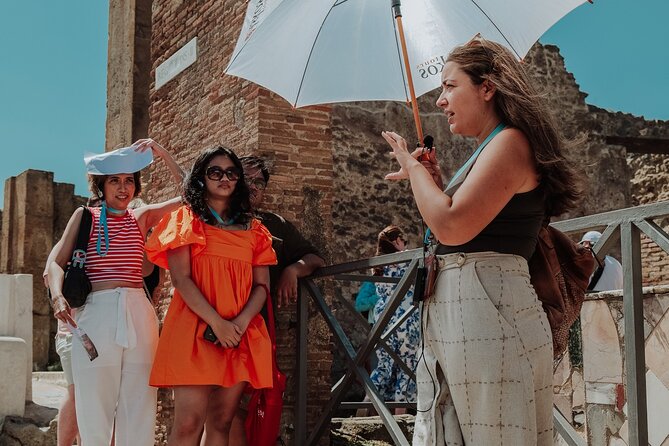
Pompeii can be crowded, especially at the most famous points. A private archaeologist guide is valuable because they can help you avoid the bottlenecks and keep your attention where it counts.
In reviews, multiple guides are praised for navigating around crowds and keeping a smooth flow through the ruins. That matters because when you’re stuck in a crowd, you miss visual details and you lose time for questions.
Pace also matters for different travel styles:
- Families: one review notes guides kept kids engaged and helped them learn without it turning into a lecture.
- Teens: another mentions that the orientation to the park and knowledge helped teens connect with what they were seeing.
- Limited mobility: a review mentions slowing down and finding spots to rest while still keeping the explanations going.
- Rainy days: one review describes a rainy visit that didn’t disrupt the tour, with weather adding to the mood rather than ruining it.
If you want maximum comfort, tell your guide up front what pace works for you. Private tours can adjust in a way group tours can’t.
What to expect from the archaeologist-style guide
This tour is guided by an archaeologist, and the difference shows up in the way explanations land. Reviews repeatedly point to guides who make life in Pompeii understandable—how people lived, what spaces meant, and what to look for.
You’ll see this in the range of guides praised: Mimma, Jolanda, Paolo, Michele, Silvia, Vito, Maria, Ivan, and Rossella come up in different reviews with similar themes. The consistent thread is that their tours connect objects and spaces to everyday life.
One more useful note: a review by someone whose guide was an architect with excavation experience suggests a deeper angle for guests who care about how sites were uncovered and studied. If that’s you, a private archaeologist guide is your best shot at getting that layer in just 2 hours.
Who this Pompeii tour suits best
This is a strong fit if:
- You only have about half a day and need a smart highlights plan.
- You want a guide who can answer questions while you’re standing in the space.
- You travel with kids or teens and want them kept engaged.
- You’d rather pay for direction than spend time trying to interpret Pompeii on your own.
It may not be the best match if:
- You want a slow, museum-style day with lots of time per room.
- You’re hoping for a “see everything” itinerary. The route is packed, but it’s still only around 2 hours.
A practical suggestion from reviews: some guests felt they could have used more time and recommended a longer tour if possible. If you can, build in extra time to return to the spots that hook you.
My booking checklist before you go
If you book this Pompeii private tour, do these three things and you’ll set yourself up for a smoother day:
- Confirm entrance ticket inclusion in writing (because you may pay extra based on guest reports).
- Wear closed shoes so the walking feels manageable.
- Plan what you’ll do after the tour. If you finish at the forum area and still want more, you’ll be glad you didn’t plan a rushed afternoon.
Also, the cancellation policy is flexible: free cancellation up to 24 hours ahead for a full refund. That gives you room to shift plans if weather or timing changes.
Should you book this Pompeii archaeologist private tour?
Yes, if you want an efficient, explanation-forward way to experience Pompeii. The price is high, but the private archaeologist setup can be worth it when you’re short on time, you want crowd-smart pacing, or you care about understanding how spaces connect to everyday life.
I’d book it if the idea of hitting Stabian Baths, the Forum area, houses, a market space, and street context in one guided loop sounds like your ideal Pompeii day. Just go in knowing it’s a fast tour. Then treat it like a strong primer: you’ll learn what to notice, and you can decide what deserves a longer stop on your own.
If you’d like, tell me your travel month and whether you’re visiting with kids or anyone with mobility needs. I can suggest the best time window and a simple after-tour plan.
FAQ
How long is the Pompeii Private Tour with an Archaeologist Guide?
The tour lasts about 2 hours.
Is this tour private or shared?
It’s private. Only your group participates.
What language is the tour offered in?
The tour is offered in English.
Is the Pompeii entrance ticket included in the tour price?
The tour details say the admission ticket is included for the Pompeii archaeological site stop, but one review reported paying around 20 euro per person extra. I recommend confirming ticket inclusion with the provider before your visit.
Where do we meet the guide?
You meet at Porta Marina Superiore main entrance, with the guide holding an Askos Tours sign. The listed starting and ending address is Via Villa dei Misteri, 1, 80045 Pompei NA, Italy.
What should I wear for the ruins?
Wear closed shoes. Flip-flops can be difficult on the ruins. Service animals are allowed.