REVIEW · POMPEII
Private Day Tour to Vesuvius, Herculaneum & Pompeii with Pick Up
Book on Viator →Operated by A DRIVE INTO THE BLUE · Bookable on Viator
Three ancient worlds in one long day. This private tour strings together Pompeii, Herculaneum, and a Vesuvius crater climb with pickup where your street access allows it, plus licensed guiding on the archaeological sides when you upgrade. I love how the stops are timed so you get real context (not just random walls), and I love the private-group pace that lets you ask questions and pause for photos. The trade-off is that the day is full, so Pompeii feels like a smart highlight circuit rather than a slow, every-street walk.
You’ll spend the day with a driver and guides (you may meet people like Antonino/Tony, Giacomo, or Alona), moving efficiently between sites so you’re not wrestling buses. And since weather matters for the volcano views, going early in the day is often a smart move if the forecast looks changeable.
In This Review
- Key Highlights You’ll Actually Feel
- Pompeii–Herculaneum–Vesuvius in One Long Day (Done Sensibly)
- Pickup, Driver, and the Pace Between Sites
- Pompeii Highlights That Help You Read Ancient Daily Life
- Herculaneum’s Salone della Barca and the Clarity Factor
- What makes Herculaneum special here
- Vesuvius Hike: Trail #5 Il Gran Cono and What to Expect
- Trail basics you can plan around
- Crater views and the weather reality
- What to wear
- Upgrade Worth Considering: Guided Ruins vs. Head-Scratch Touring
- Price and Value: What You Pay for (and What You Don’t)
- What to Bring (So the Day Feels Easier)
- Who This Private Tour Fits Best
- Should You Book This Pompeii, Herculaneum, and Vesuvius Day Trip?
- FAQ
- Do you offer pickup from my hotel?
- How long is the tour?
- Is this a private tour?
- What’s included in the price?
- Is lunch included?
- Do I need a separate ticket for Mount Vesuvius?
- What happens if the weather is bad?
- How much hiking is on Vesuvius?
- What level of physical fitness is needed?
- What’s the cancellation policy?
Key Highlights You’ll Actually Feel
- Door-to-door style pickup: from your accommodation, a nearby car-access point, or cruise/train meeting points
- Pompeii with a licensed guide: start at the main gate, then hit major highlights in an easy flow
- Herculaneum’s tighter footprint: smaller, better preserved, and easier to focus on details
- A real hike on Vesuvius: about 35 minutes up and 35 down on the trail to the crater area
- Optional guide upgrade at the ruins: makes the architecture and daily-life clues click faster
- Tickets handled for Pompeii and Herculaneum (depending on your option), while Vesuvius tickets are extra
Pompeii–Herculaneum–Vesuvius in One Long Day (Done Sensibly)
This is the kind of day trip that works because it’s built around three different “readable” experiences: a busy street grid (Pompeii), a smaller town with clearer survival details (Herculaneum), and then a physical climb that puts the whole eruption story into perspective (Vesuvius).
The big win is the structure. You’re not left to wander and guess. Instead, you’re guided through standout places like Porta Marina, the Forum, Thermopolium VI, and rich-house stops such as Casa del Fauno and Casa dei Vettii. That guidance matters because Pompeii can feel like a giant outdoor museum if you don’t know what you’re looking at.
One practical consideration: it’s a full schedule, roughly 8–9 hours, with most walking happening around the volcano. If your idea of a perfect day is long quiet roaming, you may feel the pace a bit. If you want to maximize what you see without losing context, this format is hard to beat.
You can also read our reviews of more tours and experiences in Pompeii.

Pickup, Driver, and the Pace Between Sites
The day starts with pickup that’s designed for real-life logistics. If your exact street isn’t accessible by car, you’ll meet at the nearest spot where the vehicle can reach you. If you’re on a cruise, pickup is coordinated in the Naples, Salerno & Amalfi coast, or Sorrento areas. If you arrive by train, there’s also pickup from the platform.
Once you’re in the vehicle, the driver is responsible for moving you between stops smoothly. That matters on the Amalfi side because traffic and parking can ruin your momentum. Here, the goal is to keep your energy for the ruins and the hike, not for negotiating transportation.
As for timing, Pompeii begins with meeting a licensed guide and entering through the main gate after tickets. Herculaneum follows with similar “meet at the gate, then guided time in the park” rhythm. Then the day shifts from ruins to the mountain trail. It’s a long day, but it’s organized so you’re not stuck waiting around.
Pompeii Highlights That Help You Read Ancient Daily Life
Pompeii Archaeological Park is scheduled for about 2 hours with a licensed guide. After that, the day’s Pompeii time is shaped by short highlight stops. It’s not every block. It’s the points that explain how the city worked.
Here’s what the route is doing for you:
- Piazza Porta Marina (the Porta Marina area)
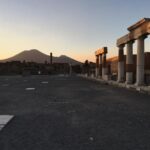
This gate gives access to the west side of the city and is one of Pompeii’s most impressive gates. If you only remember one entrance, let it be this one. It’s a fast way to picture movement into town and why gates were so important.
- Foro de Pompeya (the Forum)
This is the civil forum—where business, justice, markets, and public worship connected in one central place. Even in a small window of time, it’s the best “daily life map” you’ll get.
- Basilica (business and justice space)
The basilica links to the Forum through five entrances and sits inside a layout with tuff pillars. Seeing it early helps you understand that Pompeii wasn’t just houses and streets; it had institutions and routines.
- Thermopolium VI (a hot-food shop)
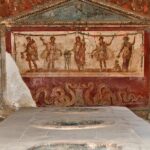
These places sold prepared hot food. It’s one of the best ways to get your mind out of the idea of Romans as only philosophers and senators. People ate, bought, and drank in everyday spots like this.
- Casa del Fauno (a huge household block)
This is one of the larger homes, covering about 3,000 square meters and dating back to the 2nd century BC based on its original layout. If you’ve ever wondered how wealth looked in Roman cities, this kind of scale answers that.
- Casa dei Vettii (Priapus, prosperity, and art on the door)
One of the richest homes in Pompeii, protected by Priapus, the god of prosperity. There’s a painted symbol on the right side of the door tied to the owners’ success as trade-rich brothers. The point of the stop isn’t just the name. It’s learning how to read meaning from what you see.
- Stabian Baths (Therme Stabiane)
This is where architecture explains daily habits. You’ll recognize the sequence from apodyterium (dressing room) through frigidarium, tepidarium, and calidarium. Baths in the Roman world were social and practical at once.
- Teatro Grande (a theater built into the hill slope)
The Grand Theatre uses the natural slope and has a design that splits seating and circulation into sections. It’s a great stop if you want to understand Roman engineering without getting lost in technical terms.
If you do Pompeii on your own, you can still enjoy it—but you’ll likely miss the “why this matters” layer. With the guide-led approach, those short stops start to feel like a lesson you can walk through.
Herculaneum’s Salone della Barca and the Clarity Factor
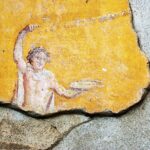
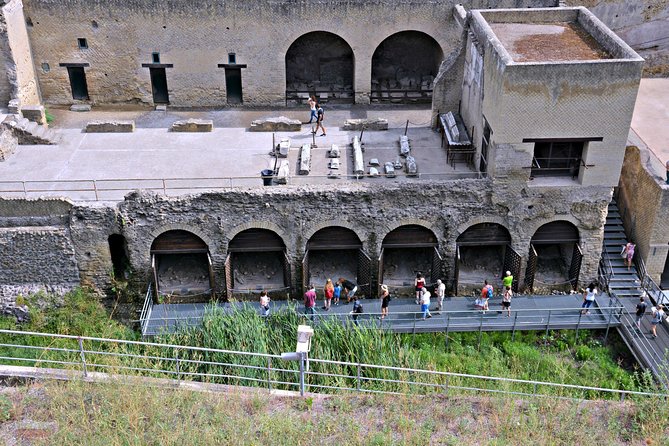
Herculaneum starts after a drive and then a licensed guide meets you at the park entrance. You get about 1 hour 40 minutes in the archaeological park, plus an extra highlight stop in the Salone della Barca di Ercolano.
The biggest reason this works is that Herculaneum is simply easier to read. It’s smaller than Pompeii and, for many visitors, that makes it feel less overwhelming. You can slow down mentally and notice things that would be easy to miss when you’re rushing a bigger site.
What makes Herculaneum special here
- Salone della Barca di Ercolano (the boat hall)
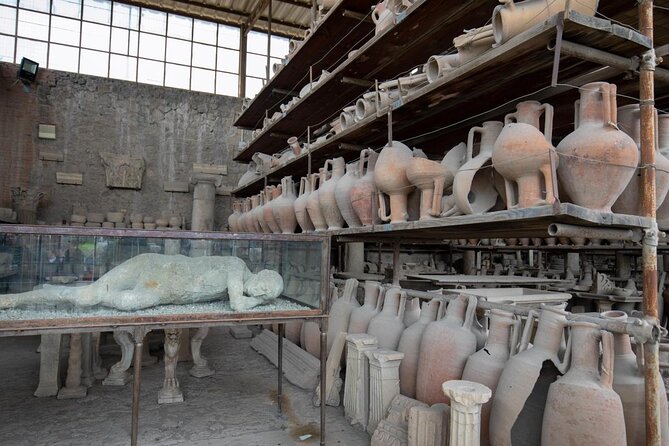
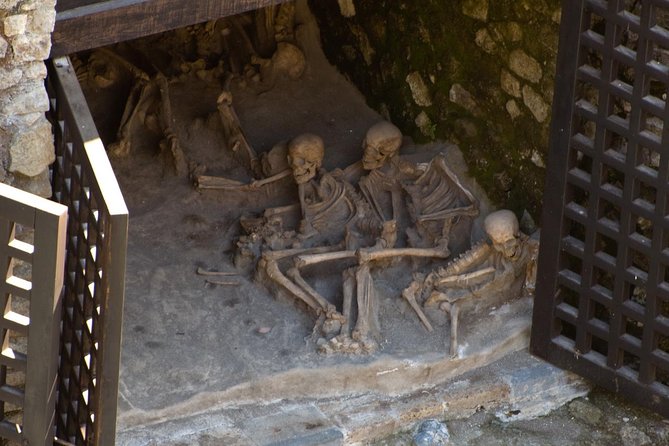
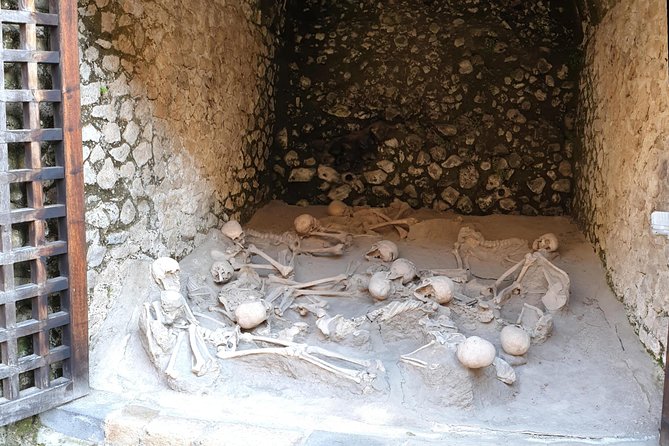
One of the last major discoveries shows the restored remains of a boat dug up in the marina area, connected to the discovery where 300 skeletons were found. Even if you don’t hang on every detail, it’s a powerful stop because it ties the town’s story to work, travel, and disaster in one tangible image.
- Casa dei Cervi (a wealthy home stop outside the main guided time)
You get a brief view of one of Herculaneum’s wealthiest private homes, described as belonging to an owner who was essentially “a billionaire” by modern terms. It’s a quick reminder that Herculaneum’s preserved structures tell you about status just as clearly as Pompeii.
If you’re choosing between Pompeii and Herculaneum, this itinerary sells the point well: Pompeii gives you scale and variety, while Herculaneum gives you clarity. Doing both in one day is tiring, but the pairing makes the history feel more complete.



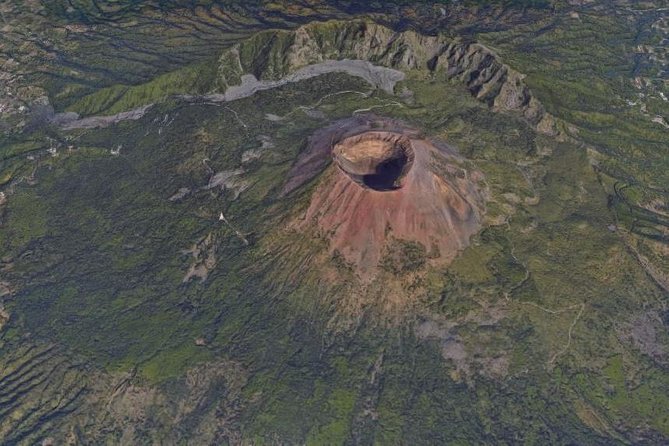
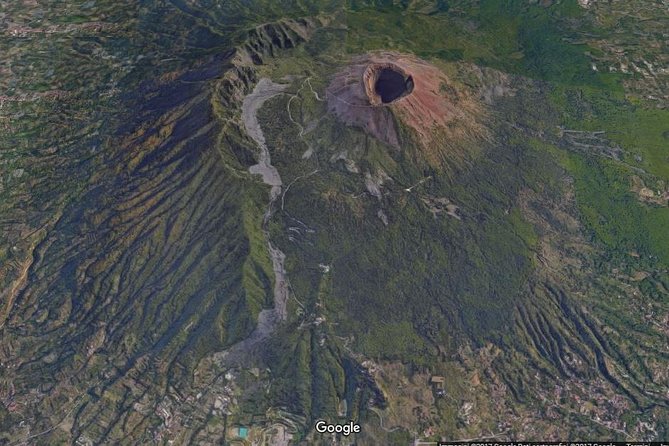
Vesuvius Hike: Trail #5 Il Gran Cono and What to Expect
Now comes the physical part. The day includes a drive toward the trailhead, a climb to the summit area, and a return walk. Plan for walking both up and down, plus time for transfers.
Trail basics you can plan around
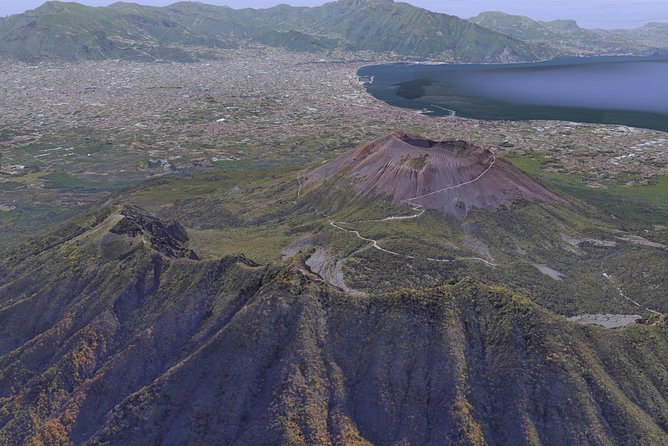
- The nature trail is listed as Trail n. 5: Il Gran Cono
- It starts from the Piazzale around 1,000 meters above sea level
- There’s a chance to visit Vesuvius National Park info points before starting, where you can pick up a map and get protected-area info
- The schedule shown is roughly: 40 minutes drive to the closest point to the trail, about 35 minutes walk up, about 35 minutes walk back down, and then around 40 minutes drive back to the highway
- Total time on the Vesuvius portion is approximately 2 hours 30 minutes (including drives)
Crater views and the weather reality
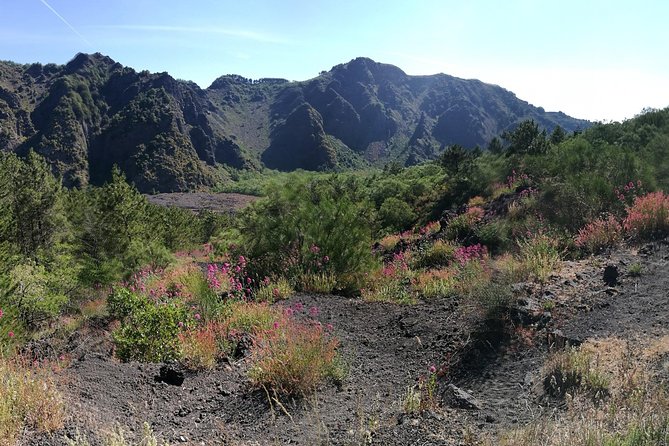
When visibility is good, the climb is worth it for the views over the Bay of Naples and out toward places like Sorrento. But if clouds move in, you can lose the inside-crater visuals. I’d treat this like a “go early if you can” situation. If the forecast looks uncertain, morning is often your best shot.
What to wear
This hike is not a gentle stroll. Expect rough, gravelly trail conditions. Wear shoes with solid grip. If your footwear is even slightly sketchy, you’ll feel it on the way down when your legs start to tire.
Upgrade Worth Considering: Guided Ruins vs. Head-Scratch Touring
This tour includes a professional guide if the option is selected. That upgrade is worth thinking about if you like your ruins explained in plain language: what you’re looking at, how spaces worked, and what features mean.
Even within the schedule, a guide changes your experience. Instead of seeing a door and a wall, you start connecting details: bath sequences, commercial storefront patterns, forum purposes, and domestic clues like the symbolic art at Casa dei Vettii.
If you prefer to learn at your own speed, you might still enjoy the non-upgraded version. But if this is your one shot at Pompeii, Herculaneum, and Vesuvius together, I’d lean toward adding the on-site guidance where offered.
Price and Value: What You Pay for (and What You Don’t)
The price is listed at $120.98 per person, with a private setup and pickup included when possible. The day includes bottled water, a driver, and it may include tickets to Pompeii and Herculaneum depending on the option you select.
What’s not included:
- Lunch
- Food and drinks beyond the included bottled water
- Mount Vesuvius ticket (€12.60 per person)
So is it good value? For me, it makes sense when you add up three things you’d otherwise pay for separately: guided museum-style time at multiple sites, private transportation that keeps you efficient, and the added complexity of coordinating pickup and timing for one of Italy’s most popular volcano experiences.
It’s not a budget day. But it’s a “you’re paying to save effort and gain clarity” day.
What to Bring (So the Day Feels Easier)
Because you’re in motion for hours and then hiking, small planning choices pay off.
Bring:
- Comfortable shoes with grip for the Vesuvius walk
- A light layer (weather can shift fast)
- A small snack or plan for lunch, since lunch isn’t included
- Any needed cash or card for items not covered (including the Vesuvius ticket)
Also: dress code is casual, and the tour notes moderate physical fitness as the expectation. If you’re unsure, focus on whether you can comfortably walk on gravel and handle a round-trip hike time built around about 35 minutes each way.
Who This Private Tour Fits Best
This is a great match if you:
- Want a one-day plan that hits Pompeii, Herculaneum, and Vesuvius without building your own transportation
- Like your history in context, not just labels on walls
- Appreciate a private group pace where you can ask questions and slow down when something catches your eye
- Are okay with a longer day and the volcano hike component
It might be less ideal if you:
- Want hours inside Pompeii to explore everything at your own rhythm
- Get discouraged by packed schedules
- Prefer tours without hiking, since Vesuvius includes a real climb and descent
Should You Book This Pompeii, Herculaneum, and Vesuvius Day Trip?
If this is your first time in the area and you want a “big bucket list” day with a sensible structure, I’d book it. The combination of Pompeii’s civic and domestic highlights, Herculaneum’s clearer survival details, and the crater hike makes the story feel connected instead of scattered.
My booking advice is simple:
- Pick the early hours when weather is uncertain so you have a better shot at visibility on Vesuvius.
- Upgrade the on-site guiding if you want the ruins to make immediate sense.
- Plan lunch money and expect a long day. This isn’t a quick in-and-out tour.
If you want Pompeii alone at a slower pace, you might choose a different format. But if you want three major hits in one day with pickup and smooth timing, this private setup is a strong choice.
FAQ
Do you offer pickup from my hotel?
Pickup is offered from your accommodation when streets allow. Otherwise, you’ll meet at the closest car-accessible spot. There are also pickup options for cruise ship areas and for travelers coming by train.
How long is the tour?
The tour duration is about 8 to 9 hours.
Is this a private tour?
Yes. It’s a private tour/activity, and only your group participates.
What’s included in the price?
Bottled water, a driver, and tickets to Pompeii and Herculaneum may be included depending on the option you select. Pickup and drop-off are also part of the experience.
Is lunch included?
No. Lunch and food and drinks are not included.
Do I need a separate ticket for Mount Vesuvius?
Yes. The Mount Vesuvius ticket is not included and is listed as €12.60 per person.
What happens if the weather is bad?
The experience requires good weather. If it’s canceled due to poor weather, you’ll be offered a different date or a full refund.
How much hiking is on Vesuvius?
The schedule includes about a 35-minute walk up, about a 35-minute walk back down, plus driving time to and from the trail area.
What level of physical fitness is needed?
The tour notes a need for moderate physical fitness. Comfortable shoes are important, especially for the hike.
What’s the cancellation policy?
Free cancellation is available up to 24 hours in advance for a full refund. If you cancel less than 24 hours before the start time, the amount paid isn’t refunded.