REVIEW · POMPEII
Pompeii Guided Group Tour with Entry Ticket and Archaeologist
Book on Viator →Operated by Pompei Tour Organizer_Tempio Travel · Bookable on Viator
Pompeii is huge. A 2-hour guided walk with express entry helps you hit the best “daily life” sights without getting lost in the weeds. I love the stop-by-stop focus on how Romans ate, bathed, and lived, and I also love the headsets for bigger groups. One possible drawback: if your tour guide’s background is closer to tour-guiding than archaeology, you may want to lower expectations on the level of expert detail.
The meeting setup is straightforward once you know the trick: arrive 15 minutes early at the Circumvesuviana station first floor, then follow the office name signage. The route moves at a busy-site pace but still leaves you with a clear sense of what to explore next on your own. This is a good match if you want highlights with context, not a slow museum stroll.
In This Review
- Key highlights worth planning for
- Meeting at Porta Marina Superiore: the station-first start that saves stress
- What’s included in the $59.13 price—and what you’re paying for
- The route in 2 hours: how Pompeii’s daily life is built stop by stop
- From Porta Marina Superiore to the Archaeological Park entrance
- The Forum: Pompeii’s political, economic, and religious center
- The Macellum: the market where food culture comes alive
- Terme del Foro: Roman bath design, split by gender
- Casa del Fauno: luxury, mosaics, and what copies mean
- Casa dei Vettii: dramatic art, erotic rooms, and social reality
- Via dell’Abbondanza: the main street connection you’ll appreciate later
- Thermopolium: the ancient fast-food stop
- Headsets, accents, and pacing: making group tours work in Pompeii
- Who this tour suits (and who should plan differently)
- Weather, comfort, and timing tips that actually matter
- Should you book this Pompeii guided group tour?
- FAQ
- How long is the Pompeii guided group tour?
- What language is the tour offered in?
- What is included with the tour price?
- What is not included?
- Where do I meet the tour?
- What time should I arrive?
- Is the tour dependent on weather?
Key highlights worth planning for
- Express entry ticket included so you spend less time waiting at the gates
- Headsets included for groups over 15 for clearer listening over crowd noise
- Porta Marina Superiore start makes the “walk into Pompeii” feel natural
- Forum to baths to elite homes shows how politics, hygiene, and class mixed daily
- Street-food stop (Thermopolium) gives you a very real, very Roman feel for quick meals
- Max 35 travelers keeps the group manageable for a ruins site
Meeting at Porta Marina Superiore: the station-first start that saves stress

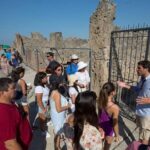
This tour begins at Via Villa dei Misteri, 1, at the Circumvesuviana stop called Pompei Scavi villa dei Misteri. You’re told to show up 15 minutes before the voucher time, and the meeting point is inside the station building—specifically on the first floor—at an office called Tempio Travel / Pompeii Tickets. The station building is described as red, and it’s about 100 meters from the entry of Porta Marina Superiore.
Here’s my practical advice: don’t trust one navigation app alone. If maps send you to the wrong place (it can happen), you can save time by matching the office name and floor number, not just the street or gate. Also, plan to arrive with a little buffer. Pompeii is chaotic at entry times, and a missed start can be a big headache.
You can also read our reviews of more tours and experiences in Pompeii.


What’s included in the $59.13 price—and what you’re paying for

At $59.13 per person, you’re essentially buying three things: a 2-hour guided walk, express entry to the Archaeological Park of Pompeii, and listening equipment for larger groups. You also get a standard admission ticket included at each stop listed on the route, so you’re not repeatedly dealing with ticket lines.
What you don’t get is also important: there’s no extra admission ticket for the Villa of Mysteries. If that’s a must-see for you, you’ll need a separate plan. Another “hidden” factor is your footwear and stamina. Two hours in Pompeii is enough to cover major highlights, but it still means steady walking over uneven ground.
Group size matters for value here. The tour caps at 35 travelers, and for groups above 15, headsets are included. That reduces the classic problem of trying to hear a guide while everyone is craning over shoulder-to-shoulder ruins.
The route in 2 hours: how Pompeii’s daily life is built stop by stop
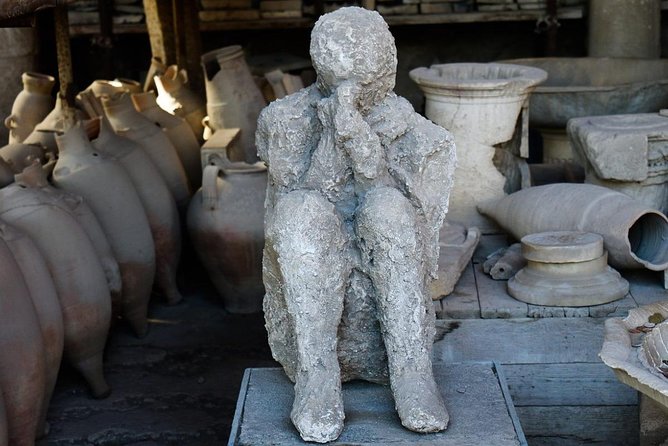
The tour is designed like a story. You start near Porta Marina Superiore, then move into the city’s public core (the Forum area), and then you shift to elite homes and street-level life. By the end, you’ve seen enough to understand how Pompeii worked day to day—and you’ll know where to spend extra time if you return on your own.
The big win is the balance: you’re not only looking at “pretty stones.” You’re learning why those stones matter—where people shopped, where they washed, what they ate, and how social status showed up in home design and decoration.
One thing to keep in mind: Pompeii is enormous. This route hits major beats, but it won’t cover everything. Think of it as the guided map that tells you where to dig deeper later.
From Porta Marina Superiore to the Archaeological Park entrance
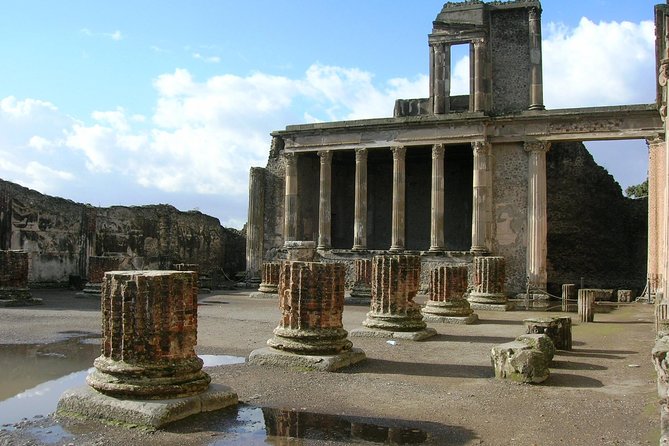
The first stop is the Archaeological Park of Pompeii, starting at Porta Marina Superiore. This is a quick entry moment—about 2 minutes—and it sets the tone. Your guide frames what you’re about to see, which helps you orient faster than if you walk in cold.
Even if you’ve seen photos, I’d treat the first minutes as the most important learning window. Pompeii’s scale surprises people. When you get the orientation early, later stops feel less like random ruins and more like neighborhoods with a rhythm.
The Forum: Pompeii’s political, economic, and religious center
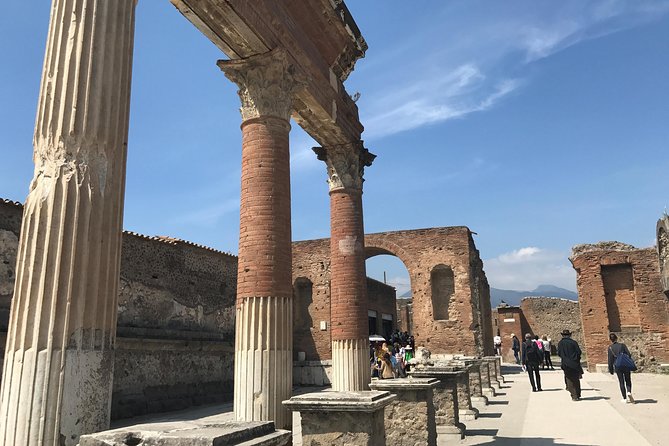
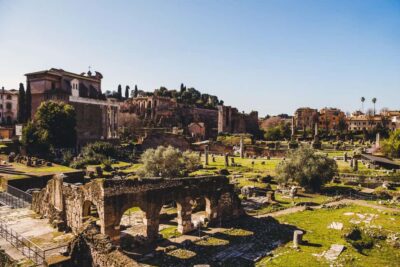
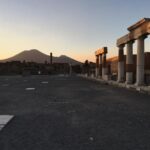
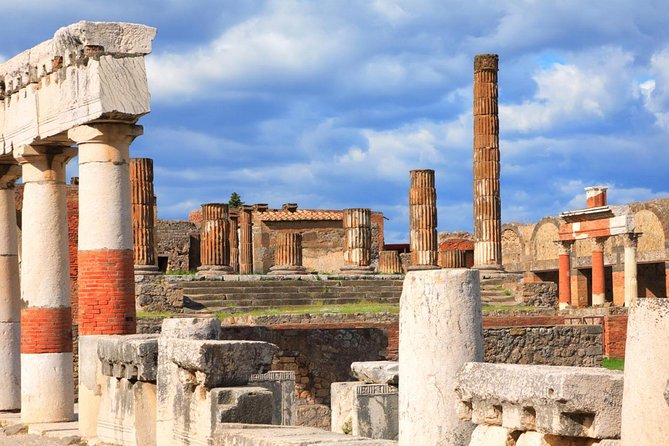
The Forum of Pompeii is the big centerpiece on this itinerary, with about 30 minutes here. You’re learning that the Forum wasn’t just for speeches. It was the town square—where civic power, business, and religion all overlapped.
This is also where the tour’s “daily life” approach really clicks. You’re not only imagining what might have happened. You’re seeing the physical design of the space and getting explanations for how people moved through it and why it mattered. The Forum area gives you context for the next stops, because it’s tied to commerce and public routine.



The Macellum: the market where food culture comes alive
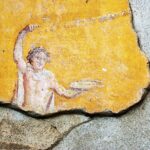
Right on the Forum sits the Macellum. The tour spends about 10 minutes here, and the focus is on the market for meats and fish. You can also see frescoes tied to what Romans ate in the first century CE.
This is one of those stops that feels more immediate than “big monument” ruins. A market tells you how people lived. Who ate what. How they bought it. Even if you only catch fragments of the painted scenes, the guide’s explanation makes the space feel like a real place, not a snapshot.
Practical note: markets can be crowded in peak season, and the ruins are busy visually. If you want photos, aim for a quick sweep early in the stop rather than waiting until you’re at the busiest angle.
Terme del Foro: Roman bath design, split by gender
Next is the Terme del Foro, behind the Temple of Jupiter. You get about 15 minutes here, and the details matter. The bath complex is described as covering around 410 square meters and having both a men’s and a women’s section, each with its own entrance.
The guide also points out the water system: the baths were supplied by the Serino aqueduct, though they also had a well available if water was scarce. That little detail helps you picture Rome’s infrastructure as something practical, not just fancy engineering.
There’s also the “preservation payoff.” The ceiling of the rooms is noted as original, and you can see the stucco from the period. The calidarium includes a marble tub, and the floor is described as mosaic. Even in a short stop, this is the kind of place where once you understand the layout, you start seeing the logic everywhere.
Casa del Fauno: luxury, mosaics, and what copies mean
The tour then moves into Casa del Fauno, about 10 minutes. This is one of the larger, more luxurious elite homes in Pompeii’s Roman period. The standout mentioned is the famous Mosaic of Alexander—but here you’re seeing a copy, not the original. The original is said to be conserved at the MANN.
This stop is a smart “value lesson.” It explains that Pompeii’s most famous artifacts aren’t always sitting in place today, and that you may see replicas where originals were moved for protection. For you, that means you can still enjoy the design and meaning, even if the absolute original is elsewhere.
If mosaics are your thing, this is a good way to build a quick visual vocabulary for what you’ll notice next in other homes.
Casa dei Vettii: dramatic art, erotic rooms, and social reality
Casa dei Vettii gets about 10 minutes and it’s one of the most talked-about homes on Pompeii routes. This domus dates to the Roman era and was buried by the eruption of Vesuvius in 79 CE. It was later uncovered through archaeological work.
The home is named for its owners: Aulo Vettio Restituto and Aulo Vettio Conviva. The tour also points out a room with preserved erotic wall paintings. The description ties this room to a sex-work context, saying it was used by a prostitute who lived with the proprietor.
This is not everyone’s favorite stop, but it is a reality check. Pompeii isn’t only dramatic ruins and tragic end-of-world vibes. It also shows how people managed their private lives, desires, and business arrangements. A guide’s tone matters here. When done well, the stop feels honest rather than sensational.
If you’d rather keep things more PG, you can still enjoy the architecture and art technique, and you can spend less time on the room details.
Via dell’Abbondanza: the main street connection you’ll appreciate later
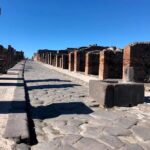
After the Vettii house, you continue along Via dell’Abbondanza. This street links major parts of the city between the Forum and Porta Sarno, including other key areas such as the Stabian Baths, the theaters, the Temple of Isis, and the amphitheater.
You won’t see everything in those areas on this short tour, but you get the directional logic. After this, if you do a self-guided follow-up, you’ll have a better sense of how the city stitched itself together.
Thermopolium: the ancient fast-food stop
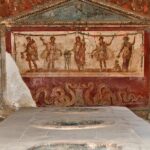
The final major stop is the Thermopolium Regio VI, Insula VIII, 8, where you spend around 10 minutes. The name translates to a place where something is sold hot, and the tour frames it as the ancient fast-food version—food for grab-and-go.
This is a satisfying ending because it brings you back to street-level life. You’ve seen public buildings, markets, baths, and wealthy houses. Now you get a reminder that everyday people needed quick meals, just like today.
If you like history that feels practical instead of purely monumental, this stop usually lands well.
Headsets, accents, and pacing: making group tours work in Pompeii
This tour includes headsets for groups larger than 15. That’s a real help because Pompeii can swallow sound. It also lets the guide keep moving without everyone constantly stopping to ask, so you keep momentum.
Still, audio can vary. Some people reported difficulty hearing due to audio quality and echo in the ruins. My advice: wear your headset properly from the start, and if something feels off, tell the guide early. Don’t wait until the middle of the Forum. Fixing it fast is the difference between enjoying the story and missing it.
As for pace, it’s designed for a 2-hour total run time. It’s not a slow, photo-heavy stroll. If you want lots of time at each stop, you may need to do your own follow-up after the tour ends.
A few guides have been named in feedback—Laura, Alessandra, and Eraldo—and the overall pattern is clear: you want a guide who can keep explanations engaging while still shepherding a group through crowds.
Who this tour suits (and who should plan differently)
This tour fits you best if you want:
- A guided way to understand how Pompeii worked day to day
- A route that hits the Forum zone plus standout homes
- A fast, organized structure so you’re not wandering without a plan
It’s also a strong option for first-timers. If Pompeii is your first time in the archaeological site, you’ll get context fast, which makes independent exploring later much easier.
If you want maximum time in the Villa of Mysteries, this route probably won’t satisfy you on its own since that ticket is not included. And if you’re looking for a deeply specialized archaeology lecturing style, I’d treat this as a guided “expert-led” highlights walk, not a university seminar.
Weather, comfort, and timing tips that actually matter
The tour notes that it requires good weather. That’s not just small print. Pompeii walking gets harder in rain and slippery surfaces can turn “2 hours” into “why am I doing this.”
Plan on sturdy shoes. You’ll be walking a lot on uneven stone and through areas with crowds. Also, pick a start time that fits your day. The tour offers different times, which helps if you’re trying to match your energy level and other Pompeii plans.
If peak hours are on your schedule, prebook early. This tour is often booked about a month in advance on average, and entry chaos is real.
Should you book this Pompeii guided group tour?
Book it if you want a smart, time-saving way to see the Forum, baths, elite homes, and street life with clear explanations—and you like having the logistics handled. At $59.13 with express entry plus headsets, the price can feel fair because you’re paying for convenience and a guided framework, not just access to ruins.
Hold off or choose a different plan if Villa of Mysteries is your top priority, or if you’re extremely strict about getting a true archaeology specialist and not just a highly skilled guide. Also, if you’re sensitive to audio quality issues in crowded spaces, go in ready to adjust your headset and ask early if you can’t hear well.
If you’re on the fence, my rule is simple: in Pompeii, a guided “highlights plus context” tour is often the best first step. Then you can decide what deserves your extra time.
FAQ
How long is the Pompeii guided group tour?
It’s approximately 2 hours.
What language is the tour offered in?
The tour is offered in English.
What is included with the tour price?
You get a 2-hour guided tour, an express entrance ticket to the Pompeii Archaeological site, and headsets for listening to the guide for groups with more than 15 people. Admission tickets are included at the stops listed on the itinerary.
What is not included?
Parking fees, transport, and food or drinks are not included. An additional entrance ticket is needed for the Villa of Mysteries, since it’s not included.
Where do I meet the tour?
The meeting point is at Via Villa dei Misteri, 1, 80045 Pompei NA. You meet at the first floor of the Circumvesuviana station (Pompei Scavi villa dei Misteri) at the office named Tempio Travel / Pompeii Tickets, about 100 meters from Porta Marina Superiore.
What time should I arrive?
You should arrive about 15 minutes before the time shown on your voucher.
Is the tour dependent on weather?
Yes. The experience requires good weather. If it’s canceled due to poor weather, you’ll be offered a different date or a full refund.